How to Learn Vocabulary from Classic Books Without Losing the Story
The usual advice makes reading worse
Open any guide to building a vocabulary and you meet the same instruction: keep a dictionary beside you and look up every word you don't know. It sounds conscientious. In practice it is the fastest way to stop reading.
A novel read this way becomes a stop-start exercise. You reach an unfamiliar word, break off, find the definition, lose the thread of the sentence, and read it again — three times a page, for four hundred pages. Comprehension drops because you keep interrupting it. And almost none of the words stay: a definition read once, cold, between two halves of a sentence you were trying to follow, is gone by the next chapter. You pay for the words with the pleasure of the book and end up with neither.
There is a better way, and it starts by looking up far fewer words, not more.
Read for the story first
Let most of the unknown words go. This feels irresponsible and is not. Context is a better teacher than a definition in isolation: a word you meet five times across a living story, each time in a slightly different sentence, settles into memory in a way no flashcard reproduces. A word handed to you cold, once, does not.
You already know this works, because it is how you learned most of the words you have. No child reads with a dictionary. They meet a word in enough sentences that its shape and weight become clear, and one day they simply own it. Reading a classic as an adult is the same machine, running faster.
So when you hit a word you don't know, try to feel its meaning from the sentence around it and keep going. Comprehension is the engine. Stall it every few lines and you stop reading, and people who stop reading do not build a vocabulary.
Keep two kinds of words, and skip the rest
Letting words go does not mean learning nothing. It means choosing. Out of every hundred words you don't recognise, two kinds earn your attention.
The first are the words that keep blocking you. They recur, and you cannot follow the passage without them. That is a real debt, and it is worth paying — the book will keep asking until you do.
The second are the words you would actually want to use. Now and then a writer reaches for a word so exact, or so vivid, that you stop and admire the sentence. Those are worth keeping not because they are hard but because they are good — sagacious, churlish, luminous, words you can imagine saying yourself.
Everything else you can let pass, especially the archaic furniture: the thou wouldst and methinks and ere that decorate older books and that you will never write or speak. Recognising them as you read is plenty. One precise modern word you own is worth more than a shelf of memorised antiques.
Look words up in context, never in a vacuum
When you do look a word up, read the definition against the sentence in front of you, not on its own. Most words carry several meanings, and the dictionary lists them all; the book chose exactly one. Discourse can be a formal lecture, an easy conversation, or the act of holding forth at length, and which one Melville meant is settled by his sentence, not by the entry. The meaning that sticks is the meaning in this sentence.
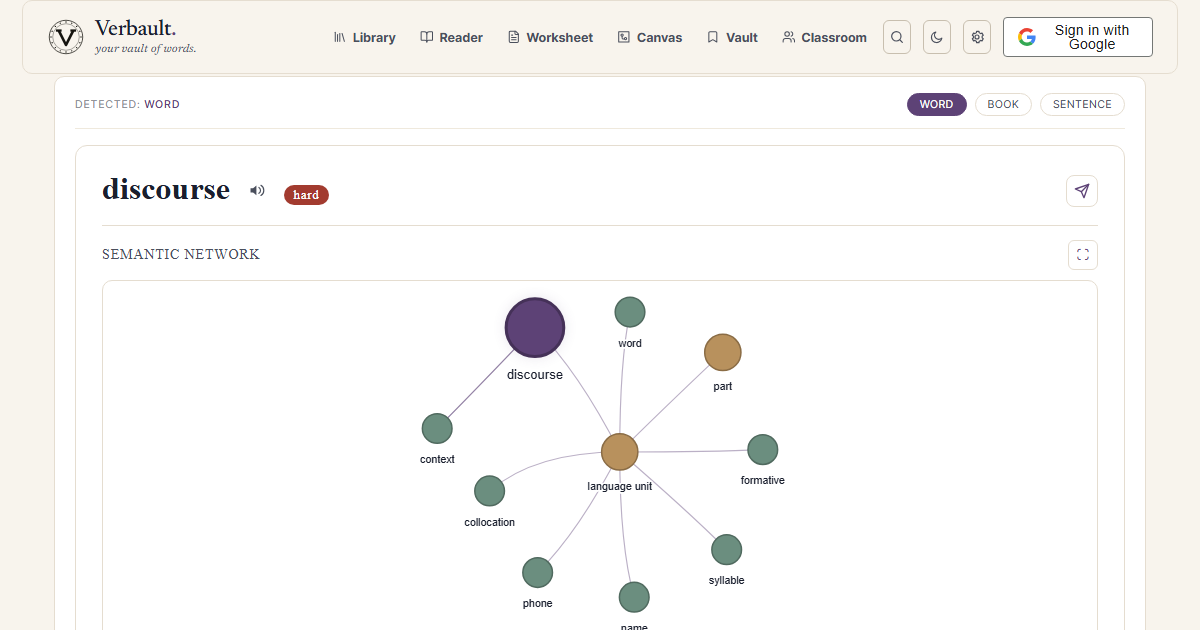
It also helps to know how rare a word is. A genuinely uncommon word is usually worth keeping; a common word you only half-know rarely repays a study session. Seeing a word beside its definition, its place in a web of related words, and a real sentence it came from is the difference between meeting a word and learning it.
Seeing a word once does nothing — meet it again
Here is the step almost everyone skips, and the one that does the actual work. Recognising a word when you re-read it is not the same as knowing it. Recognition is easy and feels like progress; it isn't. To make a word yours, you have to pull it back out of memory a few days later, after you have half-forgotten it. That small struggle — what did that mean again? — is what fixes it in place.
So the loop is short. Read, keep a few words, and meet them again a few days on, once they have gone slightly cold. Then use one: put it in a sentence of your own, or simply notice it the next time it turns up in a different book. A word you have retrieved and used a handful of times is a word you have for good.
How Verbault takes the friction out
Every step above has a cost — stopping to look words up, deciding which to keep, finding them again later — and the Reader exists to lower each one.
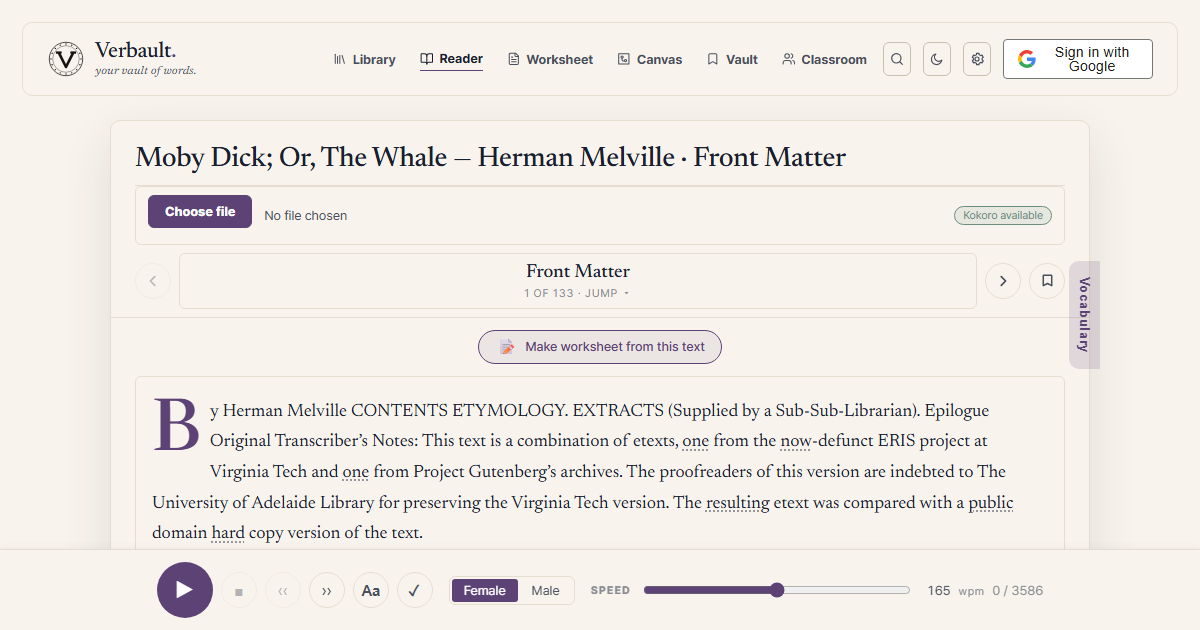
Tap instead of stopping. Open a book, such as Moby Dick, and tap a word you don't know. Its meaning, how common it is, and a button to hear it spoken appear right there, without taking you out of the page. Marking a word no longer means breaking off to a dictionary, so the first habit above — keep reading — survives contact with hard words.
See which words are worth your time. Verbault marks every word by reading level — easy, medium, or hard — based on how common it is in real English. The hard words, the genuinely rare ones, are usually the keepers, and the levels do that sorting for you at a glance.
Look it up in full, in context. Each word has its own page — the one for perseverance, say — with its definitions, a sentence it appears in, and a network of related words, so you see the word's neighbourhood instead of a bare line.
Keep them, and meet them again. Save the words worth keeping to your Vault as you read. Verbault then schedules them to come back — a few days later, then a little further apart — so the "meet it again" step happens on its own instead of depending on you to remember to remember. The Vault's review and play modes are built around exactly that retrieval.
None of this is complicated. Read the book. Let most of the words go. Keep the handful that block you or delight you, look them up against the sentence they came from, and meet them again next week. The method is old; the tools only clear it of friction.
Comments (0)
Log in to comment.