Words from Moby Dick; Or, The Whale
Six words worth keeping from Moby Dick; Or, The Whale by Herman Melville — each with its meaning, its reading level, and the sentence it appears in.
hamper
hard · look “hamper” up
a restraint that confines or restricts freedom (especially something used to tie down or restrain a prisoner)
I put it on, to try it, and it weighed me down like a hamper, being uncommonly shaggy and thick, and I thought a little damp, as though this mysterious harpooneer had been wearing it of a rainy day.
Rooted in: From Middle English hamper, contracted from hanaper, hanypere, from Anglo-Norman hanaper, Old French hanapier, hanepier (“case for holding a large goblet or cup”), from hanap (“goblet, drinking cup”), from Frankish hnapp (“cup, bowl, basin”), from Proto-Germanic hnappaz (“cup, bowl”). Cognate with Old High German hnapf (“cup, bowl, basin”) (German Napf (“bowl”)), Dutch nap (“cup”), Old English hnæpp (“bowl”). More at nap. — Wiktionary (CC BY-SA 4.0)
scarce
hard · look “scarce” up
deficient in quantity or number compared with the demand
Toes are scarce among veteran blubber-room men.
Rooted in: From Middle English scars, scarse, from Old Northern French scars, escars ("sparing, niggard, parsimonious, miserly, poor"; > French échars, Medieval Latin scarsus (“diminished, reduced”)), of uncertain origin. One theory is that it derives originally from a Late Latin scarpsus, excarpsus, a participle form of *excarpere (“take out”), from Latin ex- + carpere; yet the sense evolution is difficult to trace. Compare Middle Dutch schaers (“scarce”), Middle Dutch schaers (“a pair of shears, plowshare”), scheeren (“to shear”). The standard pronunciation having the /ɛə(ɹ)/ vowel instead of expected /ɑː(ɹ)/ is due to a tendency for Old and Middle French preconsonantal /ar/ to be borrowed as Middle English /aːr/ that only survives in this word and dace in the modern standard, but is more frequent in Early Modern English and traditional dialects; compare Scots gairden (“garden”), lairge (“large”). — Wiktionary (CC BY-SA 4.0)
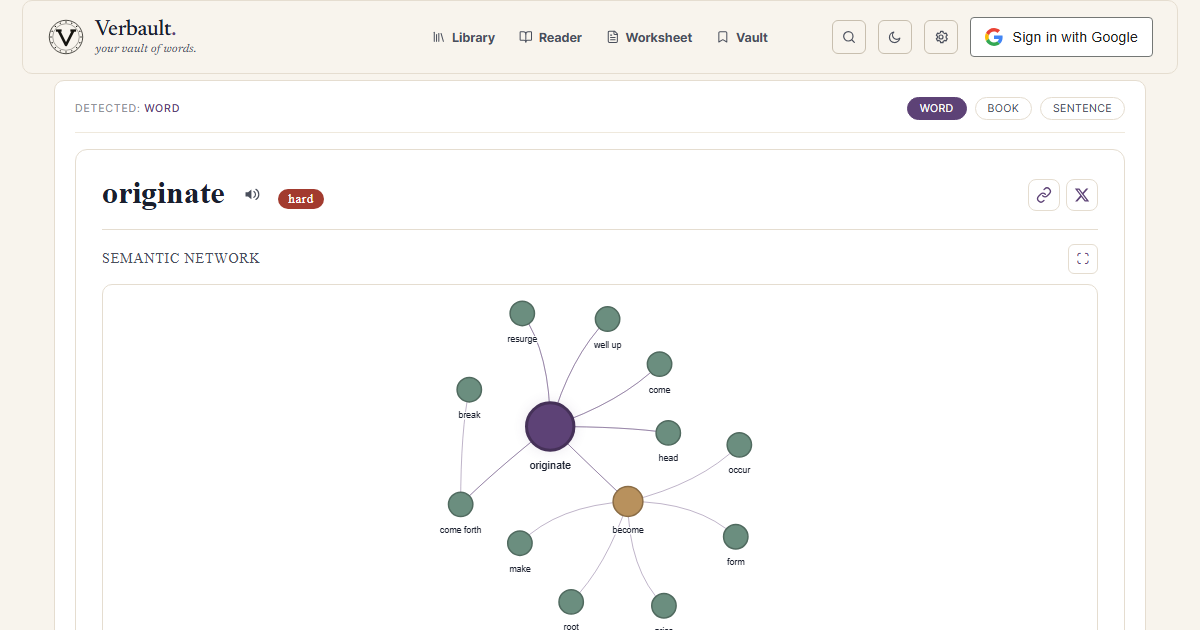
originate
hard · look “originate” up
come into existence; take on form or shape
Now how did this odious stigma originate?
Rooted in: From Medieval Latin orīginātus, perfect passive participle of orīginō (“to begin, give rise to”) (see -ate (verb-forming suffix) for more), from orīgō (orīgin- in compounds) + -ō. Compare Italian originare and Spanish originar. — Wiktionary (CC BY-SA 4.0)
treacherous
hard · look “treacherous” up
dangerously unstable and unpredictable
More than all, his treacherous retreats struck more of dismay than perhaps aught else.
Rooted in: From Old French trecheros, tricheros (“deceitful”), equivalent to treacher + -ous. See treacher. — Wiktionary (CC BY-SA 4.0)
cruiser
hard · look “cruiser” up
a car in which policemen cruise the streets; equipped with radiotelephonic communications to headquarters
thou terror of all cruisers that crossed their wakes in the vicinity of the Tattoo Land?
Rooted in: From cruise + -er. — Wiktionary (CC BY-SA 4.0)
solace
hard · look “solace” up
the comfort you feel when consoled in times of disappointment
Yet, oh, the great sun is no fixture; and if, at midnight, we would fain snatch some sweet solace from him, we gaze for him in vain!
Rooted in: From Old French solas, from Latin sōlācium (“consolation”), root from Proto-Indo-European *selh₂- (“mercy, comfort”). — Wiktionary (CC BY-SA 4.0)
Want the whole story? Open Moby Dick; Or, The Whale in the Reader.
Comments (0)
Log in to comment.