Word Lookup, Reading Levels, WordNet, and Wiktionary
How Reading Levels Work
Verbault assigns one of three reading levels to every word, based purely on how common the word is:
- Easy — among the 500 most frequent words in the Brown corpus.
- Medium — ranks 501–2,000.
- Hard — anything rarer than rank 2,000 (including words the corpus does not list at all).
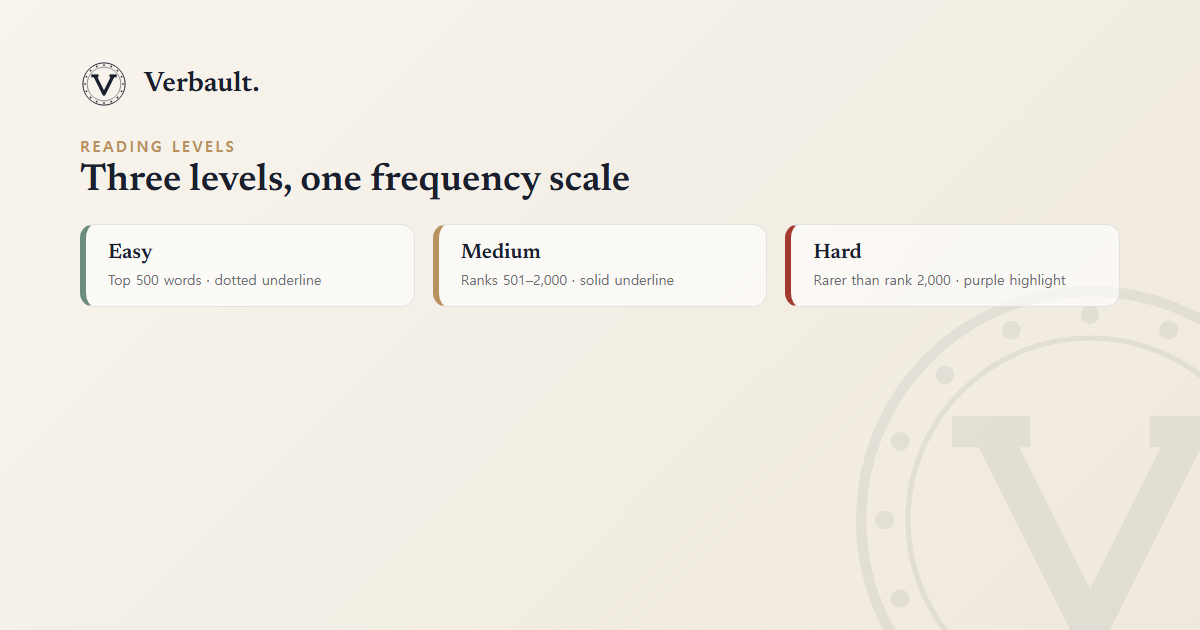
The frequency data comes from the Brown corpus, a balanced sample of American English edited texts published in 1961. This provides a stable, licence-compatible baseline — and because the levels are derived from frequency alone, they are consistent across every text you open, from a Jane Austen novel to a 1910 newspaper editorial. In the Reader, each level gets its own visual treatment (a dotted underline, a solid underline, or a soft purple highlight) so the words worth studying stand out without colouring the whole page.
The Word Lookup Panel
Click any word in the Reader or visit /word/<word> directly (e.g. /word/serendipity)
to open the full lookup panel. It shows:
- Wiktionary definitions (displayed first, when available) — sourced under Creative Commons CC BY-SA.
- WordNet synsets — from Princeton WordNet, the gold-standard English lexical database.
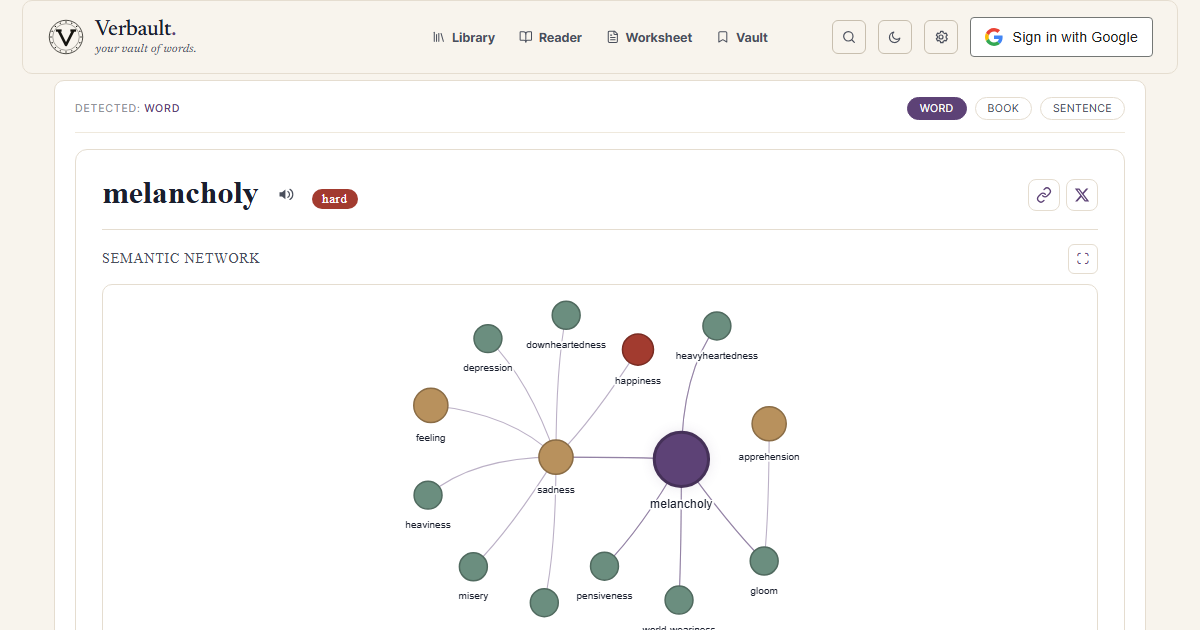
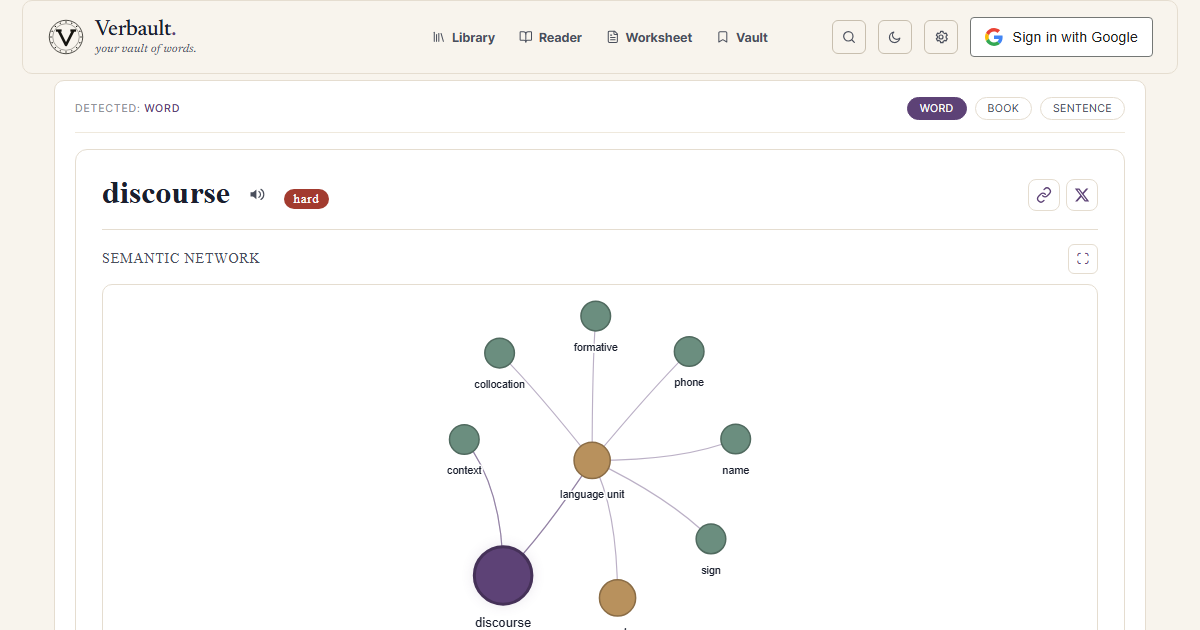
- A semantic network of related words you can explore visually.
- Example sentences drawn from the Gutenberg corpus.
- The word's reading level and Brown corpus rank.
Why Both WordNet and Wiktionary?
WordNet excels at semantic relations — synsets, hypernyms, hyponyms — which power the word-web worksheet type and the semantic-network graph above. Wiktionary provides richer definitions, etymology notes, and coverage of proper nouns and technical terms that WordNet sometimes lacks. Showing both gives learners the most complete picture, and the panel always labels which source each definition came from.
Looking Up a Word Directly
Any word has its own SEO-friendly page, which means you can link to a definition, bookmark it, or find it from a search engine. Try:
- /word/eloquent — eloquent definitions and examples.
- /word/melancholy — melancholy synsets from WordNet.
These pages also link to related words and example sentences from books like Frankenstein, so a single lookup can become a small reading session of its own.
For the full guide to the Reader's tap-to-define feature, see the Reader guide, or browse more tutorials in the guides category.
Comments (0)
Log in to comment.