One Word, Several Meanings: Looking Up the Sense That Fits the Sentence
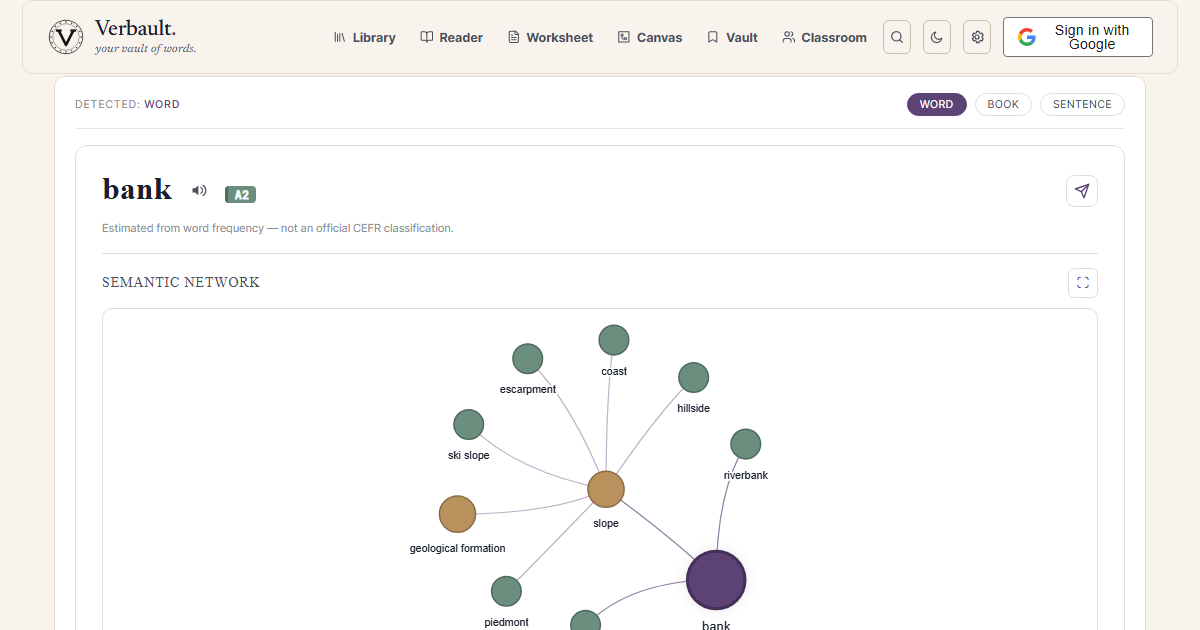
Read this sentence and you will not stumble: they pulled the boat up onto the bank and sat down in the grass. The word bank gives you no trouble at all. It means the edge of the river, and you knew that before you reached the end of the line, because everything around it — the boat, the grass, sitting down — had already settled it for you.
Now open a dictionary to bank. The first thing it shows is a financial institution. Below that, a row or tier of something. Below that, the verb: to tilt an aircraft, to pile up, to rely on. The river's edge is in there somewhere, four or five meanings down, waiting to be found. The dictionary is not wrong. It is answering a different question from the one you asked.
The dictionary orders senses for everyone, not for you
A word with several meanings is polysemous, and English is full of them — as a rule, the commoner the word, the more meanings it carries. Bank, spring, light, fair, kind, novel, draw: each is a little bundle of unrelated senses sharing one spelling.
When a dictionary lists those senses it has to put them in some order, and the order it picks is overall frequency: which sense turns up most often across everything ever written. For bank the money sense wins that contest by a wide margin, so it leads. That ranking is genuinely useful when you have no context. If someone says the bare word bank with nothing around it, "financial institution" is your best single guess.
But you almost never meet a word bare. You meet it in a sentence, and the sentence has already decided which meaning is in play. By the time you look bank up you do not need the most common sense in the language; you need the one that fits they pulled the boat up onto the bank. The dictionary cannot know that, so it hands you everything in frequency order and leaves the sorting to you. On a hard word, in the middle of a paragraph you are trying to follow, that sorting is the small tax that makes you stop reading.
What "in context" actually decides
The surrounding words narrow a meaning in two steps, and the first is almost mechanical: they fix the part of speech. He banked the plane into the turn — bank is a verb, and naming that one fact discards every noun sense at once. The far bank of the river — a noun, and now every verb sense is gone. Part of speech alone usually clears away more than half the entries before meaning even enters the picture.
The second step is the topic. Once you know bank is a noun here, the boat and the grass point you to the river's edge rather than the vault. We do all of this without noticing, in the half-second before reading on. A reference that did the same — led with the sense the sentence points to, rather than the sense the language as a whole prefers — would save you the stop.
How Verbault looks up the sense that fits
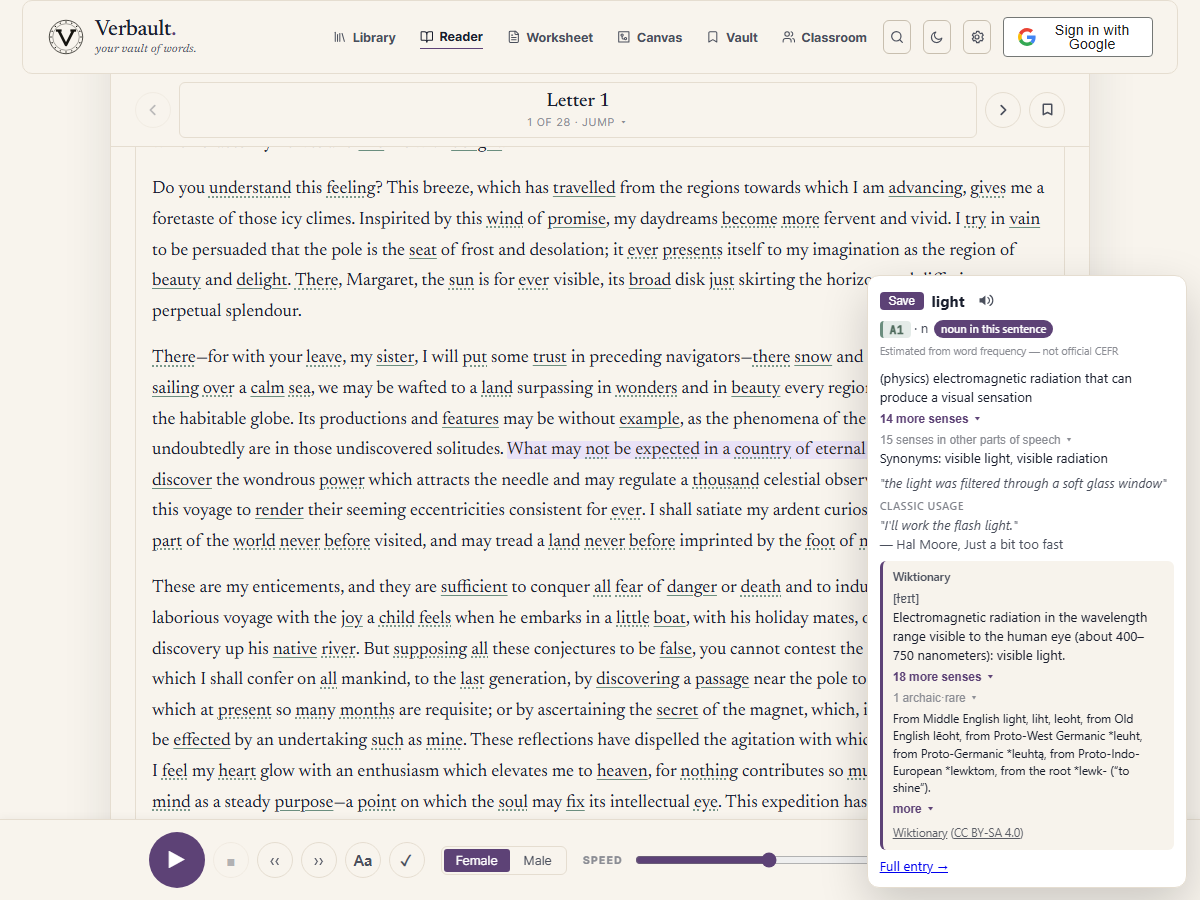
The Verbault Reader is built around that idea. When you tap a word it does not empty the whole entry onto the page in frequency order. It reads the sentence you tapped the word in, works out the part of speech and the likely sense from that context, and shows that meaning first. Here is how to use it.
- Open any book and start reading. Pick a title — Frankenstein, say — and read normally. Every word is already live; there is nothing to set up.
- Tap a word you want to check. A small card opens over the page without taking you off it. At the top is the meaning that fits the sentence you are in, often with a quiet label — noun in this sentence, verb in this sentence — naming the reading it chose.
- The other meanings are still there, one tap down. Verbault does not throw away the senses it did not lead with. Below the first meaning sit two small toggles — more senses in the same part of speech, and senses in other parts of speech — so the full entry is always one tap away. It reorders the dictionary; it does not trim it.
- Keep the word if it is worth keeping. One more tap saves it to your Vault as a card that remembers three things together: the word, the sentence you met it in, and the meaning that fit. When it comes back for review later it returns in its context, not as a bare headword with five senses to sort again.
One honest note, because it bears on trusting the feature. Working out the part of speech from a single sentence is a guess, and on a short or unusual sentence the guess is sometimes wrong — a small function word read as a noun, that sort of thing. Verbault is built to fail softly here: when it is unsure it still shows the likely sense first, but keeps every other sense one tap below, so a wrong guess only changes the order the meanings appear in. The right meaning is never hidden, only now and then placed second. Better to under-promise on the ranking than ever bury the sense you actually needed.
When you want the whole word, not just one sense
The popup is for reading flow: get the sense, stay on the page, move on. Sometimes you want the
opposite — to stop and study a word in full. For that, every word has its own page at
/word/{lemma}, which you can open from the popup or search for directly.
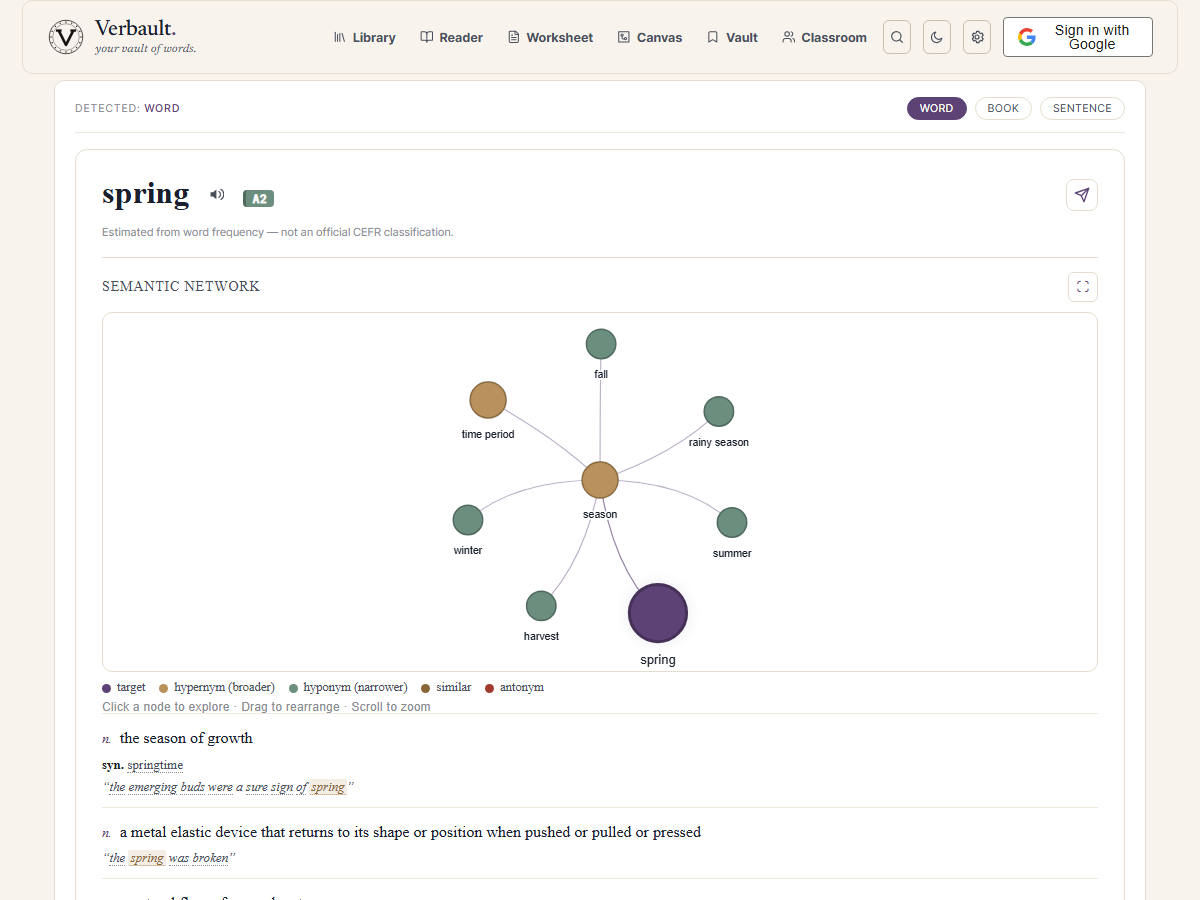
The word page lays the whole word out at once: every sense, a reading-level badge showing how common the word is, and a semantic network — a small map of the nearer words around it. It is the place to see, at a glance, just how many unrelated things a single spelling can carry. Look up spring and the map holds the season, the coil of metal, the source of water, and the act of leaping, all under one five-letter word — the same crowd of meanings the Reader quietly sorts for you while you read. (If the reading-level badge is new to you, an earlier post explains how the bands are set.)
None of this is really about dictionaries. It is about keeping your eyes on the sentence. A word means what its sentence makes it mean, and most of the time you already know which meaning that is; the work is only in confirming it without breaking your stride. Verbault's part is to hand you the fitting sense first and keep the rest within reach, so a word you half-know stops being a reason to stop, and the page carries you on.
Comments (0)
Log in to comment.