Passive vs Active Vocabulary: Why You Understand More Than You Can Use
You are halfway through an email when you stop. The plain word you have just typed — sad, or boring, or very good — is not the one you want, and you can feel a better one sitting just out of reach. You would know it the instant you saw it. It simply will not come, so you settle for the plain word and send the email slightly annoyed with yourself.
An hour earlier you read a chapter of a novel thick with exactly the kind of word you were reaching for, and you understood every one of them without slowing down. Understanding a word effortlessly on the page, yet being unable to summon it when you need it, is one of the most ordinary experiences in language. It also has a name.
Two vocabularies, not one
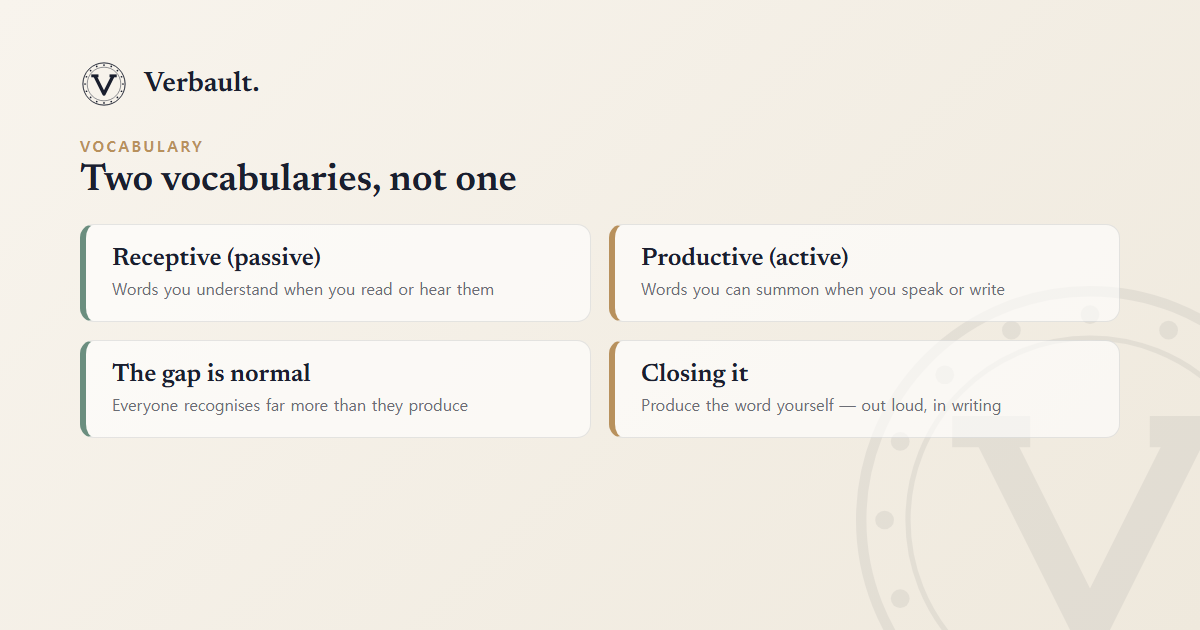
You have not one vocabulary but two, and they are very different sizes. Linguists call them your receptive and productive vocabularies; in plainer terms, the words you recognise and the words you use.
Your receptive vocabulary is everything you understand when you meet it — reading a page, hearing someone speak. Your productive vocabulary is the smaller set you can summon on your own, when you are the one writing or talking. For every reader, native speakers included, the first is far larger than the second; your reading vocabulary outsizes your speaking one, often by thousands of words.
This is worth stating plainly, because the gap can feel like a personal failing and it is not. It is simply how a vocabulary is built. We take words in by meeting them far faster than we ever put them to use, so the understood pile grows tall while the usable pile lags behind. Decades of research describe the same split — Paul Nation's work on receptive and productive word knowledge is the standard reference — and it holds for everyone from a schoolchild to a professional writer.
Why one is so much bigger than the other
The two tasks are not equally hard. Recognising a word is a cued task: the word is right there in front of you, and all you have to do is confirm that you know it. Producing a word is uncued: you start with a meaning in your head and have to generate the word from nothing. Picking the right answer from four options is easy; writing it on a blank line is not, and the difference between recognition and production is exactly that difference.
Reading trains the easy half almost for free. Every page hands you words already wrapped in context, and you confirm hundreds of them an hour without effort, so your receptive vocabulary swells the more you read. What reading almost never does is make you produce a word. You can read for years — widely and well — while your productive vocabulary quietly falls behind, because nothing in the act of reading forces a word out of you.
So a wide reader can have met a word like perfunctory a hundred times, understood it cleanly on every one of them, and still never once have had to reach for it cold. In one sense the word is thoroughly learned; in another it is entirely unavailable.
Moving a word from recognise to use
If reading builds the receptive side, the productive side has to be built another way, and only one thing does it: producing the word yourself, on purpose, more than once. Recognition does not ripen into use on its own, however many times you re-read the word. You have to be the one to make it.
That is less work than it sounds. Three small habits do most of it.
Summon the word before you check it. When you keep a new word, cover its meaning and try to produce the word from the definition alone — the blank-line version, not the multiple-choice one. Pulling a word out of memory is what makes it retrievable next time; spotting it on a flashcard does much less. This is retrieval practice, and it is worth doing properly: Verbault's Review and Play modes are built around it, and an earlier post on learning from classic books explains why it works.
Put the word in a sentence of your own. Not a sentence about the word, but a true one about your own day. A word you have used once in a real sentence is closer to being yours than a word you have revised twenty times in the abstract. The sentence does not have to be clever; it has to be yours.
Spend the word while it is still warm. Use it, deliberately, in the next message or note where it fits, even if a plainer word would have done. The first few times feel forced and a little self-conscious. After that the word stops needing to be summoned and starts arriving on its own, which is the moment it has crossed over.
The thread through all three is the same. Recognition is free and feels like progress, but it is not the part that makes a word usable. Production costs a small, deliberate effort, and that effort is the whole difference between a word you know and a word you can reach for.
Closing the gap in Verbault
Verbault is built first around the receptive half — meeting words and understanding them in context — but the same tools let you do the harder, productive work on the words worth it. The loop is short.
- Meet words while you read. Open a book in the Reader — Frankenstein, say — and tap any word you do not know. Its meaning, how common it is, and a button to hear it spoken appear right there on the page, without pulling you out of the chapter. Save the ones worth keeping to your Vault as you go.
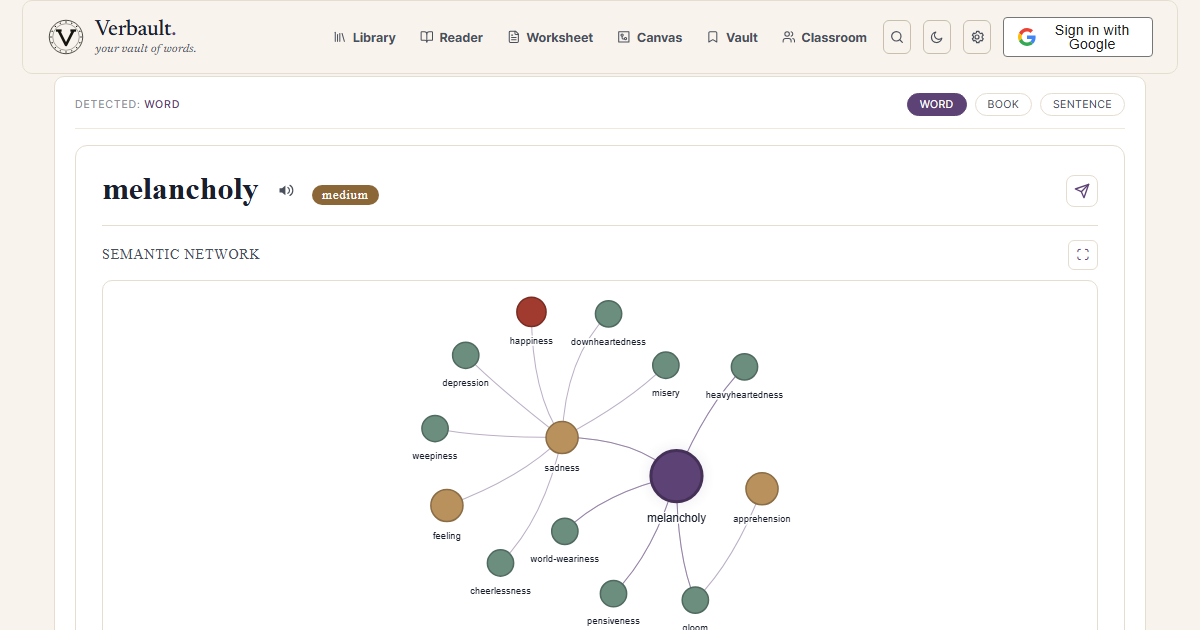
- See the word's neighbourhood. Every word has its own page — the one for melancholy, for example — showing not just its definition but a map of the words related to it. The synonyms clustered around a word (here gloom, world-weariness, pensiveness) are usually words you also only recognise, so activating one tends to drag its neighbours along with it.
 3. Practise producing, not just recognising. The Vault's
Review and Play sessions bring your saved words back and ask you to
summon them — the blank-line task, not the pick-it-from-the-page one — and they do it on a
schedule, so a word comes back before you forget it. That is the productive muscle, exercised
on purpose.
4. Then actually use one. This last step is the only one no app can take for you. Choose a
word you have been recognising for years and put it in something you write this week. That
single deliberate use does more than another round of revision ever will.
3. Practise producing, not just recognising. The Vault's
Review and Play sessions bring your saved words back and ask you to
summon them — the blank-line task, not the pick-it-from-the-page one — and they do it on a
schedule, so a word comes back before you forget it. That is the productive muscle, exercised
on purpose.
4. Then actually use one. This last step is the only one no app can take for you. Choose a
word you have been recognising for years and put it in something you write this week. That
single deliberate use does more than another round of revision ever will.
None of this is elaborate. Read widely and your receptive vocabulary will look after itself. The words you want to be able to use are the ones you have to summon, write into a sentence of your own, and spend while they are still warm. The understood pile grows on its own; the usable one is built by hand.
Comments (0)
Log in to comment.