Test Your English Reading Level in 60 Seconds
Recognizing a word isn't the same as knowing it
There's a quiet trick your brain plays while you read. A word goes by — pellucid, sanguine, countenance — and it looks familiar, so you file it under "known" and keep going. Ask you to define it a beat later, though, and the meaning has already slipped. That is false fluency: the comfortable feeling of understanding, running a little ahead of the understanding itself.
Verbault's 60-second reading check is a small, honest mirror for that gap. You read a short passage, mark the words you don't know, and it shows you where recognition and recall actually part ways, and from that, roughly what reading level you are working at. No sign-up, no timer pressure, no score to cram for. About a minute, start to finish.
What the check actually does
The check is deliberately short, and it works in three passes. Each one measures something the last one cannot.
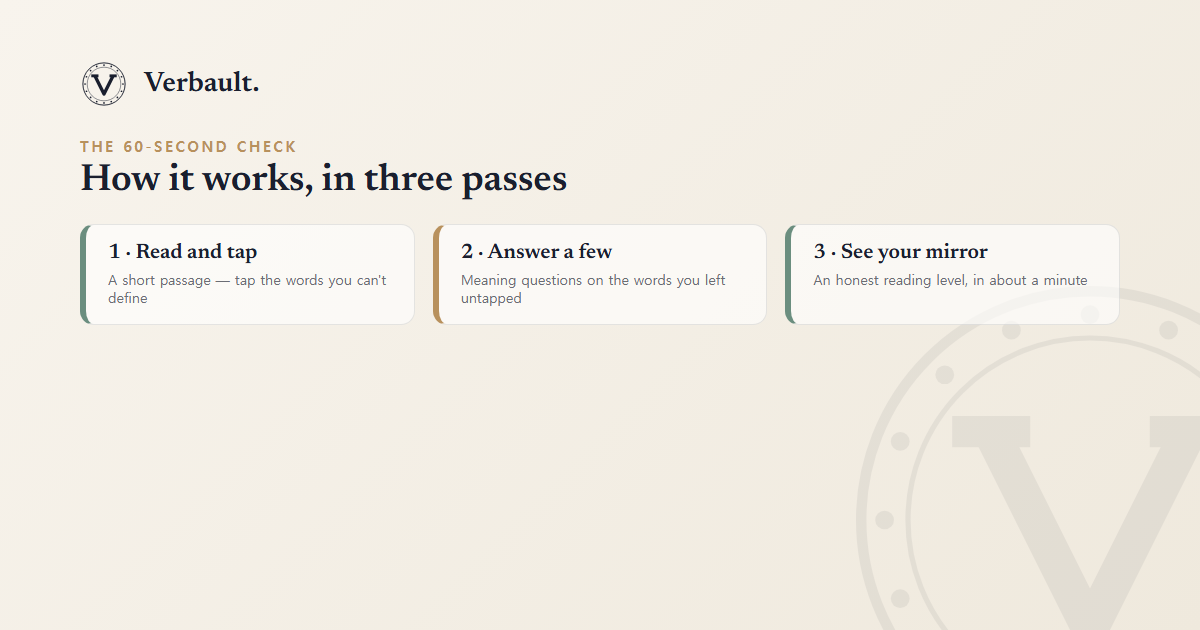
- You read and tap. First you get a passage of about eighty words, taken from a real public-domain book in the library. It is ordinary prose, not a word list. Tap every word you could not confidently explain to someone else. Tap one by mistake and tap it again to undo. This is you telling the check what you think you know.
- You answer a few questions. Then it turns the tables. From the words you left untapped (the ones you quietly claimed to know), it picks a handful and asks you to choose the meaning that fits. Recognizing a word's shape is easy; picking its meaning out of four is where false fluency shows. Mixed in are a couple of invented words that obey English spelling but mean nothing at all. If you say you know one of those, that is a gentle sign you may be marking familiar-looking words as known a little too freely.
- It shows you the mirror. Finally it puts the two halves together, what you claimed against what held up, and reports the gap.
One detail worth knowing: the check does its scoring on the server, so the "right answer" is never sitting in the page for you (or an over-eager browser) to peek at. You just choose, and it keeps the score.
What your result tells you
The result screen is the point of the whole exercise, so it is built to be honest rather than flattering.
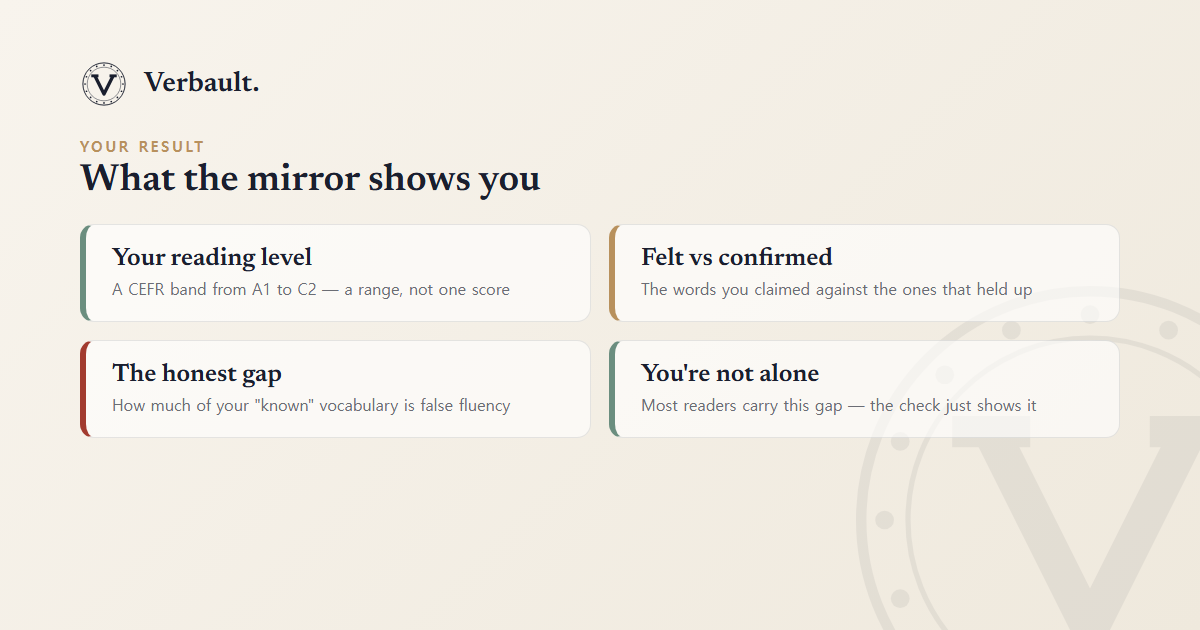
- A reading level, given as a range. You get a CEFR band: the standard A1-to-C2 scale used across English teaching, running from beginner (A1) to near-native (C2). It comes as a range, say B1–B2, not a single number. A one-minute sample can place you honestly within a band or two; it cannot pretend to more precision than that, so it does not.
- Felt coverage versus confirmed coverage. It shows how much of the passage you felt you knew (everything you did not tap) next to how much actually held up under the questions. The distance between those two is your false fluency, made visible.
- A reminder that you are normal. Almost everyone carries this gap; even a fluent reader recognizes far more than they can define on demand. The check tells you so, because the number is only useful if it does not leave you feeling caught out.
- And it admits when it cannot tell. If the invented-word answers suggest the sample was not reliable (if too much got waved through as "known"), the check says it cannot give you a confident level, rather than inventing one. An honest "we're not sure" is worth more than a confident wrong answer.
How to take it
You can do the whole thing right now, on a phone or a laptop:
- Open the check. Go to the 60-second reading check. It starts on its own, with nothing to install and no account to make.
- Read the passage and tap. Read at your normal pace and tap any word you could not define. Be honest with yourself here; the check is only as good as your taps are truthful.
- Answer the questions. A few multiple-choice meaning questions, and the occasional "do you know this word?" Answer from what you actually know, not from what looks safe.
- Read your mirror. Your level and your gap appear in under a second. Sit with it for a moment — the surprise is usually the point.
Keep your baseline
Your result lives in that browser tab and nowhere else: refresh the page and it is gone. If you would like to keep it, sign in with a free account and Verbault attaches the result to your profile, where it becomes the first entry in the Progress view of your Vocabulary Vault. Think of it as a starting line: a reading you took on one particular day, there to measure later readings against as you keep going.
If your result was a confident one, you can also share it as an anonymous card (your level and your gap, with nothing that identifies you) for anyone curious enough to take the check themselves.
Why we built it this way
Most "what's your level?" quizzes reward recognition, which is precisely the thing that misleads you. You see a word, it rings a bell, you click the answer that feels right, and the quiz congratulates you. This one is built to catch the bell-ringing and set it apart from real knowledge. The untapped-word questions and the invented words exist for no other reason.
It also fits the rest of Verbault. The same easy, medium, and hard reading levels the check uses to weigh the passage are the ones the Reader shows under every word, and the words you keep tripping over are exactly the ones worth saving to your Vault. The check is the honest first look; the reading is where the gap slowly closes.
Try it now
It costs you a minute and tells you something most people never measure. Take the 60-second reading check, read your mirror, then open a book in the Reader — the words you have just discovered you did not quite know are a good place to start.
Comments (0)
Log in to comment.