Contain, Retain, Detain: The Hidden 'Hold' in English's -tain Words
The verb hiding inside contain, retain, and detain
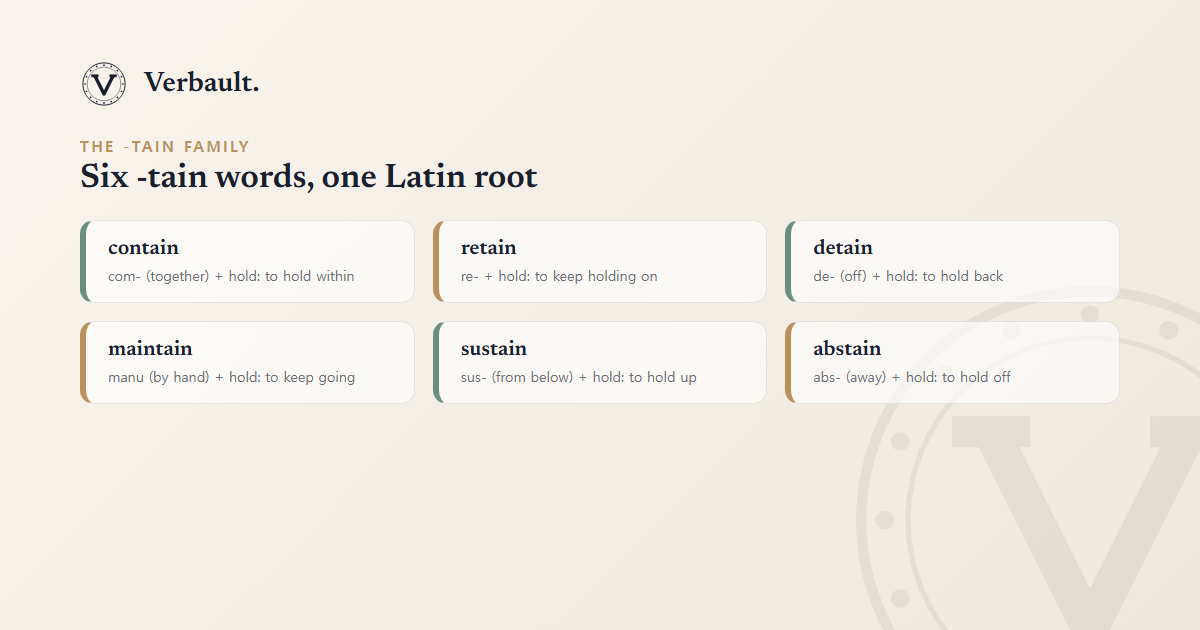
Say contain, retain, detain, and maintain one after another and the shared ending is easy to hear. What is harder to notice is that they share a meaning too. Each one is built on a single Latin verb, teneō (tenēre), which means to hold. They are not distant cousins that happen to rhyme. They are the same verb wearing different prefixes, and each prefix tells you which way the holding goes.
Once you see that, a whole shelf of English words stops being separate vocabulary to memorise and becomes one idea with variations. You learn hold once, then read the prefix.
One verb, a different hold each time
Here is the family, with the direction each prefix adds. Most of these word pages spell the same Latin root out in their origin line, so you can check for yourself.
- contain — com-, "together": to hold together, to hold within. A jar contains water because it holds the water in.
- retain — re- + hold: to keep holding on to something. What you retain, you keep.
- detain — de-, "off, back": to hold someone back from leaving. The police detain a suspect; a delay detains a train.
- sustain — sus-, "up from below": to hold up, to keep from falling. A beam sustains a roof; hope sustains a person.
- abstain — abs-, "away from": to hold yourself away from something.
- obtain — to get hold of a thing and keep it.
- pertain — per-, "through": to reach through to something, and so to belong to it. The rule pertains to you.
- entertain — inter-, "among": to hold among, to keep company with. That is how "hold together" drifted, over centuries, into "keep someone amused."
maintain hides a nicer surprise. The main- is not a prefix at all; it is the Latin manū, "by hand" — the same hand you can still see in manual and manuscript. To maintain something is, at root, to hold it in your hand: to keep it going. Across the whole family the prefix changes the direction of the holding, and the root keeps the holding itself constant.
The noun gives the old root away
In the verbs, that Latin root is buried under a smooth French -tain ending. But turn each verb into its noun and the older spelling surfaces again — the -ten- or -tin- of teneō:
- retain → retention
- detain → detention
- maintain → maintenance
- sustain → sustenance
- abstain → abstinence
- contain → content, and the older continent (that which holds together)
When you spot -ten- or -tin- sitting inside an English word, it is often this same Latin verb, still holding on after two thousand years.
The word that only looks like family: attain
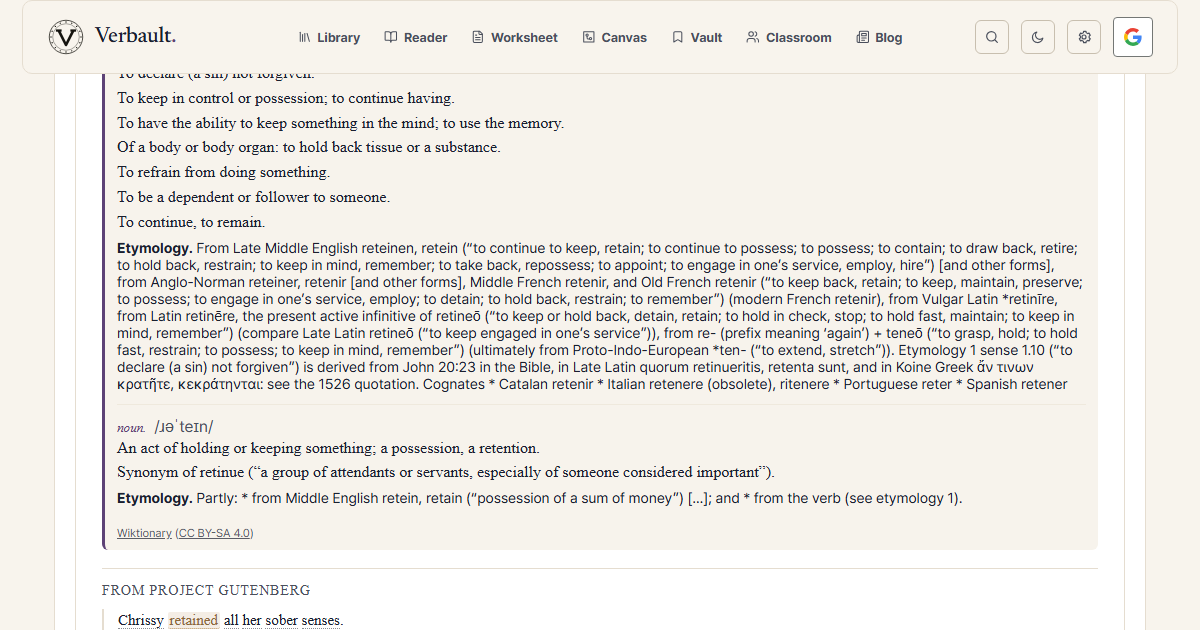
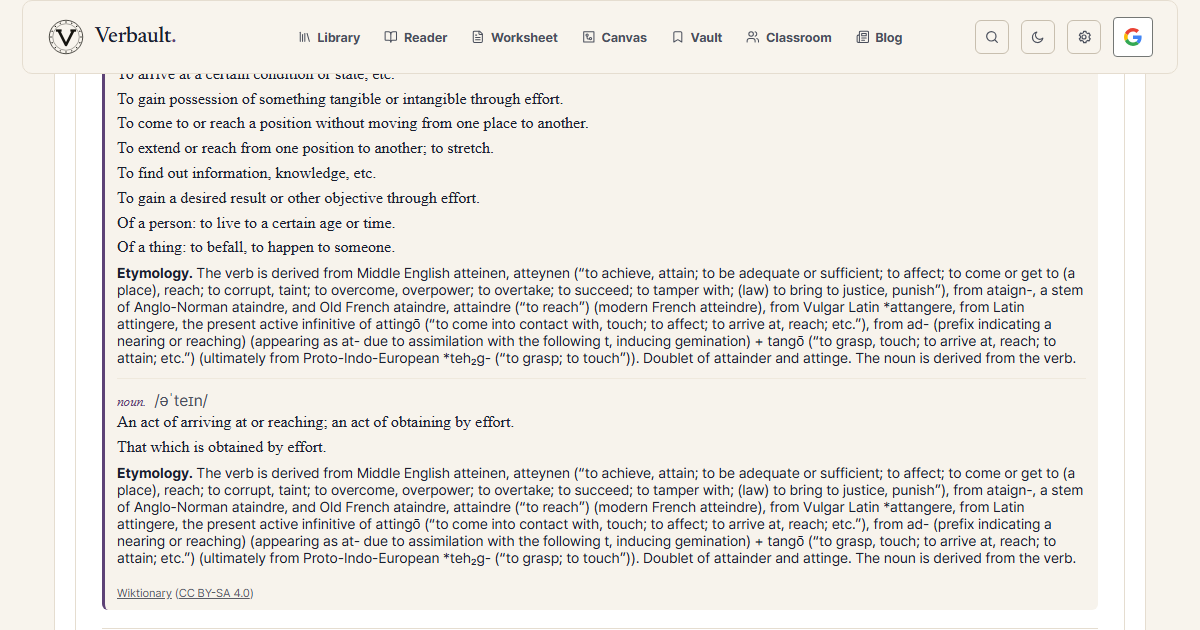
Now for the impostor. Attain ends in -tain, and "to attain a goal" feels close enough to holding that you would forgive anyone for filing it with the rest. But attain does not come from teneō at all. Its word page traces it to Latin attingere — ad-, "toward," plus tangō, "to touch." To attain is to reach out and touch, not to hold. The matching ending is a coincidence of French spelling, not a shared root.
The surest way to see this is the company attain keeps. Its real relatives are not retention and detention but tangent (a line that just touches a curve), tactile (having to do with touch), and contact (a touching together). Every one of those goes back to tangere, "to touch." Attain wandered into the -tain neighbourhood wearing the same coat as contain and retain, but it grew up in a different house.
Why this is worth knowing
When you next meet an unfamiliar -tain word, "hold" is a good opening guess for its core meaning; read the prefix for the direction and you are usually most of the way there. Just treat the ending as a hint, not a law. Attain is one exception, and there are quieter ones: certain, curtain, and mountain all end in -tain without holding anything — they come from Latin certus ("settled"), cortina ("a hanging"), and mont- ("mountain"). The spelling lines up by accident; the roots do not.
The way to be sure, every time, is the origin line, and each Verbault word page prints it. Open attain in one tab and retain in another, and the two roots — touch and hold — are right there to compare.
You can also read these families straight out of a book. Open a chapter in the Reader and tap a -tain word: the meaning that fits the sentence comes up first, and its origin is one tap below, so the shared hold — or the odd word that only pretends to belong — is easy to catch in the wild.
Comments (0)
Log in to comment.