One Word, Many Voices: How 'Death' Changes Across Twenty-Five Centuries
An everyday word carrying its full weight
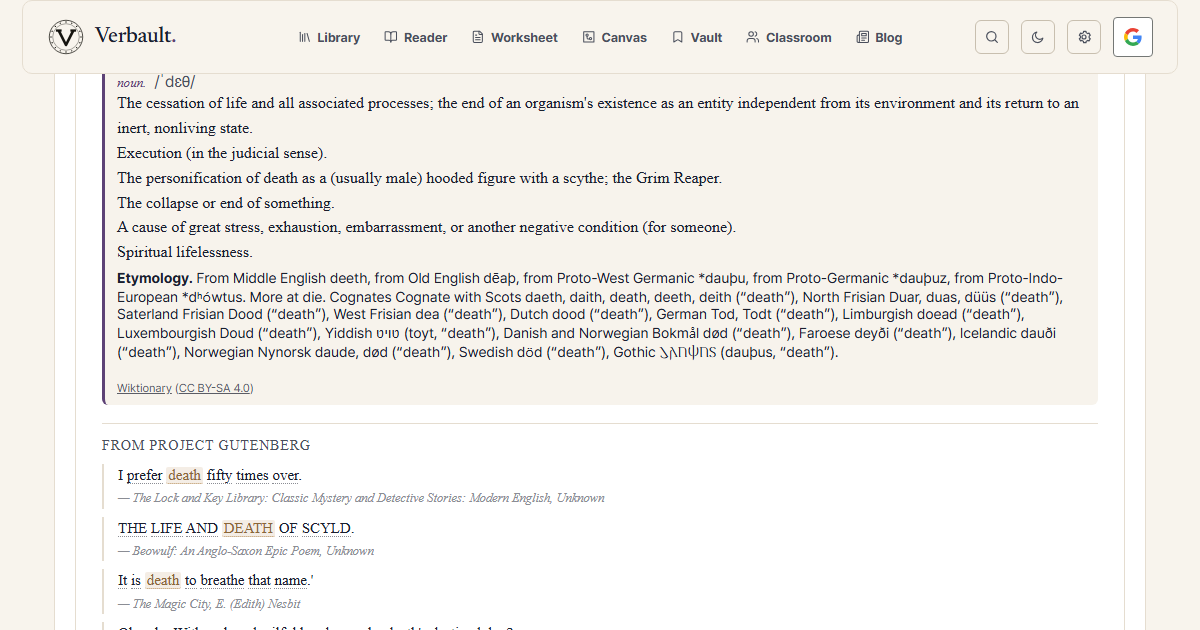
Open the word page for death and Verbault files it at the easiest level there is: reading level easy, CEFR A1, the first band a beginner ever meets. It is one of the earliest nouns anyone learns, plain enough to appear in a first week of lessons.
Yet the same five letters do very different work depending on who is holding the pen. Read death in a Greek fable, then in a prisoner's book of consolation, then in a Regency drawing room, then in a Dickens factory town, and you are not quite reading the same word each time. The dictionary sense barely moves. The weight of it changes completely.
This post follows one word, death, through six writers and roughly twenty-five centuries, using real sentences drawn from the public-domain books in Verbault's library.
Where the word comes from
death goes back through Middle English deeth to Old English dēaþ, and further still to a Proto-Germanic root for dying. The origin line on its Verbault page ends with a small pointer: more at die.
That pointer is the whole family in three words. The noun death and the verb die are one root cut two ways — one names the event, the other the act — and English kept both, giving each its own job. You use the pair without noticing it is a pair. The rest of this post is what writers have done with the noun once they had it.
The same word, six different weights
A fable's plea. In Aesop's Fables, read here in translation, the frogs call up to the boys pelting them with stones:
I beg of you: what is sport to you is death to us.
Death here is a matter of whose side you are on. One party's game is the other party's ending, and the line turns on the gap between two words held a sentence apart. Sport is worth a second look: it now means athletics, but the older sense is play, amusement, idle fun. Verbault's sport page leads with today's dominant athletic meaning, yet the origin note underneath traces it back to Middle English to divert — disport — the field of play the frogs actually mean.
A prisoner's consolation. Boethius wrote The Consolation of Philosophy in a cell, awaiting execution. In it, death is not a threat but a mercy that comes too late or not at all:
Blest is death that intervenes not / In the sweet, sweet years of peace, / But unto the broken-hearted, / When they call him, brings release!
This is death as release — the thing you find yourself longing for when nothing gentler will end the pain. A word most writers reach for as an ending is here the one door out.
A social measure. By Jane Austen's Pride and Prejudice, death has become a yardstick for disgrace. Mr Collins, writing about an elopement, offers this comfort:
The death of your daughter would have been a blessing in comparison of this.
The word is doing social arithmetic. A death, he means, would have been the lighter blow — a staggering thing to say, and the sentence needs death to carry the full weight of the comparison.
A life reduced to commerce. In Charles Dickens's Hard Times, death is set at one end of a ledger:
Every inch of the existence of mankind, from birth to death, was to be a bargain across a counter.
Here death is a bookend, the far edge of a life measured entirely in transactions. The line leans on bargain — an agreement, a deal struck between two sides — to make a whole existence sound like something bought and sold over a shop counter.
Death turns seductive. In Sheridan Le Fanu's vampire novella Carmilla, the word loses its dread and becomes almost inviting:
Dim thoughts of death began to open, and an idea that I was slowly sinking took gentle, and, somehow, not unwelcome, possession of me.
Not unwelcome is where the horror lives. Death has stopped feeling like a thing to fear, and the narrator's calm is more unsettling than any struggle would be.
A word under doubt. By William Hope Hodgson's The House on the Borderland, even the meaning has come loose:
Not that I fear death — as death is understood.
Everything hangs on the qualifier. Death as it is understood — the ordinary sense — is set against whatever stranger, worse thing the narrator has glimpsed and cannot name. The word is suddenly not big enough for what he means.
The through-line
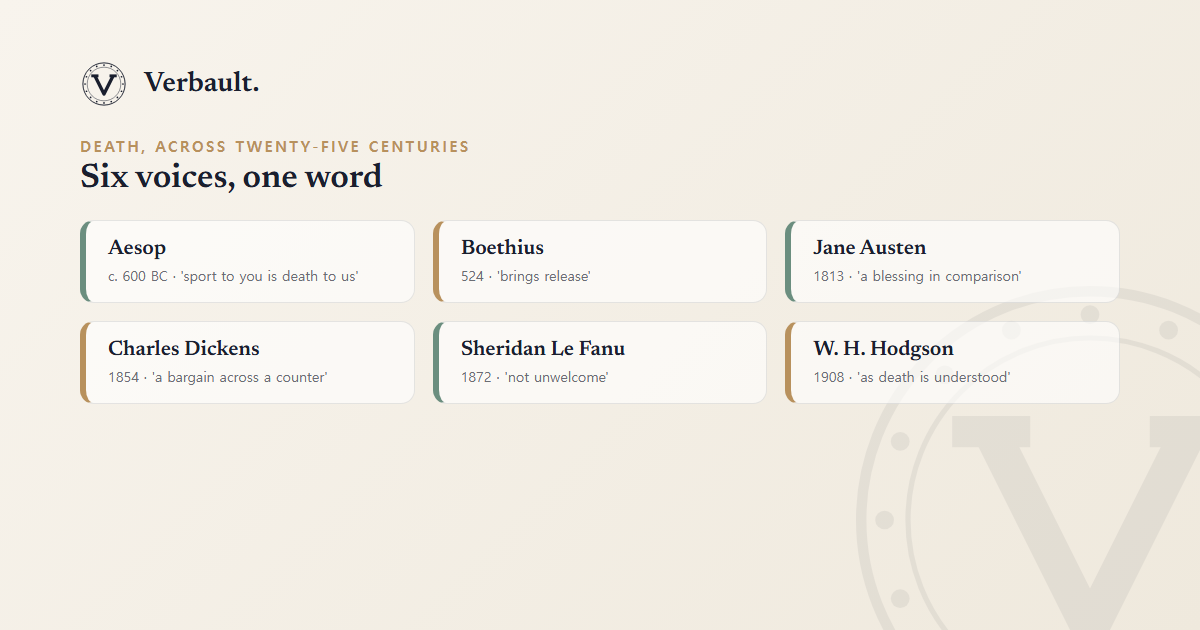
Line those six up and one plain, A1 word has carried a plea, a mercy, a measure of disgrace, a transaction, a seduction, and a metaphysical doubt — all without its dictionary definition moving. Writers rarely reach for rare words to say new things. More often they lean on the commonest words in the language and let the surrounding sentence bend them. Death is a good word to watch this happen in, because everyone already knows it, so the shift in weight from one voice to the next is easy to feel.
See it for yourself
Every quotation above comes from a book you can open in Verbault, and you can trace a word like this yourself in a few minutes.
- Start on the word page. Open death. Near the top you get its reading level and meaning; scroll down and Verbault lists real example sentences drawn from the public-domain library, each labelled with the book it came from. That list is the raw material this post arranges by hand.
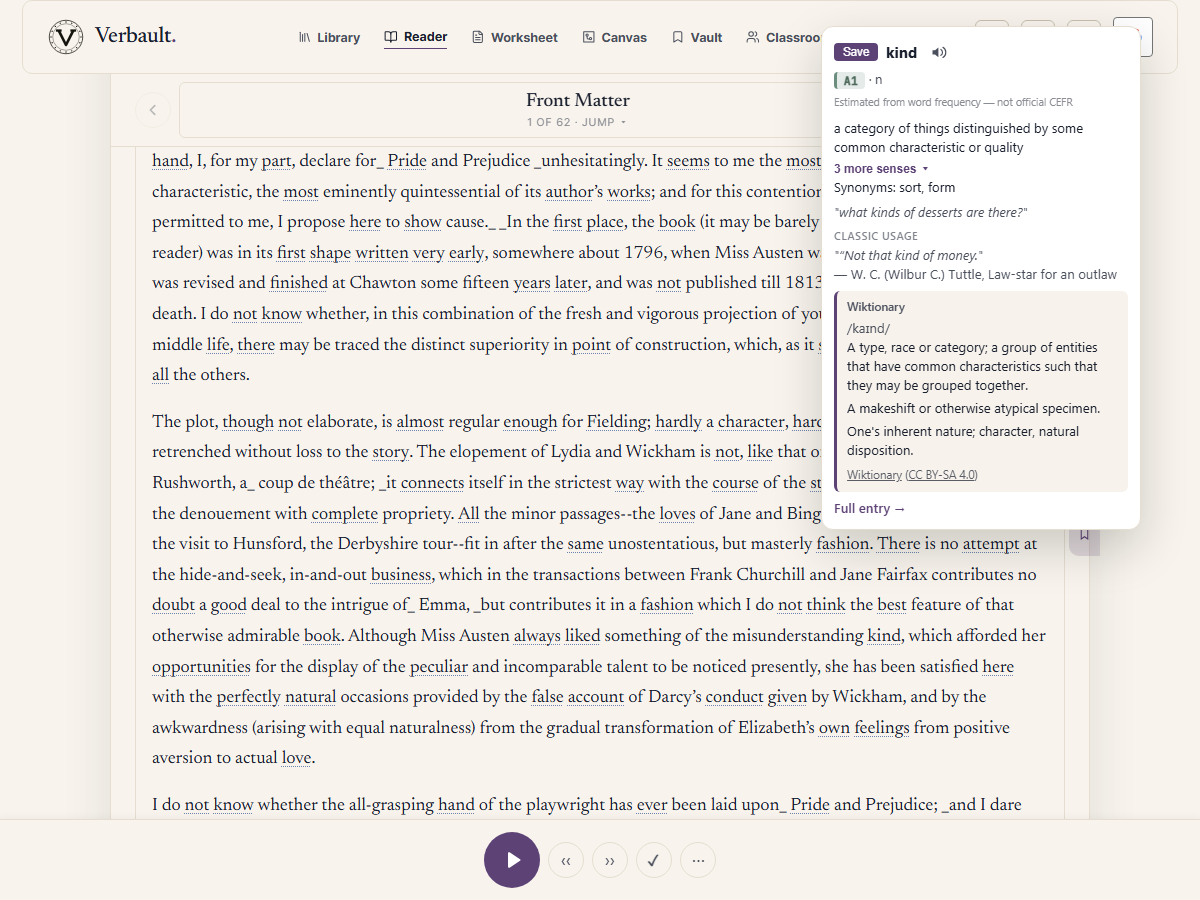
- Read it in its own sentence. Open a book in the Reader, such as Pride and Prejudice, and tap any word. A card shows the meaning that fits this sentence first, with the word's origin one tap below and a speaker button to hear it read aloud.
- Watch the harder words in each quote. The sentences above turn as much on their neighbours as on death itself. Open sport and bargain and read the senses in order: seeing that sport once meant play, or that a bargain is a deal struck across a counter, is what unlocks the line it sits in.
These six quotes first appeared as a short Verbault video, Death: One Word, Many Voices, which reads each one aloud in order. This post is the longer, linkable version of the same walk.
Comments (0)
Log in to comment.