One Word, Many Voices: How 'Time' Changes Across Fourteen Centuries
An everyday word carrying a lot of weight
Open the word page for time and Verbault files it at the easiest level there is: reading level easy, CEFR A1, the first band a beginner ever meets. It is one of the most common nouns in English, the kind you stop noticing by the end of your first week of lessons.
Yet the same four letters do very different work depending on who is holding the pen. Read time in a sixth-century book of consolation, then in a Regency drawing room, then in an opium-eater's confession, and you are not quite reading the same word each time. The dictionary sense barely moves. The weight of it changes completely.
This post follows one word, time, through five writers and roughly fourteen centuries, using real sentences drawn from the public-domain books in Verbault's library.
Where the word comes from
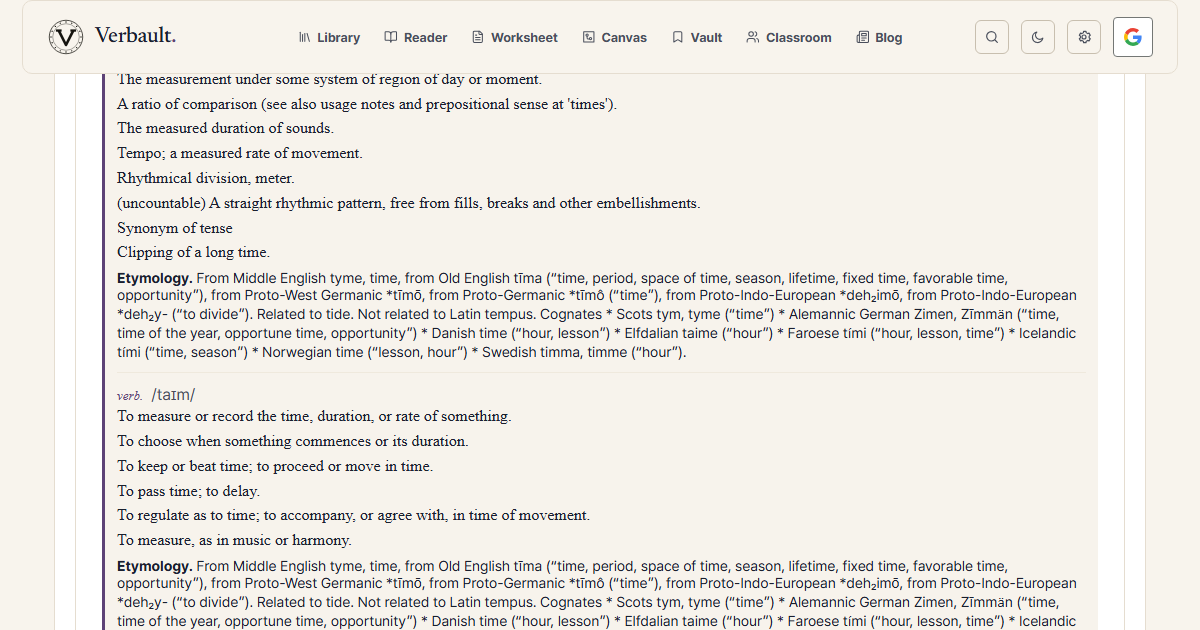
time goes back through Middle English tyme to Old English tīma, "a space of time, a season, a fixed or favourable moment." Further back still, the root is Proto-Indo-European deh₂y-, "to divide." At bottom, time is not an abstract flow at all. It is something cut into parts: a span marked off from the rest.
That origin has a quiet relative you already know. The same root sits under tide, the sea divided into its regular comings and goings. Verbault's time page even says, in as many words, that it is "related to tide." So when the old proverb runs time and tide wait for no man, it is almost repeating itself: two words for a marked-off span that moves on without you.
The same word, five different weights
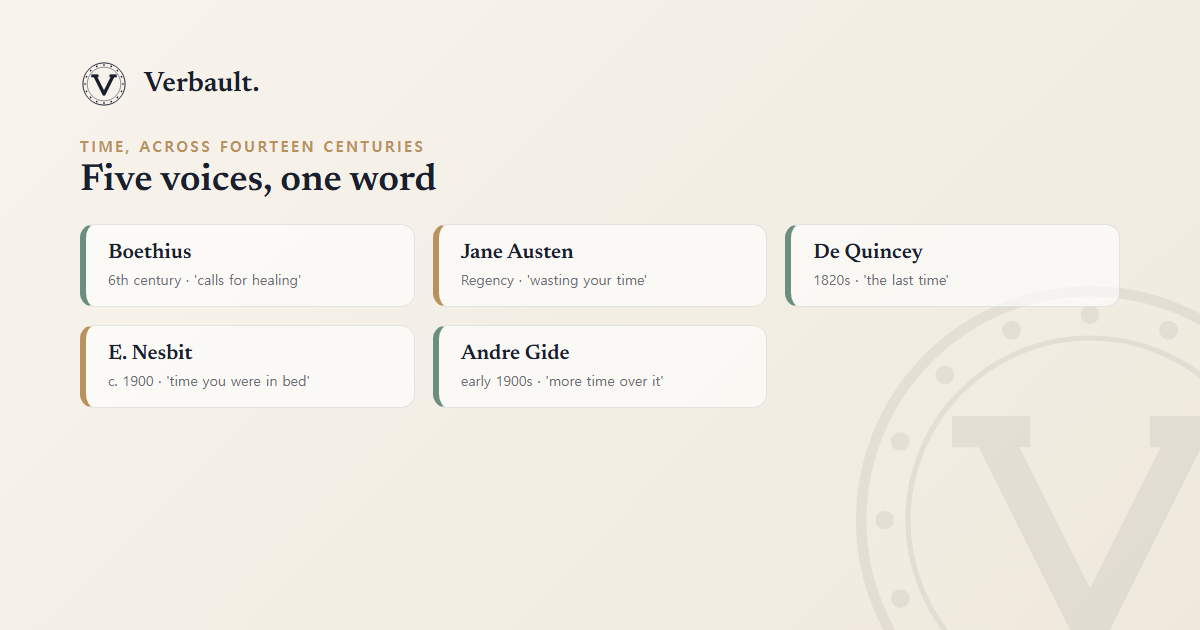
A sixth-century consolation. In Boethius's The Consolation of Philosophy, read here in an English translation, Philosophy answers the grieving prisoner:
But the time, said she, calls rather for healing than for lamentation.
Time here is the present hour, the moment as it asks something of you. Not a resource to spend, not a thing that runs out, but the occasion itself and what it calls for.
A Regency social currency. By Jane Austen's Pride and Prejudice, time has become something you can waste or spend, like money or attention:
You had better return to your partner and enjoy her smiles, for you are wasting your time with me.
It is a small, sharp line, and the idea of time-as-currency carries it. Two centuries on, that is still the most ordinary sense we have.
The word turns to loss. In Thomas De Quincey's Confessions of an English Opium-Eater, from the 1820s, time runs out:
I wept as I looked round on the chair, hearth, writing-table, and other familiar objects, knowing too certainly that I looked upon them for the last time.
Here the word is not spent or filled. It is ending. "The last time" is one of the plainest phrases in the language and one of the heaviest.
An ordinary evening. Look in on E. Nesbit's children's story The Magic City and the word is back to its lightest, most domestic use:
The water is cold, and it is time you were in bed.
No philosophy, no grief. A grown-up telling a child the day is over. This is time as most of us use it most of the time, and it belongs in the set precisely because it is so unremarkable.
A measure of effort. Finally, in André Gide's study of Dostoevsky, again in translation, time becomes something you invest in the quality of your work:
If he had spent more time over it, the result would have been better.
Time as the raw material of good craft: the more of it you put in, the better the thing you make.
The through-line
Line those five up and one plain, A1 word has carried consolation, social wit, grief, a child's bedtime, and a verdict on craftsmanship, all without changing its dictionary definition. Writers rarely reach for rare words to say new things. More often they lean on the commonest words in the language and let the surrounding sentence bend them. Time is a good word to watch this happen in, because everyone already knows it, so the shift in weight from one century to the next is easy to feel.
See it for yourself
Every quotation above comes from a book you can open in Verbault, and you can trace a word like this yourself in a few minutes.
- Start on the word page. Open time. Near the top you get its reading level and meaning; scroll down and Verbault lists real example sentences drawn from the public-domain library, each labelled with the book it came from. That list is the raw material this post arranges by hand.
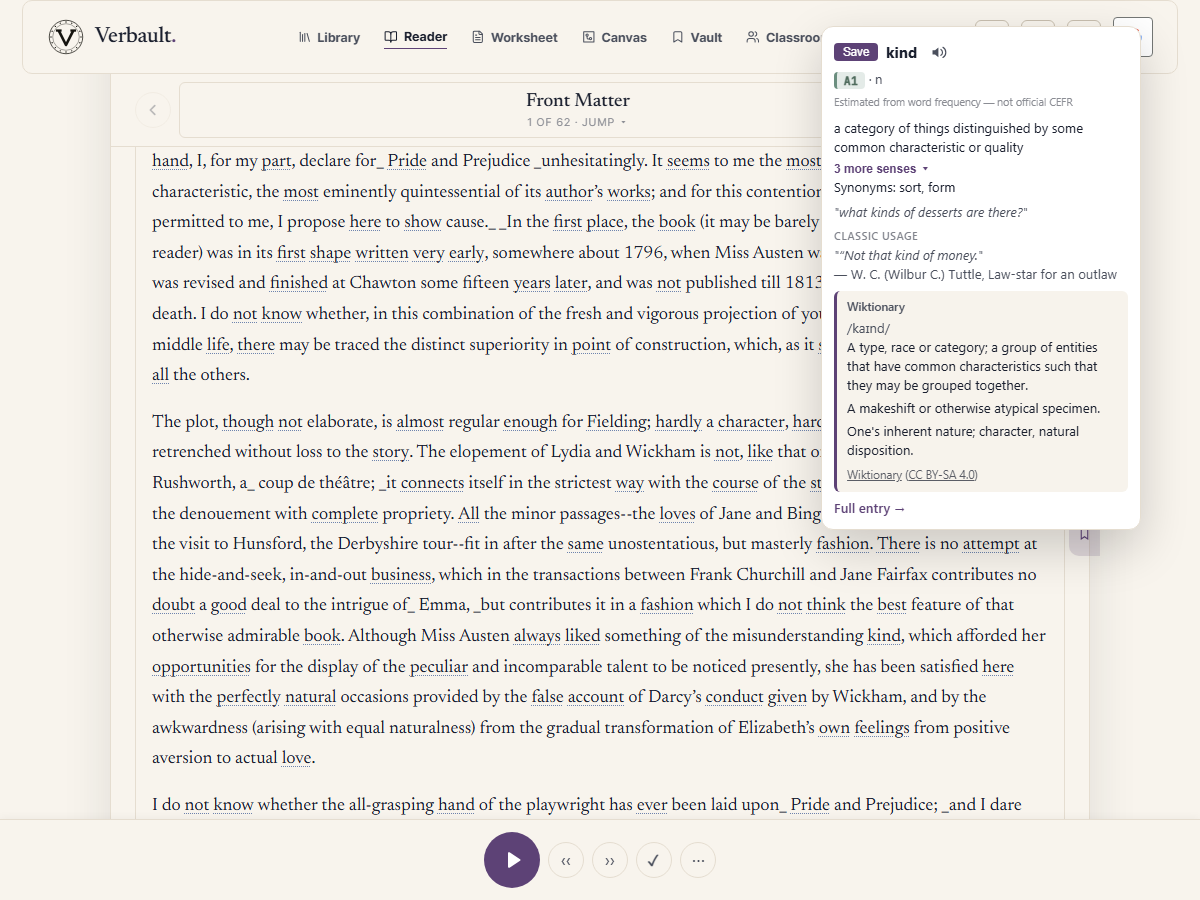
- Read it in its own sentence. Open a book in the Reader, such as Pride and Prejudice, and tap any word. A card shows the meaning that fits this sentence first, with the word's origin one tap below and a speaker button to hear it read aloud.
- Follow the root. From the time page, the origin line points to tide. Open it in another tab: it traces back to the same Proto-Indo-European root and says, plainly, "related to time." That is the same move this post used to connect two words that look unrelated.
Pick a word you think you know completely and do the same. The common ones tend to have the longest histories, and the widest range.
These five quotes first appeared as a short Verbault video, Time: One Word, Many Voices, which reads each one aloud in order. This post is the longer, linkable version of the same walk.
Comments (0)
Log in to comment.