Why a Word's Origin Is the Easiest Way to Remember It
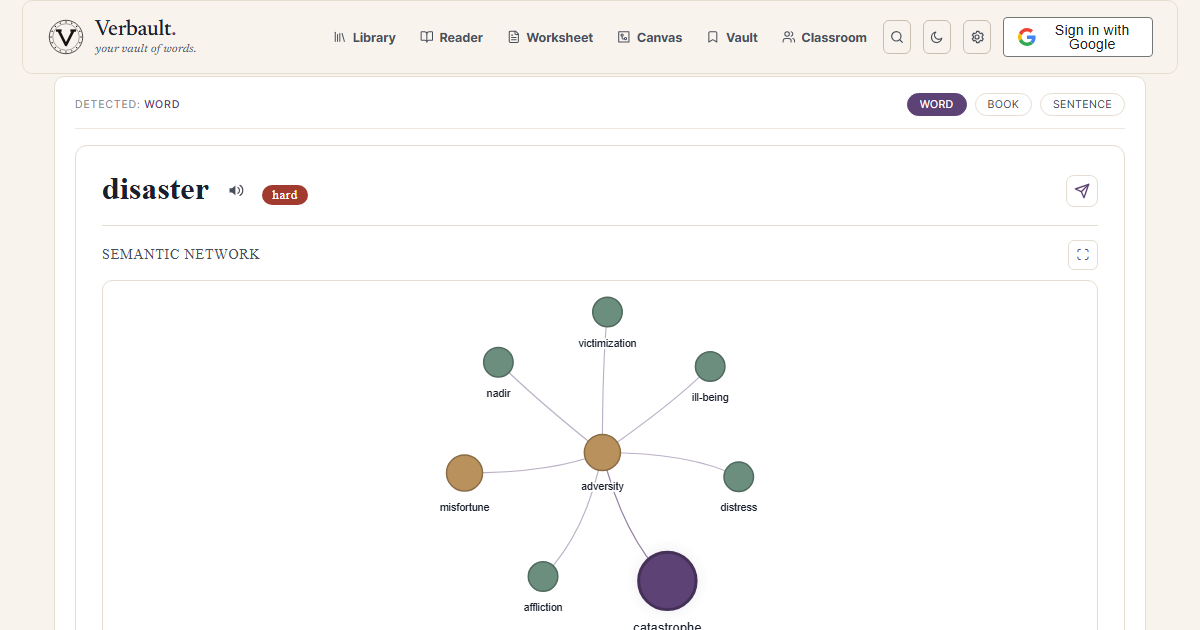
A star, hidden in 'disaster'
Pull the word disaster apart and a star falls out of it. The astro sitting in the middle is the same astro as in astronomy, and it means "star." A disaster was, at first, a bad star: a catastrophe once blamed on the planets being in the wrong place. The dis- on the front is the sour note, the sense of a sky turned against you.
Once you have seen that, the word is hard to forget. You are no longer holding three syllables in your head by force; you are remembering a small, strange picture — people looking up at an unlucky sky and naming their ruin after it. That picture is the whole argument of this post. A word's origin is usually the cheapest and most durable way to remember it.
Why origins outlast flashcards
Rote memorising treats a word as an arbitrary label: this sound means that thing, learn the pairing. The trouble is that nothing holds the pairing together. There is no reason disaster should mean catastrophe rather than, say, breakfast, so your memory has nothing to grip, and the word slides off within a week.
An etymology gives the word a reason. Disaster means catastrophe because it once meant ill-starred, and that "because" is exactly the kind of thing human memory is good at keeping. We hold on to stories, causes, and connections far more reliably than to isolated facts. Give a word a cause and you have quietly moved it onto the shelf where memory actually keeps things.
There is a second, quieter benefit. An origin often explains the word's modern shading: why disaster still carries a note of fate and helplessness that accident does not. You come away understanding the word a little better. That is the difference between a word you can recognise and a word you can use.
Learn one root, and you get a family
The real payoff is that roots travel in families. That astro / aster, meaning "star," did not stop at disaster. It is in astronomy, the ordering of the stars; in astronaut, literally a star-sailor; in asterisk, the "little star" you drop into a line; and in the aster, the flower shaped like one. Learn the root once and a dozen words light up together, each one now slightly transparent.
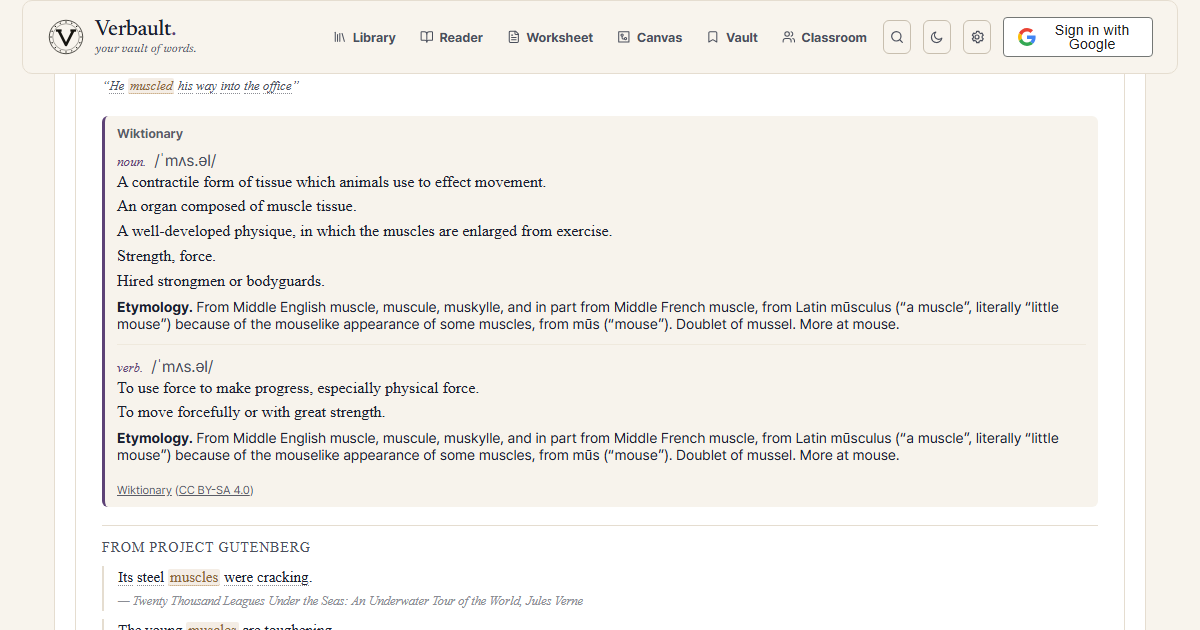
Some of these families are wonderfully odd. Muscle comes from the Latin musculus, "little mouse" — Roman writers thought a flexing arm looked like a small mouse moving under the skin. The same word gave us mussel, the shellfish, which is why the two are spelled almost alike. Once you know that, muscle is never quite an arbitrary noun again; there is a mouse hiding in your forearm.
This is why an hour spent on origins pays back more than an hour spent on a word list. A list teaches you the words on the list. A root teaches you words you have not met yet, because the next time you run into astral or muscular you will half-know it before you look.
Be wary of the stories that are too neat
One warning, because it matters. Not every origin you hear is true, and the false ones are often the most charming. The word posh is supposed to come from "Port Out, Starboard Home," the desirable cabins on a steamer to India. It is a lovely story with no evidence behind it; the real origin of posh is unknown. Tidy explanations like this — a neat acronym, a clever anecdote — are called folk etymologies, and language is full of them.
The fix is simple: trust the traced chain over the cute story. A real etymology shows the word changing shape as it crosses from language to language — disaster back through Italian disastro to Latin and then Greek — and that visible trail is what makes it trustworthy. If an origin arrives as a clever acronym with no trail behind it, enjoy it, but do not bank your memory on it.
Finding a word's origin in Verbault
You do not need a shelf of etymological dictionaries to read this way. Every word in Verbault has its own page that puts the origin in front of you. Here is how to use it.
- Open the word's page. Go straight to it — the page for companion, for example. You can also reach it from the Reader: tap any word as you read, and the popup links through to its full page.
- Read the etymology line. Near the top you will find the word's history, drawn from Wiktionary. Companion, it turns out, is com- ("with") plus panis ("bread"): a companion is, literally, someone you share bread with. The reading-level badge beside it tells you how common the word is, so you know whether it is worth keeping.
- Follow the roots outward. Once you have the root, look for its relatives. Panis, "bread," also hides inside pantry and company. Noticing those links is the habit that turns one origin into several remembered words.
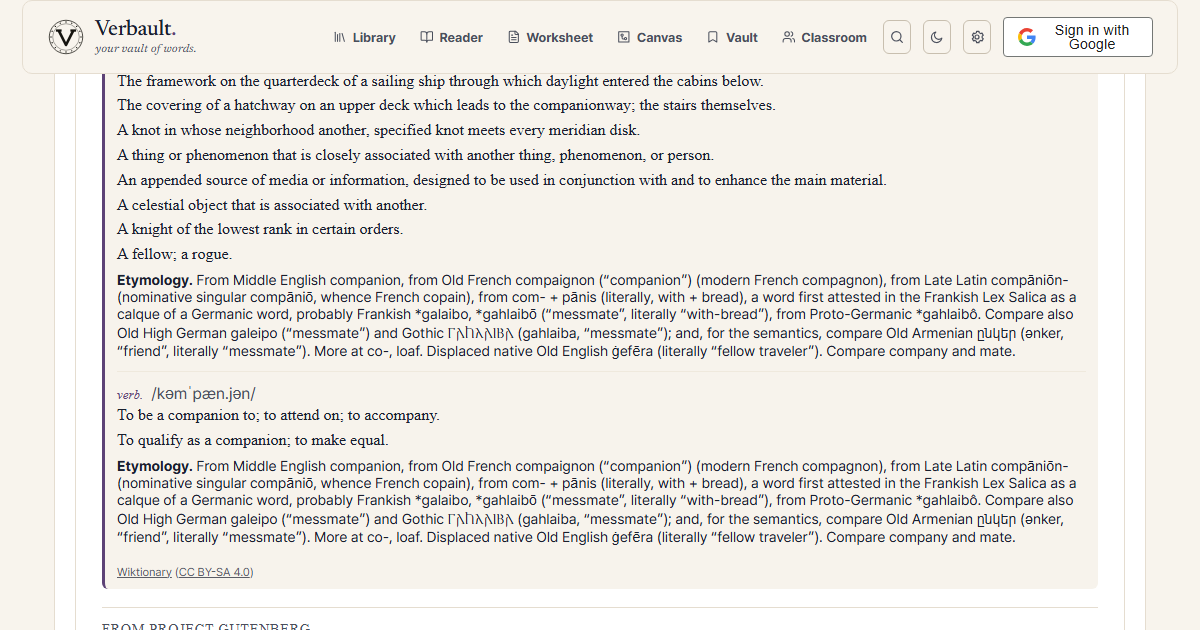
Each page also shows the word's definitions and a few real sentences from classic books where it appears, so the origin, the meaning, and the word at work all sit in one place.
None of this asks you to study harder. It asks you to be a little curious about where a word came from, and then to let that curiosity do the remembering. Take a word apart, find the picture inside it, and notice its relatives the next time they pass. The words you learn this way tend to stay.
Comments (0)
Log in to comment.