How Many Words Do You Actually Need to Read a Novel?
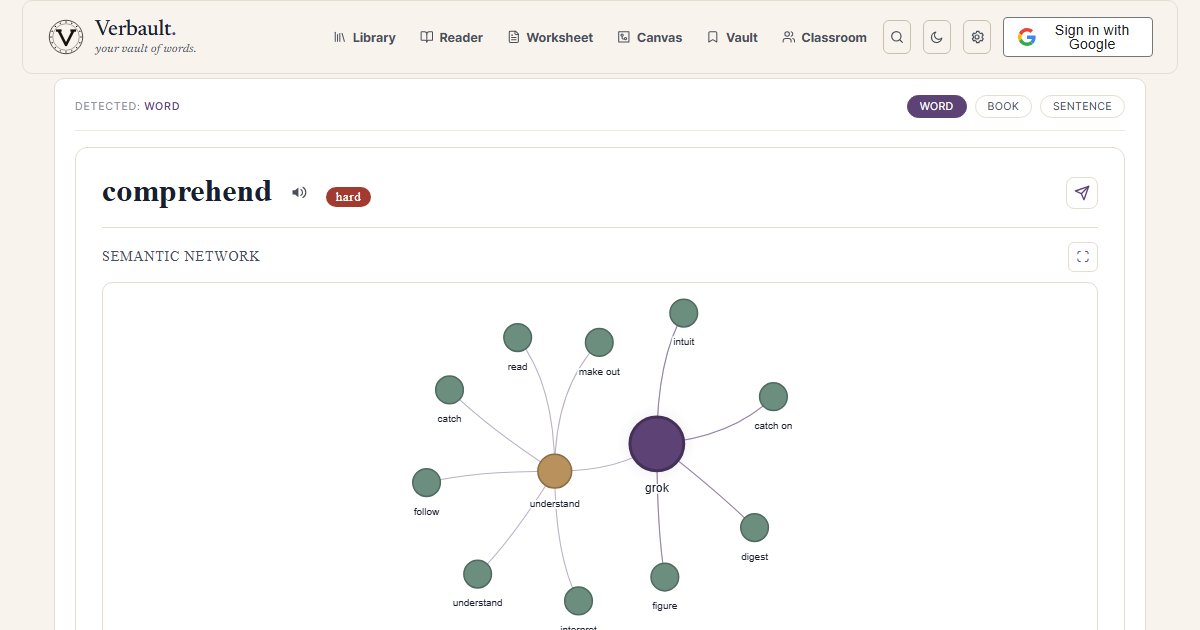
Somewhere you have probably seen the figure: to read an English novel comfortably you need to know around nine thousand words. It is the kind of number that makes a reader quietly give up. Nine thousand sounds like a wall, and it sits there discouraging exactly the people who would most benefit from climbing it.
The figure is real, and it comes from good research. But it measures something narrower than it first appears, and once you see what it actually counts, the wall turns out to be far lower — and you turn out to be far higher up it — than the number lets on.
What actually decides whether you can read a book
The useful question is not how many words you know in total. It is what fraction of the words on the page in front of you you already know. Linguists call that figure coverage, and it is the number that decides whether a book is readable.
Coverage is easy to picture. If you know 98% of the running words in a chapter, one word in every fifty is new to you — roughly one unknown word every two or three sentences. You can read straight through, lean on the surrounding sentence to guess at the strangers, and never lose the thread. If you know 95%, one word in twenty is new — closer to one in every sentence — and the reading turns into work: you can follow the plot, but the prose stops carrying you and starts tripping you.
Paul Nation and his colleagues put numbers on this. In a much-cited study, Hu and Nation found that readers needed to know about 98% of the words in a text to comprehend it comfortably on their own, without a dictionary or a teacher. At 95%, most readers in the study did not reach adequate comprehension; the missing three percent was enough to break it. Ninety-eight percent, not a hundred, is the line that matters — you do not need every word, but you need very nearly all of them.
So what is 98%, in words?
This is where the famous figures come from. Nation went on to estimate how large a vocabulary you would need to hit each coverage level in ordinary texts. For a novel, reaching 98% coverage takes somewhere around 8,000 to 9,000 word families — the source of that intimidating nine-thousand. Dropping the target to 95%, readable but effortful, costs far less: about 3,000 to 4,000 word families. And the most common 2,000 word families alone already cover roughly 80% of an average English page.
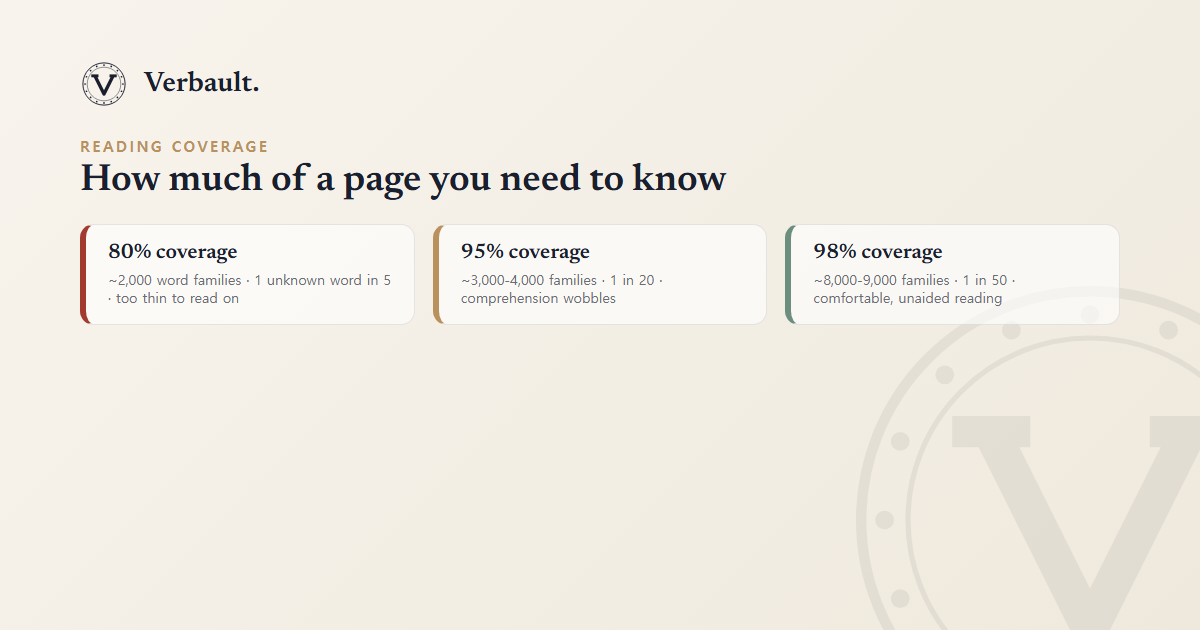
Notice the shape of that. The first two thousand words do most of the work; everything after them is the long, slow climb from 80% up to 98%, buying a percent of coverage at a time. The rare words are rare precisely because each one turns up seldom — which is also why letting an unfamiliar one go usually costs you nothing.
Why the number flatters you: word families
There is a second mercy hidden in the phrase word family, and it works in your favour. A word family is not one word. It is a base word together with its inflections and its obvious relatives: develop brings develops, developing, developed, development, developments, and undeveloped — one family, several words you would recognise on sight. You learned the family once; the rest came nearly free.
So a vocabulary of nine thousand word families is not nine thousand words. It is nine thousand bases, each trailing a handful of forms you already handle without thinking — tens of thousands of individual words in practice. When you read that a novel needs nine thousand families, the honest translation is: nine thousand roots, most of which you half-own the moment you know one member. The research counts families rather than words precisely so the total does not flatter you; the quiet effect is that the number of words you can already read is larger than any single count makes it sound.
The catch: "let the words go" has a floor
All of this connects to the advice in an earlier post on reading classic books: when you hit a word you don't know, don't stop — feel its meaning from the sentence around it and read on. That advice is right, and the coverage numbers are exactly why it works. Guessing from context only succeeds when the context is almost entirely words you already know. At 98% coverage each unknown word sits in a clear frame of familiar ones, and the frame tells you what the stranger means. The book teaches you the word for free.
But the same numbers show where the advice stops working. Drop below about 95% coverage and the frame itself fills with holes. Now the unknown word is surrounded by other unknown words, context can no longer carry you, and "read on and guess" quietly becomes "understand less and less." Guessing has a floor, and the floor is roughly that same 95-to-98% line.
This is the practical upshot, and it is more freeing than the nine-thousand figure first sounds. You do not need a huge vocabulary to read a given book well. You need a book pitched at the vocabulary you already have — one where your coverage is already up near 98% — and then the reading itself does the teaching, carrying you a few new words at a time toward the next book up. Pick a book far above your level and no amount of perseverance will rescue it; the move is not to grind but to step down to something you can read at 98% and climb from there. The skill is less about knowing more words than about matching the book to the words you have.
Finding your level in Verbault
You cannot run a coverage calculation in your head while you read, but you can get a fast, honest estimate of whether a book fits you, and the Reader is built to give you exactly that.
Every word in the Reader is marked by how common it is, on the same frequency principle the research uses. There are three levels: easy (the most common 500 words), medium (the next band, up to roughly the 2,000 mark), and hard (everything rarer than that). The easy and medium words are, near enough, the common core that already covers most of any English page; the hard words are the long rare tail — the very words that carry coverage from 80% toward 98%, and the ones actually worth keeping. The reading-levels guide explains how the bands are set.
That turns "is this book at my level?" into something you can simply see.
- Open the book in the Reader. Pick a title — Frankenstein, say — and start reading. Each word is quietly underlined or highlighted by level, so the page itself shows you its difficulty.
- Glance at how much is marked hard. If only the occasional word carries the hard mark, your coverage is high and the book will read smoothly: let those few words go, or tap to check them. If the page is crowded with hard marks, your coverage is low — the signal to step down to an easier book rather than push through this one.
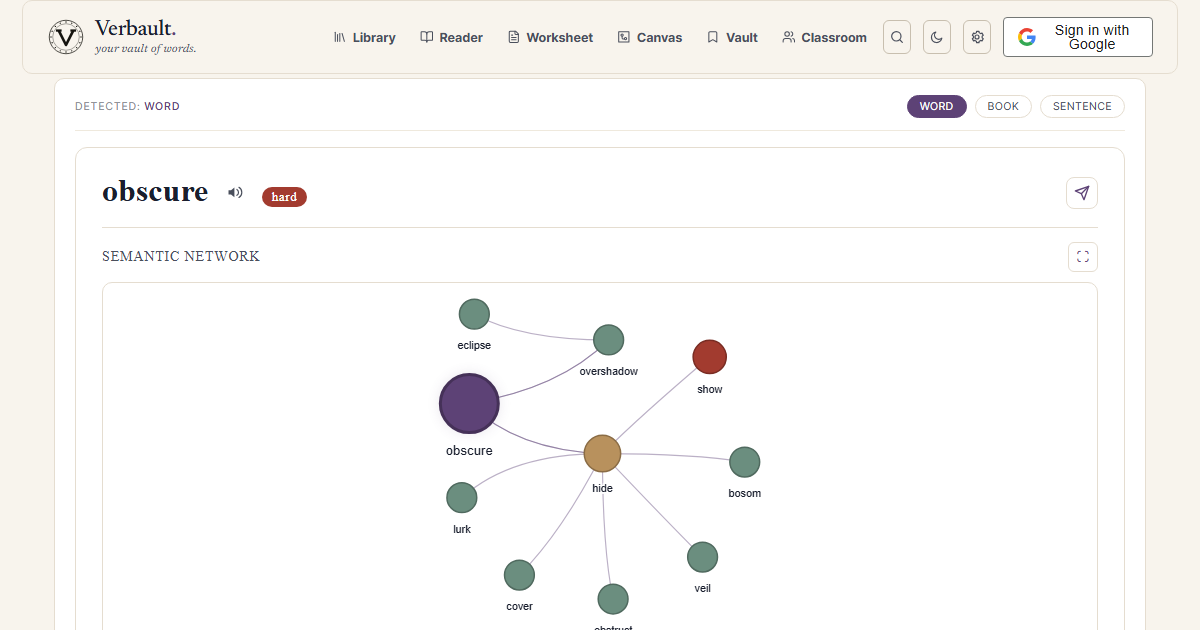
- Tap any word to confirm it. Tapping opens its meaning, how rare it is, and a button to hear it spoken, without taking you off the page. The word obscure, for instance, is marked hard and sits in a web of nearer words — hide, veil, cover, obstruct — that show you its neighbourhood at a glance.
- Keep the rare ones, not the common ones. A hard, genuinely uncommon word is usually worth saving to your Vault; a common word you only half-know rarely repays the effort. The level marks do that sorting for you.
None of this asks you to memorise nine thousand of anything. The number that governs whether you can read a book is coverage, not the size of your vocabulary in the abstract — and coverage is something you can read straight off the page. Find a book you already cover at around 98%, let the rare strangers go or keep the good ones, and read on. The vocabulary grows as a by-product. That is how everyone who reads a lot got the words they have, and it is a far shorter wall than nine thousand makes it look.
Comments (0)
Log in to comment.