Is Pride and Prejudice Hard to Read? It's the Sentences, Not the Words
The words aren't the problem
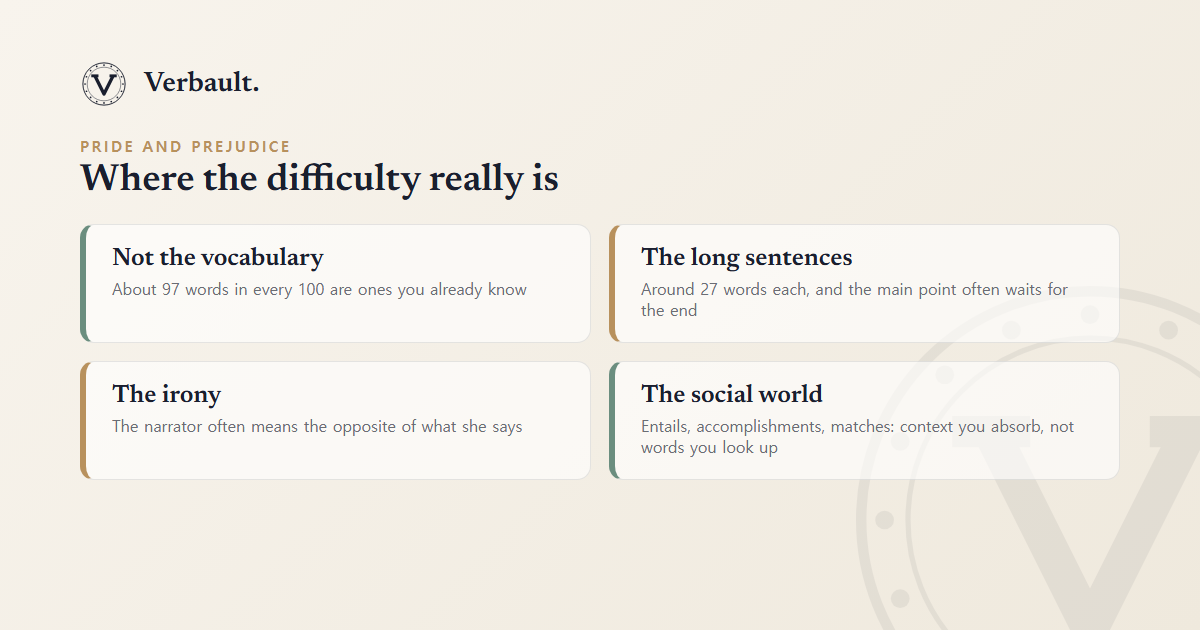
Pride and Prejudice gets shelved with the difficult classics — two centuries old, full of drawing-room manners, with sentences that seem to coil back on themselves. Yet by the one thing people usually mean when they call a book "hard" — its vocabulary — it isn't difficult at all. Verbault's reading analysis puts Austen's word stock squarely in the common middle, the same band it gives Dracula. On a typical page you already recognise about 97 words in every 100; the rare ones are a scattering, not a thicket.
So the reputation comes from somewhere else, and it does. What slows readers down in Pride and Prejudice is not the words but the shape of the sentences they sit in — and the fact that the narrator so often means the opposite of what she says.
The comparison with Dracula makes the point sharply. The two novels have almost the same vocabulary by these numbers — the same middle band, the same 97% you'll know on sight. But Austen's sentences run about a quarter longer on average, roughly 27 words to Stoker's 23, and the book's overall reading-grade score climbs to about eleventh grade against Dracula's eighth. Same words; longer, busier sentences. A book like Moby-Dick is hard in the opposite place — there the rare words really do pile up, and coverage falls to around 92% — even though its sentences run about as long as Austen's. Two famous books, difficult at opposite ends.
One honest note about that reading-grade score: it's an automatic estimate, and the formula behind it counts word length as well as sentence length. Austen's common words are often long ones — neighbourhood, acknowledged, consideration — so a page can feel dense even when nothing on it is a word you'd need to look up. The density is real; the rarity isn't.
Sentences that make you wait
The very first paragraph shows you what you're in for.
"It is a truth universally acknowledged, that a single man in possession of a good fortune must be in want of a wife."
That one is short and famous. The sentence right after it is neither:
"However little known the feelings or views of such a man may be on his first entering a neighbourhood, this truth is so well fixed in the minds of the surrounding families, that he is considered as the rightful property of some one or other of their daughters."
Forty-eight words, and the main statement — this truth is so well fixed — doesn't arrive until you're halfway through. Austen builds her sentences the long way round: she opens with a concession (However little known…), keeps the point in reserve, and lands it only after the qualifications are in place. You have to hold the beginning in mind until the end catches up to it.
This is the real work the novel asks of you, and it isn't vocabulary work. It's keeping hold of a thread. Lose the subject halfway down a sentence and the meaning slips; carry it to the end and the sentence clicks shut like a clasp. It's the same skill we wrote about in how to read a long sentence — find the main clause first, then fit the rest around it.
When the narrator means the opposite
Here's the other thing a vocabulary score can't see: irony. Look again at that famous first line. Read straight, it states a law of nature — wealthy single men are in search of wives. But Austen means the reverse. It's the families with daughters to marry off who have settled the matter, and the joke is that they've dressed their own want up as the man's. Every word is plain. The difficulty is the tone, and tone is the one thing you can't look up.
The whole novel runs on this. Listen to Mr. and Mrs. Bennet, long married:
"You have no compassion on my poor nerves."
"You mistake me, my dear. I have a high respect for your nerves. They are my old friends. I have heard you mention them with consideration these twenty years at least."
Nothing there is hard to decode word by word. What you have to hear is that he's teasing her and she can't tell — a whole marriage drawn in four dry sentences. Miss this register and the book flattens into a string of polite remarks; catch it and it turns out to be one of the funniest novels in English. The difficulty and the pleasure are the same thing.
A world with its own rules
A smaller obstacle is simply the world the book takes for granted. Estates are entailed away from daughters; a young woman's accomplishments are a kind of currency; an unmarried sister is a problem the family has to solve. None of it is explained, because Austen's first readers needed no explanation. You can look up entail — and it's worth doing, once — but most of this you absorb by reading on, the way you pick up the rules of any unfamiliar house. It's context rather than vocabulary, and context fills in faster than you'd expect.
The handful of words worth a tap
In fairness, a thin seam of genuinely uncommon words does run through the book. Verbault flags the ones that stand out from the common run — reprehensible, ungenerous, condole, minuteness — words rare enough to deserve a moment's pause. But they're a garnish: a handful across the whole novel, each easy to settle on its own. Knowing which words actually repay a stop is a small skill in itself, and we set out a rule of thumb for it in when to look up a word.
Reading it well
Put all this together and a way of reading Pride and Prejudice suggests itself.
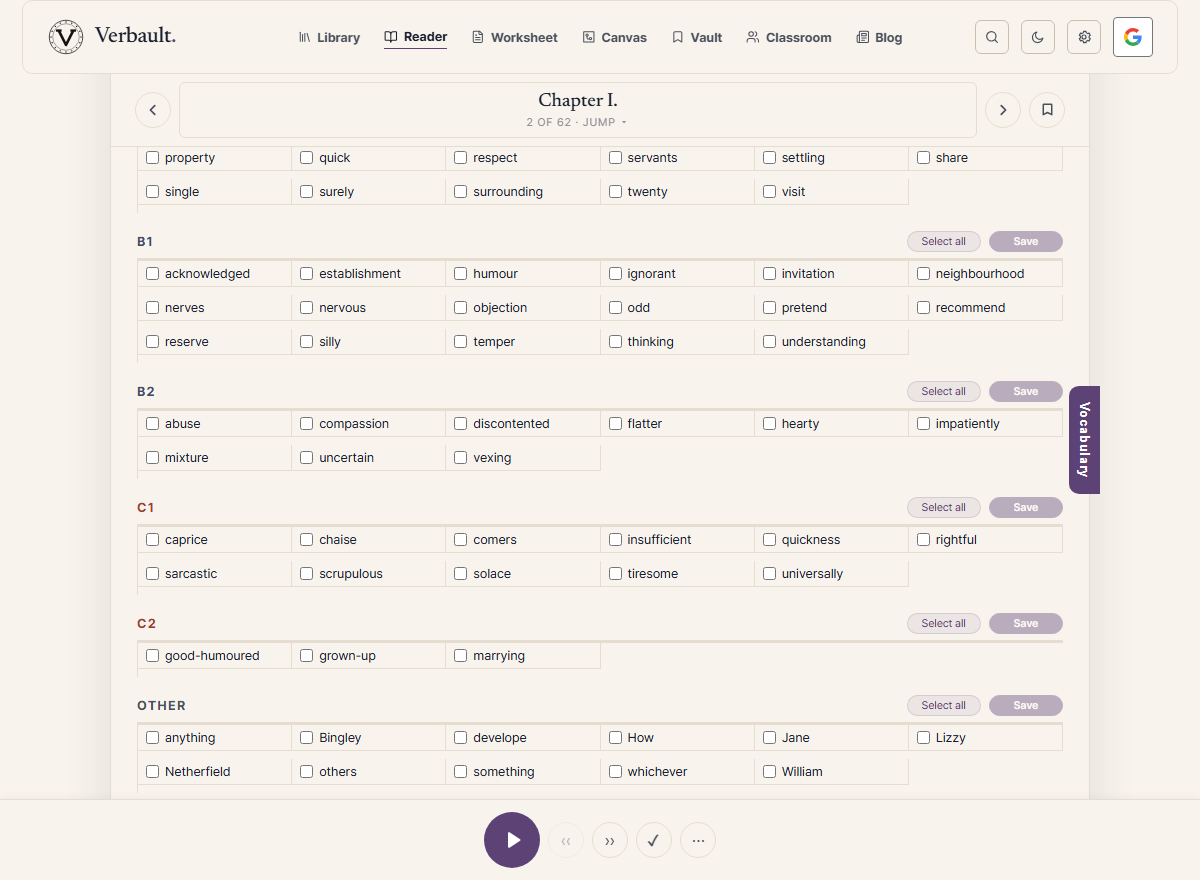
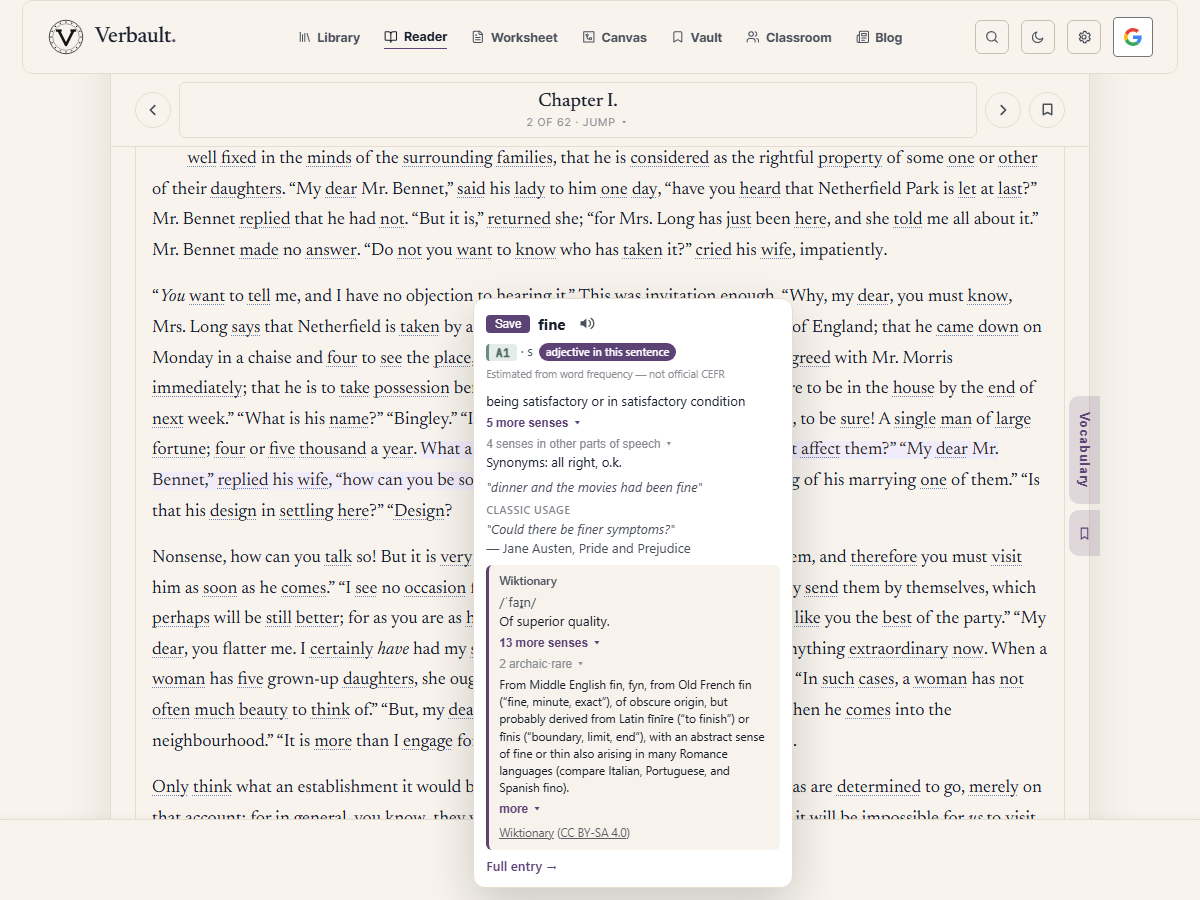
- Read it in the Reader. Open Pride and Prejudice and the whole text loads with every word tappable. Tap one and a small card gives you its reading level, the meaning that fits this sentence, and a button to hear the word spoken — so a rare word costs you a tap instead of a trip to a separate dictionary.
- Find the main clause first. In a long sentence, locate the core statement — who does what — and treat everything else as detail hung around it. Austen's grammar always resolves; you only have to wait for it.
- Read for the tone. Every so often, ask whether the narrator means a line straight. Reading it aloud helps — her irony is far easier to hear than to see.
- Let the manners settle. Don't stop for every custom. Look up the one term that's truly load-bearing and let the rest come clear from the scene around it.
The difficulty is the wit
Pride and Prejudice isn't hard the way a dense, word-thick book is hard; almost every word in it is one you already know. What it asks instead is patience with a long sentence and an ear for a dry one — and those two demands are exactly where the novel's wit lives. The sentence that makes you wait is the one that saves its joke for the end; the line you might read straight is the one Austen wrote with a raised eyebrow. Read for those, and the difficulty stops feeling like a barrier. It starts to feel like the point.
Comments (0)
Log in to comment.