How to Read a Long Sentence Without Losing the Thread
Here is how the opening of A Tale of Two Cities behaves. It begins "It was the best of times," which everyone knows, and then it keeps going: through the worst of times, the age of wisdom, the age of foolishness, the epoch of belief, the epoch of incredulity, on for a hundred words before it stops. You know every word in it. That was never the difficulty. The difficulty is holding the whole thing in your head long enough to reach the end with the beginning still intact.
This is the part of reading that vocabulary lists never touch. A sentence can be built entirely from words you know and still defeat you, because the challenge is not the words but the way they are stacked, nested, and held in suspension. Long sentences are a skill of their own, and like any skill they come apart once you know where to push.
Why the sentences got so long
Nineteenth-century prose runs long on purpose. Writers of the period inherited a tradition, going back through the eighteenth century to Latin rhetoric, in which a well-made sentence gathered several thoughts into one structure and released them together at the end. Length was a mark of skill, not a failure of editing. A semicolon let a writer set two full statements side by side without fully stopping; a dash opened a sudden aside; a run of parallel clauses built rhythm and weight. Dickens opens A Tale of Two Cities with more than a hundred words precisely because the pile-up is the point: the age was every extreme at once, and the sentence has to hold all of it.
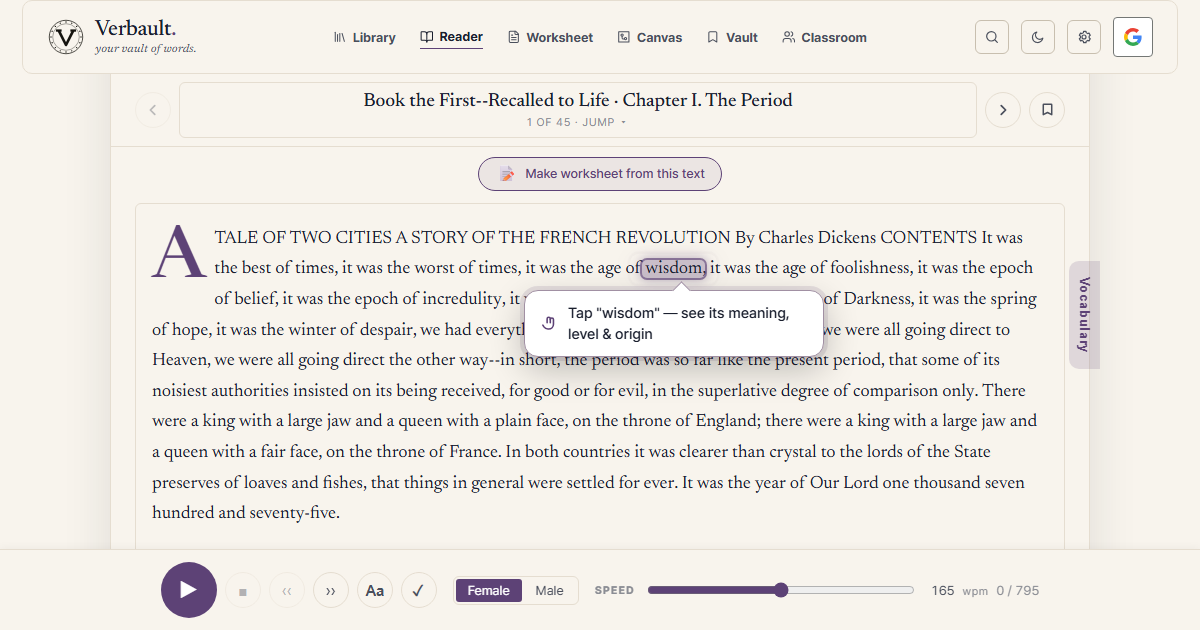
Seen whole in the Reader, the opening is one block on the page. Knowing that the length is deliberate, and that the words themselves are easy, already changes how it feels. The task is not to decode it but to find its frame.
What a long sentence is actually made of
Under all the length, almost every sentence has a spine: one subject and one main verb, the single statement that everything else is attached to. It was the best of times is the spine of Dickens's opening; the hundred words that follow are variations hung on that small frame. Strip a long sentence back to its subject and verb and it usually turns out to be saying something fairly simple, wearing a great deal of clothing.
The clothing comes in a few familiar forms:
- Subordinate clauses — the parts that begin with who, which, that, when, or because — which add detail about something already named.
- Asides set off by commas, dashes, or parentheses, which you could lift out without breaking the sentence.
- Lists and parallel phrases, stacked for rhythm, all doing the same grammatical job.
None of these change the spine. They lean on it.
Four moves for a sentence that won't end
When a sentence runs away from you, do not just reread it faster. Take it apart in four moves.
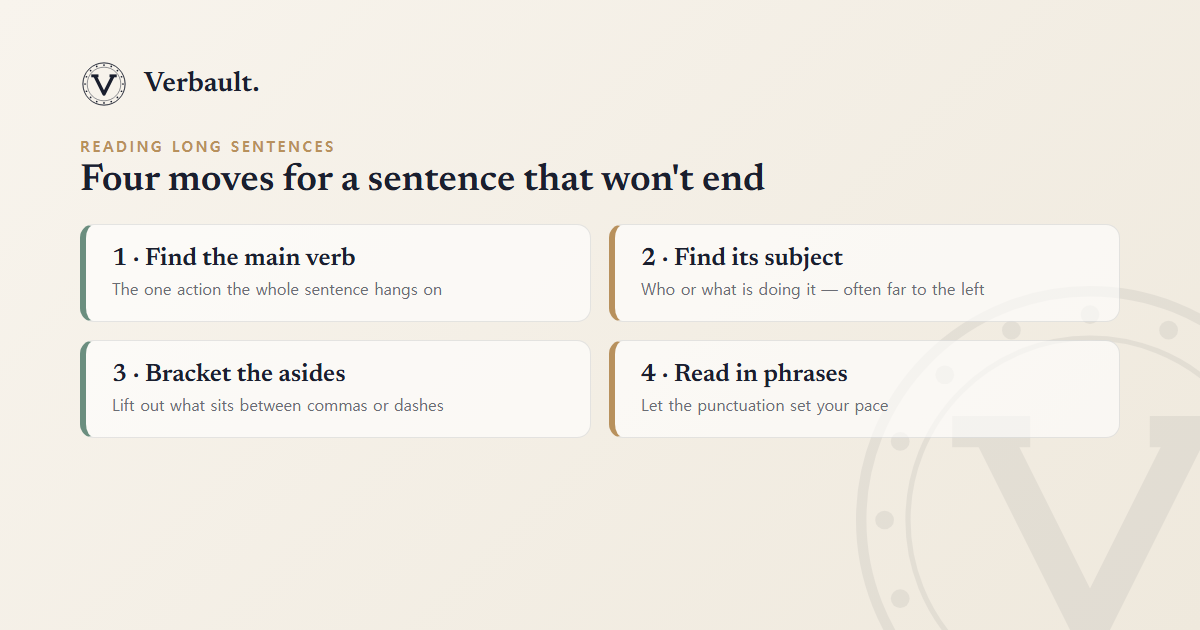
- Find the main verb. Look for the one action or state the whole sentence is built around. In a long sentence it is often smaller, and further in, than you expect.
- Find its subject. Ask who or what is doing that verb. The answer may sit far to the left, with clauses heaped up between the two.
- Bracket the asides. Anything between a pair of commas, dashes, or parentheses can usually be lifted out on a first pass. Read the sentence once without it, get the spine, then put it back.
- Read in phrases, not words. Let the punctuation pace you. A comma or semicolon is the writer telling you where one unit ends and the next begins, so read to the mark, pause, then take the next.
The order matters less than the habit. When the length overwhelms you, hunt for the verb first and the rest of the sentence arranges itself around it.
How Verbault helps you slow a sentence down
The moves above are something you do in your head, but a few things in the Reader make them easier, especially the parts your ear can do better than your eye.
Hear one sentence at a time
A long sentence read aloud half-parses itself, because a good reading voice pauses where the clauses break. Verbault's Reader reads sentence by sentence and highlights the one it is speaking:
- Open any book, such as A Tale of Two Cities or Pride and Prejudice.
- Press the speaker control in the player bar at the bottom of the Reader.
- Follow the highlighted sentence as the voice moves through it, listening for where it pauses and lifts.
Hearing where a sentence breathes is often enough to show you where its clauses divide. The text-to-speech post covers the voices and controls in full.
Hold a sentence still for a second look
Some sentences deserve a second pass later, when you are not mid-paragraph. Tap a sentence in the Reader to select it, then tap the bookmark that appears at its edge, and the whole sentence is saved to your vault with the book it came from. You can return to the ones that gave you trouble and reread them cold. The bookmarks guide walks through it.
Spend your effort on the shape, not the words
A long sentence is twice as hard when it also hides unfamiliar words, because then you are parsing the structure and decoding vocabulary at the same time. It helps to pick a text where the words are mostly known, so the only real challenge left is the shape. Verbault marks every word by how common it is, which lets you choose a book whose vocabulary sits inside your range and give the sentences your full attention — see reading levels and the dictionary. And if a word does stop you mid-sentence, tap it for its meaning in context and you are back to parsing in a second, without losing your place.
The short version
- Long classic sentences are deliberate, built to hold several thoughts at once, not mistakes to be untangled.
- Every one has a spine: a single subject and main verb. Find them first.
- Bracket the asides and read in phrases, letting the punctuation set your pace.
- Let your ear help. Hearing a sentence read aloud shows you where it divides.
Open A Tale of Two Cities, or a chapter of Pride and Prejudice, and find one sentence that runs longer than you are comfortable with. Find its verb, then its subject, set the asides aside, and read it again in phrases. It will not feel half so long the second time. For why some books pile difficulty on difficulty, see why Moby-Dick is so hard to read; for the broader habit of reading at the right level, see how to get better at reading English.
Comments (0)
Log in to comment.