When to Look Up a Word — and When to Keep Reading
The two ways reading goes wrong
There are two reliable ways to make reading a book in a foreign language miserable, and they are opposites.
The first is to look up every word you don't know. Each lookup is small, but they add up. You stop, switch to a dictionary, find the entry, come back, and by then the sentence has gone cold. A page takes an hour and you remember almost none of it, because the hour went on managing interruptions instead of reading.
The second is to look up nothing. You push on, page after page, and the unknown words quietly pile up until you are turning pages without taking anything in. You finished the chapter, but you could not say what happened in it.
The skill that sits between these is not the size of your vocabulary. It is deciding, word by word, which ones are worth stopping for.
Most words don't need looking up
You understand a sentence mostly from the words you already know. An unknown word usually arrives surrounded by familiar ones, and that frame often tells you enough — the rough meaning, the general direction — to keep going without a definition. Studies of reading comprehension suggest this works comfortably once you know about 98% of the words on a page; below that, the frame starts filling with holes. (The numbers behind that, and how large a vocabulary it takes, are their own subject — see How Many Words Do You Actually Need to Read a Novel?.)
So the useful question at an unknown word is not "do I know this?" It is: does the sentence still hold up without it?
The one question to ask
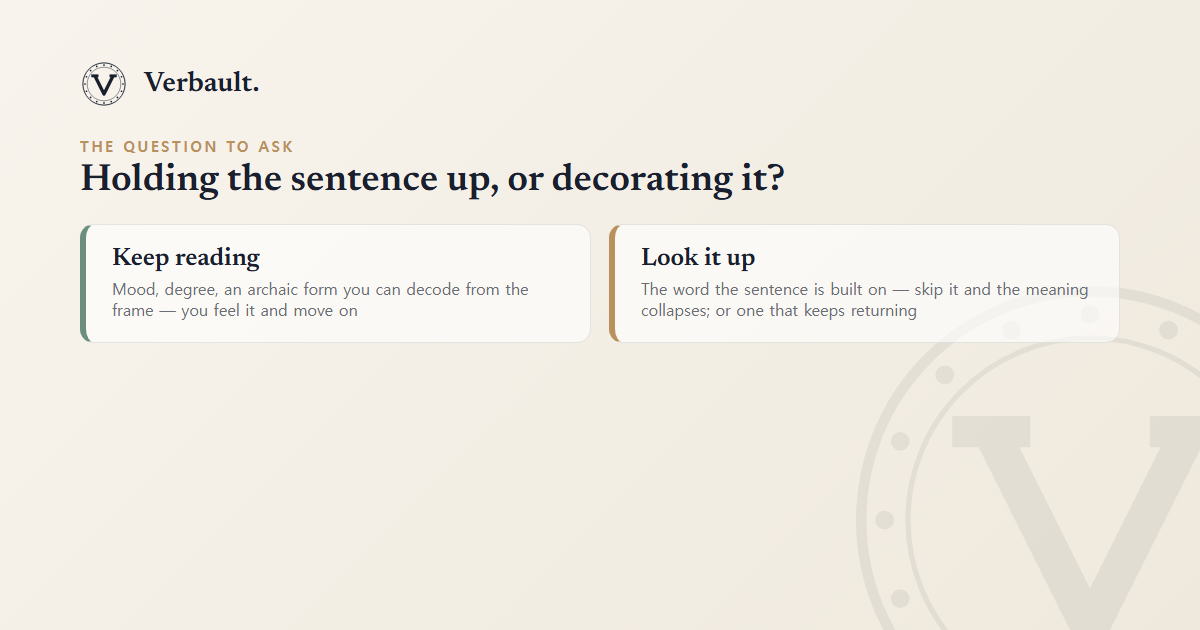
When you hit a word you don't know, decide whether it is holding the sentence up or decorating it.
A decorating word adds colour, mood, or degree. It is usually an adjective or an adverb, and you can feel its drift from the rest of the sentence. Skip it and the meaning survives.
A load-bearing word is the one the sentence is actually about: the thing happening, the person or object being described, the turn the sentence takes. Skip it and the meaning falls in. That is the word worth a look.
Two tie-breakers settle the close cases. Look a word up if it keeps coming back, since you will meet it again and paying once is cheap, or if the context gives you nothing to guess from, which usually means your coverage has dropped and guessing is no longer safe.
A line from Frankenstein
Take one famous, vocabulary-heavy sentence from Frankenstein:
It was on a dreary night of November that I beheld the accomplishment of my toils.
Three words here might stop a learner, and the right move is different for each.
- dreary is decorating. It is a gloomy November night, and you can feel that mood without a definition. Keep reading.
- beheld is old-fashioned, but the frame carries it: I beheld the accomplishment can only mean I saw it. Keep reading.
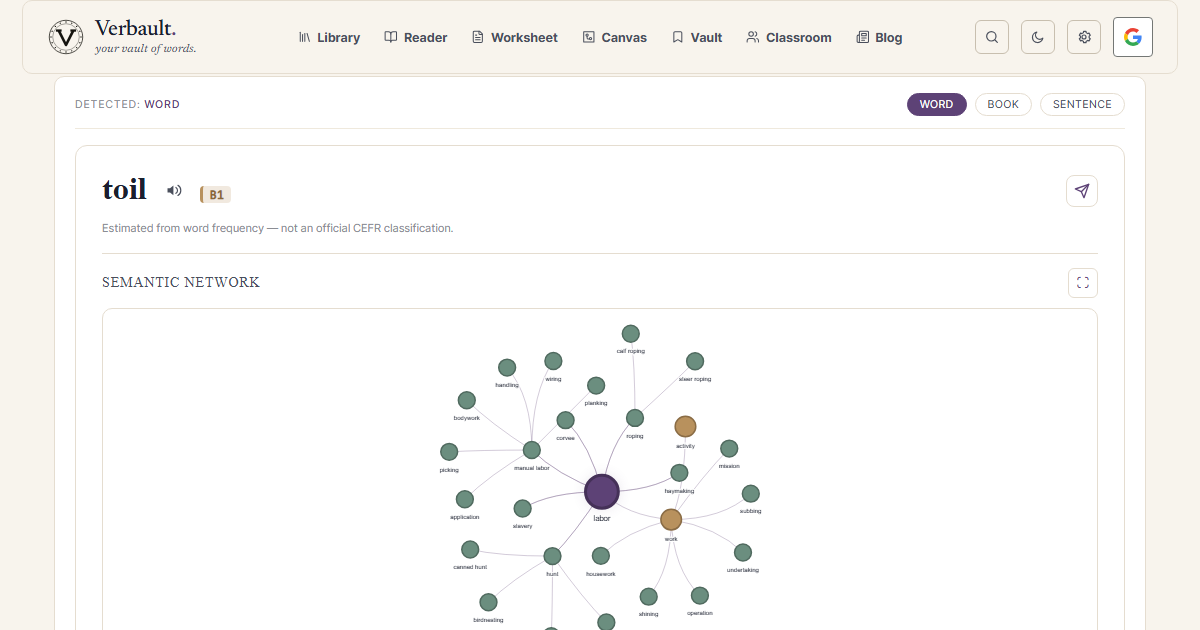
- toils is holding the sentence up. The whole line is about what the narrator has finally completed — his toils, his long labour. Miss this word and you miss what the dreary night is for. This is the one to check.
One celebrated sentence: two words you read straight past, and one worth a single glance.
How Verbault makes the glance cheap
The decision is only easy when looking a word up costs about a second and does not throw you out of the page. The Reader is built so that the glance is nearly free.
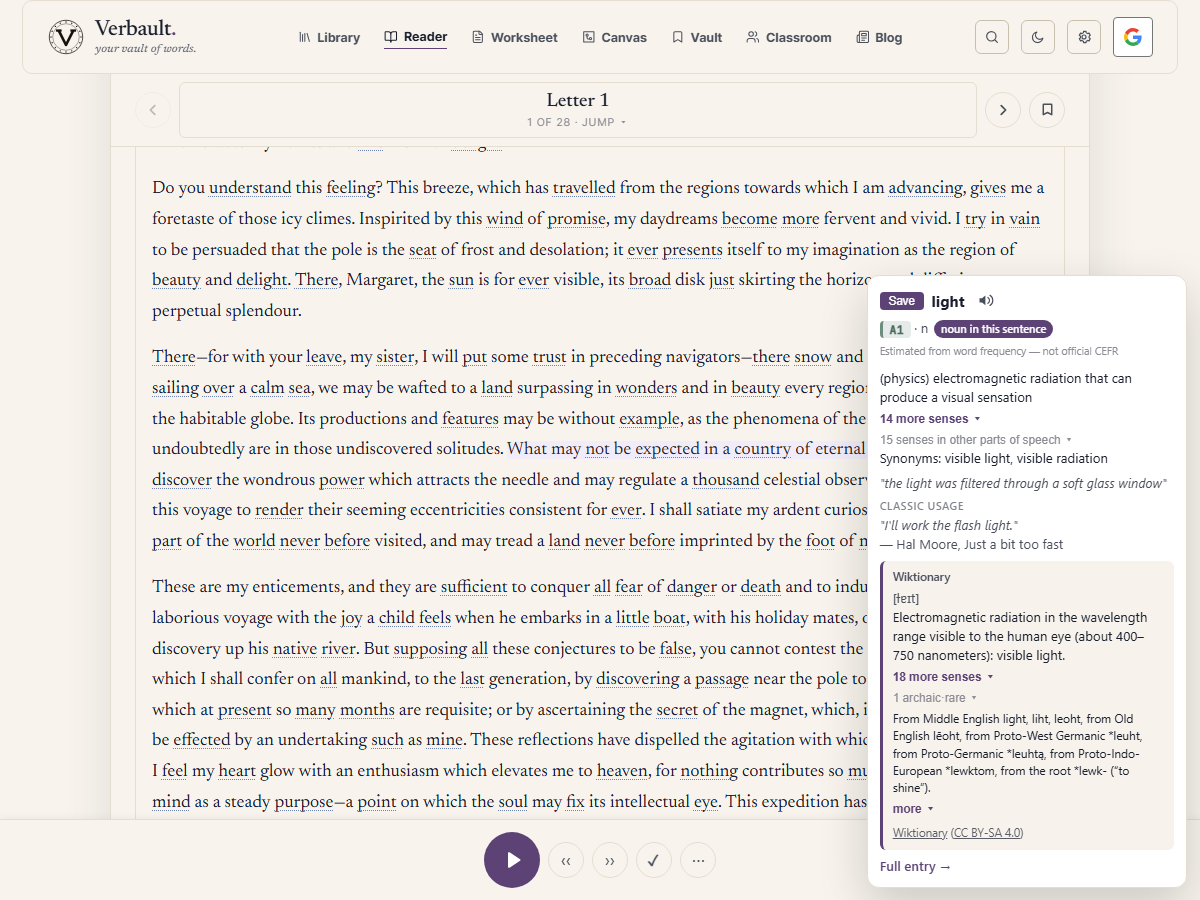
- See which words are above your level. Verbault marks each word with its reading level, so the genuinely hard words stand out from the ones that merely look unfamiliar. You can spend attention where it pays, instead of stopping at every long word.
- Tap to define, without leaving the line. Tap a word and a small card appears with its reading level, the meaning that fits this sentence, and a button to hear it read aloud. Your place is kept and the story does not stop, so checking a load-bearing word is no longer a detour.
- Save the ones worth keeping. If a load-bearing word keeps returning, tap save and it goes to a vocabulary list you can review later. You look it up once and own it, rather than looking it up again every chapter.
That last step matters more than it looks. Most of the friction in a hard book is not the first lookup; it is the fifth lookup of the same word, chapters apart, each time half-remembering it. Choosing the sense that fits the sentence is a related skill worth its own habit — see One Word, Several Meanings.
The habit
Don't set out to understand every word. Set out to keep moving while catching the words that carry the meaning, and to keep the few worth keeping. That is a smaller, calmer task than "know everything," and over a whole book it is the difference between finishing and stalling. For the wider version of this question — how to get better at reading without simply reading more — there is a separate article.
Comments (0)
Log in to comment.