Word Order Is English Grammar: How Position Decides Meaning
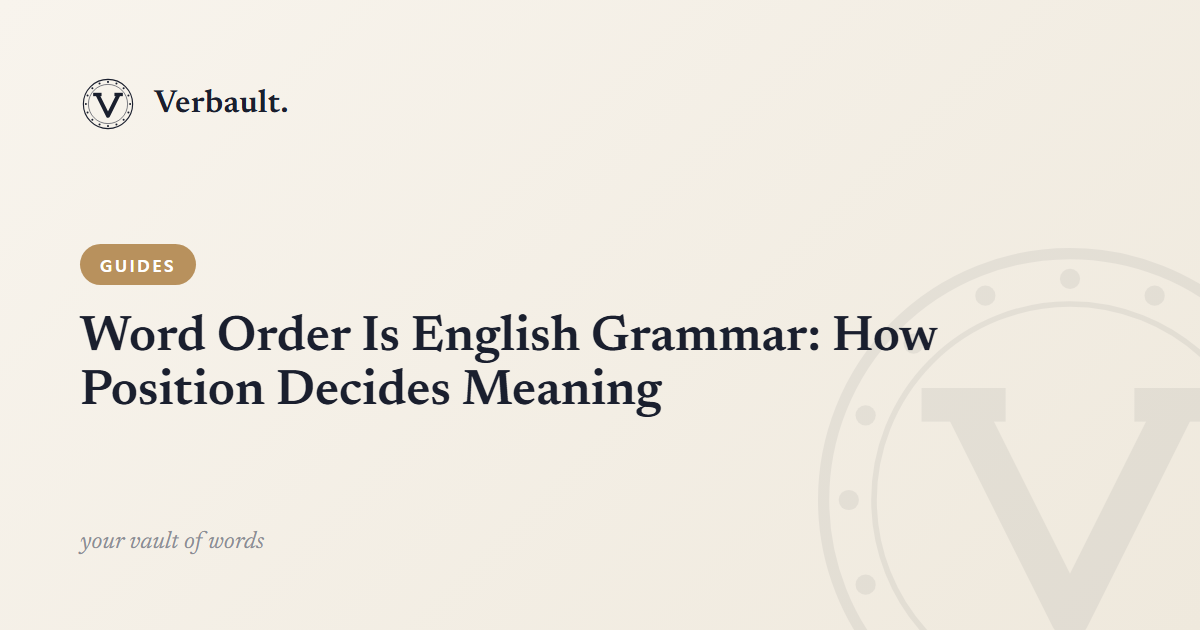
"The dog bit the man" tells a sad little story. "The man bit the dog" tells a stranger one. Same five words, same punctuation; all that changed was the order, and with it, who did the biting. Nothing on the words themselves marked the dog as the victim in the first sentence or the culprit in the second. The order did that, silently, and you understood it without a moment's thought.
That is the quiet engine of English grammar. In English, where a word sits is most of what tells you what it is doing.
English travels light
Many languages tag each word with its job. In Latin, the ending on a noun announces whether it is the subject or the object, so the words can be shuffled for emphasis and the meaning holds: the endings carry the grammar, and order is free to be stylish. Plenty of modern languages work the same way, marking the subject and object with endings or small particles.
English used to do more of this, and has spent a thousand years shedding it. Old English had a full set of endings; modern English has kept only a few — the plural -s, the past-tense -ed, the possessive 's. With the endings mostly gone, something else had to show who did what to whom, and that job fell to word order. English is a positional language: it grew strict about order as it stopped marking its words.
This is why word order can feel so unforgiving to anyone whose first language lets it float. It is not fussiness. In English the order is not decoration laid over the grammar. It is the grammar.
The frame underneath: subject, verb, object
Most English sentences are built on one frame, and you already know it by feel: subject, then verb, then object. The subject is who or what the sentence is about; the verb is the action or state; the object is what the action lands on. The dog (subject) bit (verb) the man (object). Swap the subject and the object and you have not broken the rule — you have used it, to say something else.
Everything else clips onto that spine. Adjectives sit in front of the nouns they describe; adverbs report how or when or where; prepositional phrases such as in the garden or after lunch add the setting. Strip a sentence of all of it and the subject-verb-object skeleton is usually still standing.
Even a famously elaborate sentence rests on it. Pride and Prejudice opens: It is a truth universally acknowledged, that a single man in possession of a good fortune, must be in want of a wife. Clear away the flourishes and a plain skeleton stands underneath — a single man must be in want of a wife: a subject (a single man), a verb (must be), and the rest hanging off them. The decoration is Austen's; the order is English's.
You can watch the frame line up, in color
This frame is easiest to believe once you can see it, and Verbault has a tool that makes it visible. Grammar Canvas is a game that hands you a real sentence broken into scattered word blocks and asks you to wire them back into order. The detail that teaches the grammar: every block is coloured by the job it does. The subject is green, the verb blue, the object orange, with their own colours for adjectives, adverbs, and the small joining words. As you rebuild the sentence the colours fall into their usual order — green, then blue, then orange — and the abstract rule turns into something you can point at.
To try it:
- Open Grammar Canvas. A scrambled sentence loads straight away, and you do not need to sign in to start.
- Drag a line from each word to the one that should follow it, until the sentence reads correctly. A right connection turns green; a wrong one shows red, so a mistake is easy to spot and undo.
- Watch the colours as you go. The green word and the blue word want to sit near each other; the orange word tends to follow the blue one. That recurring pattern is the subject-verb-object frame, met by eye instead of learned by rule.
You can point it at a book you are reading, so the lines you rebuild are real ones — try it on Pride and Prejudice. The full Grammar Canvas guide walks through every colour and option.
The same idea, one word at a time
Word order does a second job that is easy to miss: it often decides what a word even is. Light is a noun in the morning light and a verb in light the candle. Object is a thing in one sentence and, with the stress shifted, an act of protest in another. Nothing about the spelling tells you which; its position in the sentence does.
The Verbault Reader leans on exactly this. Tap any word as you read and the popup leads with the meaning that fits this sentence, and tucks the word's readings in other parts of speech a tap below — because it reads the surrounding words to settle which part of speech is in play, the same way you do.
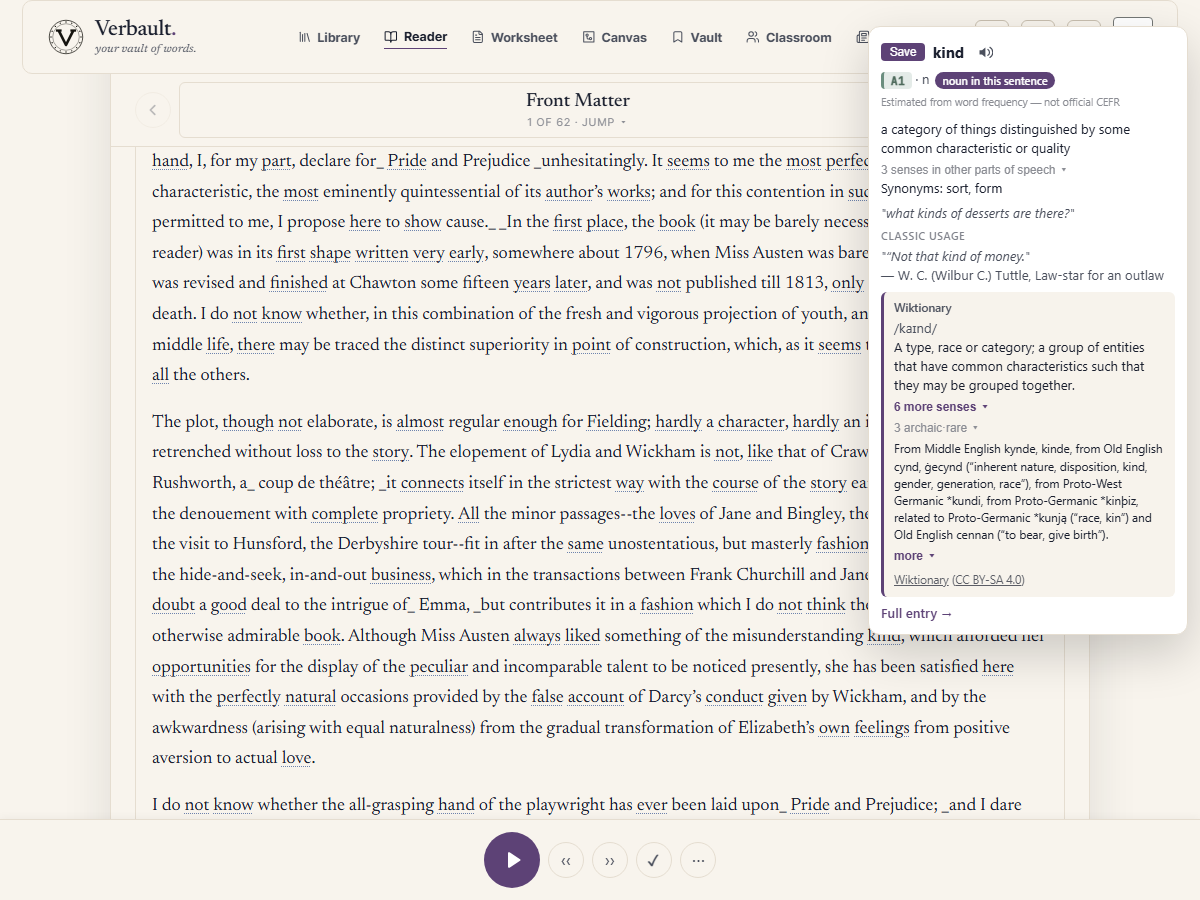
Here is how to use it:
- Open any text in the Reader — a classic such as Frankenstein, or something you paste in.
- Tap a word you want to check. A small card opens over the page without taking you off it.
- Read the card. It leads with the meaning that fits this sentence, and keeps the word's senses in other parts of speech one tap below, so a word like light is read as a noun or a verb according to where it sits.
One honest note: working out a word's part of speech from a single sentence is a judgement, and on a short or unusual line it is sometimes wrong. Verbault is built to fail softly here — when it is unsure it still shows the likely role, and the word's other readings stay one tap away, so a wrong guess only changes the order things appear in, never hides the right one.
How you actually learn this
You do not learn English word order by memorising "subject-verb-object." You learn it the way you learned it in your first language: by meeting the pattern in thousands of real sentences until it runs on its own and a wrong order simply sounds wrong. A rule can label what you are seeing; it cannot install the instinct. Only reading does that.
So the practical advice is short. Read widely, in real sentences rather than drills, and let the frame settle in on its own. When a sentence tangles and you lose the thread, that is the moment to make its structure visible: rebuild a knotty line in Grammar Canvas to see its skeleton in colour, or tap through it in the Reader to name what each word is doing. For the long, winding sentences the classics love, the guide to reading a long sentence is a companion to this one.
Reorder two words and the meaning flips. That is not a quirk of English to be tidied away. It is where the grammar lives.
Comments (0)
Log in to comment.