Cleave, Sanction, Dust: Words That Mean Their Own Opposite
The word that undoes itself
To cleave something is to split it in two — a cleaver is the heavy knife that does the job. To cleave to something is to cling to it and refuse to let go: people cleave to their beliefs, and in the old wedding service two lives cleave together. Same five letters, same sound, opposite meanings. The word is its own antonym.
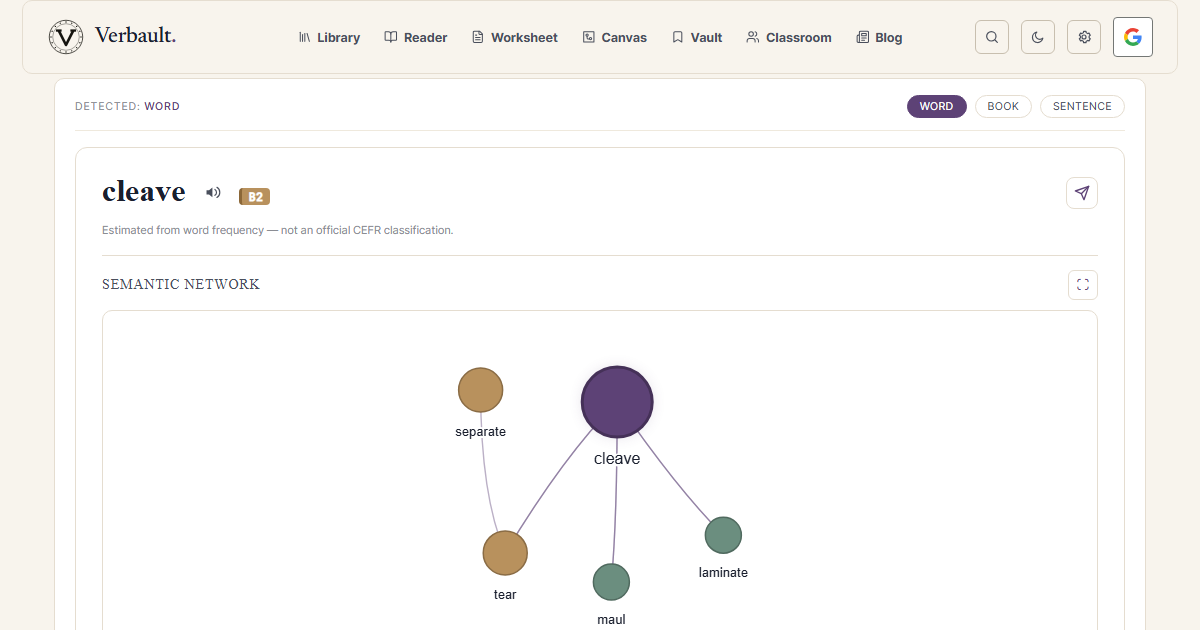
English keeps a small, strange collection of these. The name for them is contronym — sometimes Janus word, after the Roman god who faced two ways at once. Verbault's word page for cleave shows the split without comment: among its meanings sit "separate or cut with a tool" and, a line below, "stick or hold together and resist separation." The dictionary keeps both, because both are true.
How a word ends up against itself
There are two ways a word arrives here, and they are worth telling apart.
The first is a collision. Cleave is really two old words wearing the same coat. One is Old English clēofan, "to split"; the other is clifian, "to stick" — unrelated verbs that, after a thousand years of drift in spelling and sound, ended up identical. English kept them both and let the sentence sort out which was meant. The contradiction here isn't one meaning that turned on itself; it's two meanings that happened to land on the same square.
The second way is the stranger one: a single word that stretches in opposite directions until the ends no longer meet. Sanction comes from Latin sancire, to make something binding. Make a rule binding and the word can lean two ways at once — toward the approval that puts the rule in force, and toward the penalty that enforces it. A government can sanction a treaty, meaning approve it, or impose sanctions on a country, meaning punish it: the same word, working from opposite ends.
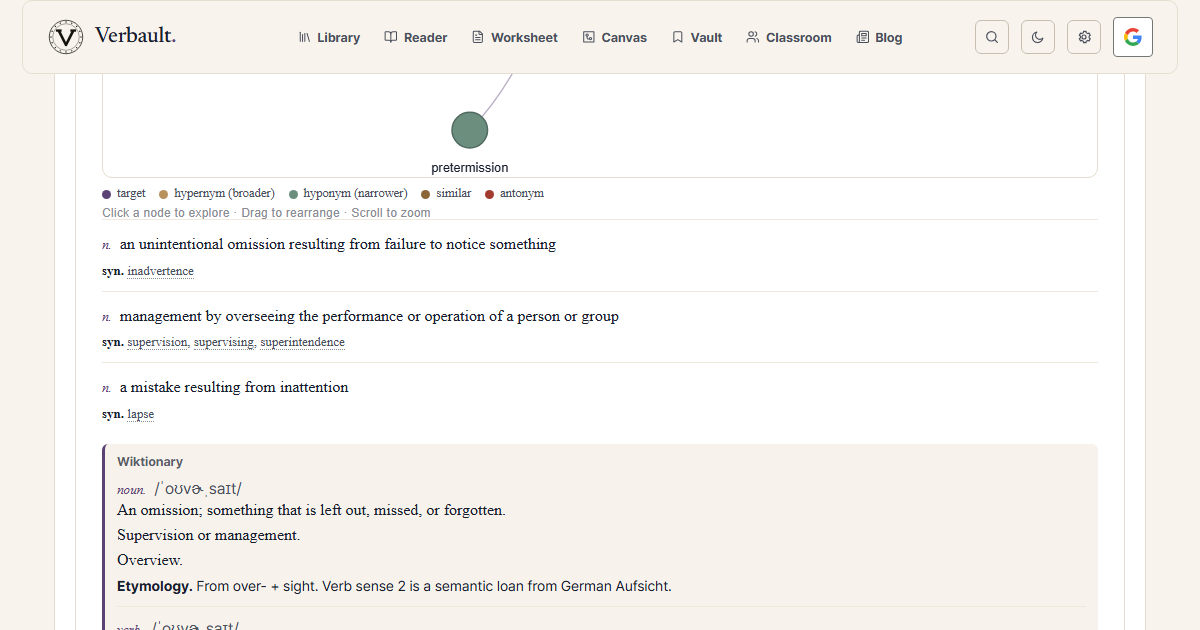
Oversight does the same thing out of plain English. To oversee is to watch over, so oversight is supervision — a committee with oversight of a budget. But to overlook is to miss, so an oversight is also the thing you failed to see — a clerical oversight. Close attention and total inattention, spelled exactly the same.
A short field guide
Once you start noticing them, they turn up everywhere — though not all are equal. A few are dictionary-deep; others are everyday words you have never thought twice about.
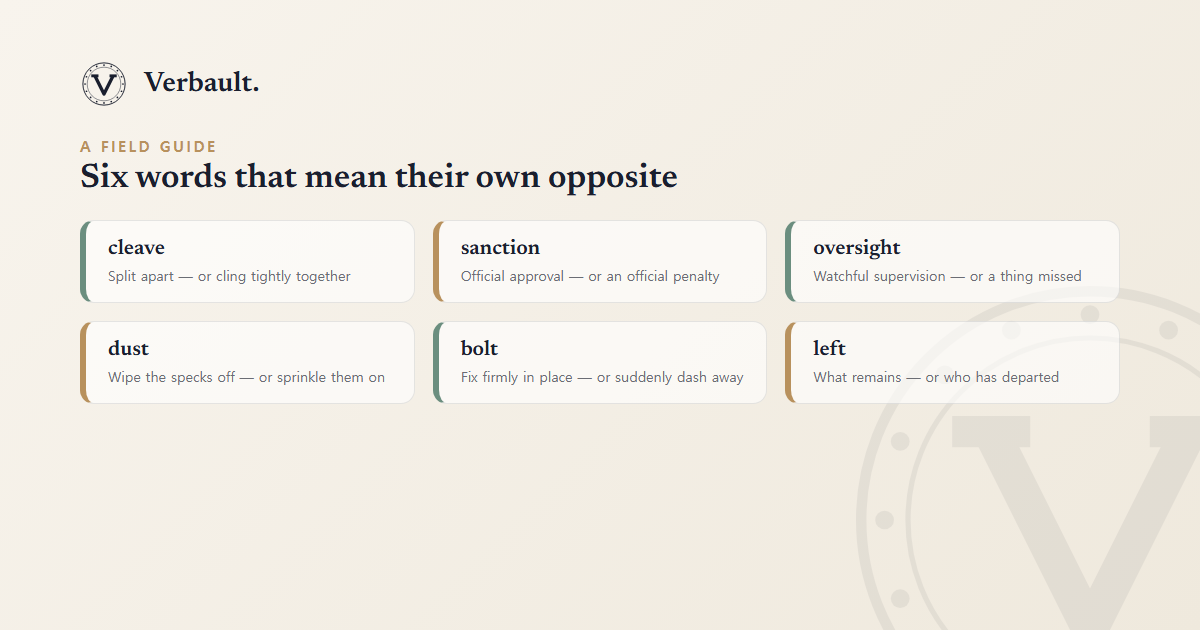
- dust — wipe the specks off a shelf, or sprinkle them on. You dust a cake with sugar, and a crop-duster adds rather than removes.
- bolt — fix something firmly in place (bolt the door) or break suddenly away from it (the horse bolted).
- left — what remains (three cards were left on the table) or who has gone (she left an hour ago). The single verb leave carries both.
- fast — moving quickly, or held so firmly it cannot move at all: a fast train, but also hold fast, stuck fast, fast asleep.
- clip — to fasten together (clip the pages) or to cut off (clip a coupon).
- screen — to show something (screen a film) or to hide it (a screen of trees).
The honest footnote is that these shade off at the edges. Cleave and sanction are contronyms a dictionary will defend; off — the alarm went off, now turn it off — is closer to the ordinary give of a small word than a real contradiction. The category has a firm centre and a soft edge, like most interesting things in a language.
Why they almost never trip you up
Here is the part that ought to be surprising and somehow isn't: these words cause no trouble at all. You have never once stalled over whether a friend who "dusted the cake" added the sugar or wiped it away. The sentence around the word settles it before you would notice there was anything to settle.
That is not luck. It is the same quiet machinery that lets you read any word with several meanings without stopping — you take the sense the sentence is built for and leave the others on the shelf. A contronym is only that machinery pushed to its limit: the rival meanings are not merely different, they are opposite, and context still picks the right one every time. We wrote about the everyday version of this in one word, several meanings.
See it for yourself
You do not need a list to find contronyms; you need the habit of looking up the words that catch your eye.
- Open a word page. Go to cleave and read its meanings straight down. For an ordinary word they would all point roughly the same way; for a contronym, two of them point apart. The reading-level badge and the list of meanings are there for any word, so you can test any candidate you suspect.
- Read with the words live. Open any book in the Reader and tap a word. The card that appears leads with the meaning that fits this sentence and keeps the others a tap below — so even a word that can mean its own opposite reaches you already pointed the right way.
- Keep the ones that delight you. Save a contronym to your vocabulary list when you meet one in the wild. They make unusually sticky words, precisely because the contradiction is hard to forget.
Contronyms look at first like cracks in the language — words that cannot decide what they mean. They are really the reverse: small standing proof of how much work the sentence around a word is always doing, so quietly that you never feel it.
Comments (0)
Log in to comment.