Phrasal Verbs in the Classics: When Knowing Every Word Isn't Enough
A sentence you can read, and still not follow
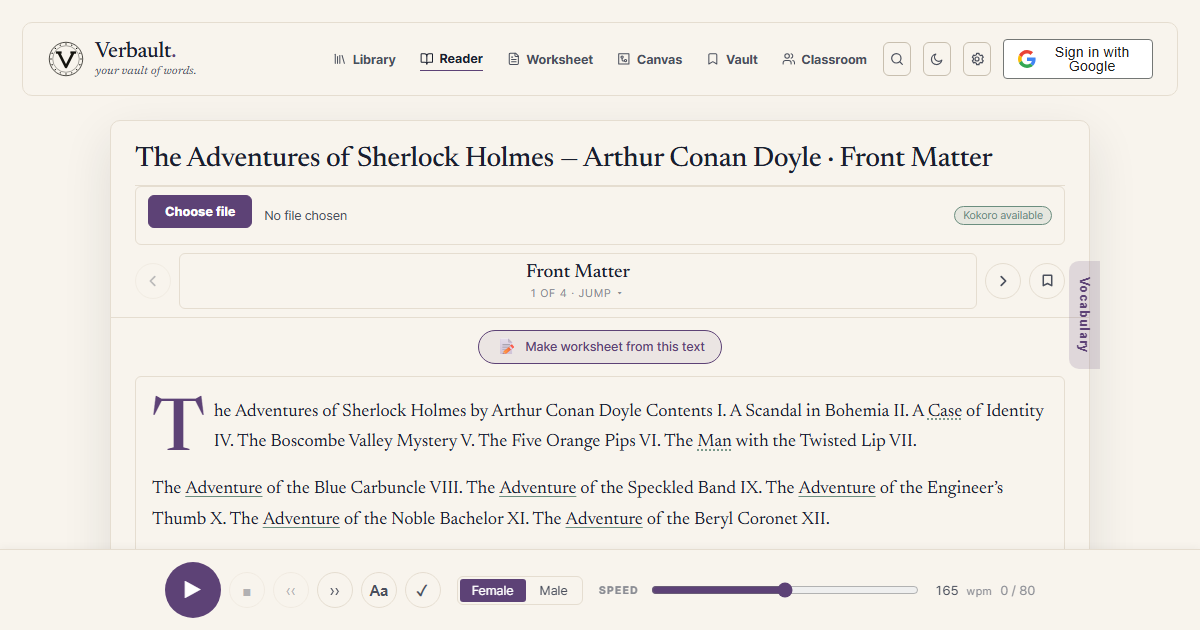
Here is a line that could come from almost any Victorian novel: He held the letter to the candle, but could not make out the hand. Every word in it is common. You have known make since childhood, and out even longer. Yet a reader who has every word can still miss the sentence, because make out does not mean make plus out. It means to see or decipher something with difficulty, and nothing in either word tells you so.
This is the quiet difficulty of phrasal verbs, and classic novels are full of them. They are not rare, and they are not archaic. They are some of the most ordinary English there is, which is exactly why they slip past you.
What a phrasal verb actually is
A phrasal verb is a verb plus a small trailing word — up, out, off, on, over, round — that together mean something you could not have guessed from the two parts. The small word is called a particle, and it is doing far more than it looks.
Give means to hand over. Give up means to stop trying. The up has nothing to do with direction; it has quietly turned the verb into a different verb. The same trick runs through set off, come round, take in, put out, and carry on. Each is built from words a beginner knows, and each means something the beginner cannot assemble from them.
Why the classics are full of them
Phrasal verbs are the workhorses of everyday English. They are the verbs people reach for when they talk, move, and act, rather than when they describe, so a novel heavy with conversation and incident is heavy with phrasal verbs. Open the Sherlock Holmes stories and you will quickly find someone who has set off down a road, a cab that has drawn up at a door, a witness who comes round after a faint, or Holmes making out a footprint in the mud.
Some of these feel completely modern, like give up and set off, because the everyday core of English has barely moved in two centuries. A few have drifted, such as fall out for "to quarrel" or come round for "to change one's mind," and that drift is part of what makes an old book feel slightly foreign even when every individual word is familiar.
The trap: words you know, a meaning you don't
Phrasal verbs are easy to miss because they hide in plain sight. They are built from the highest-frequency words in the language, the get, give, make, take, come, go, put, and set that you read straight past. And a dictionary aimed at single words is little help here: looking up out will never tell you what make out means.
The clearest way to feel this is to take one verb and change only the particle.
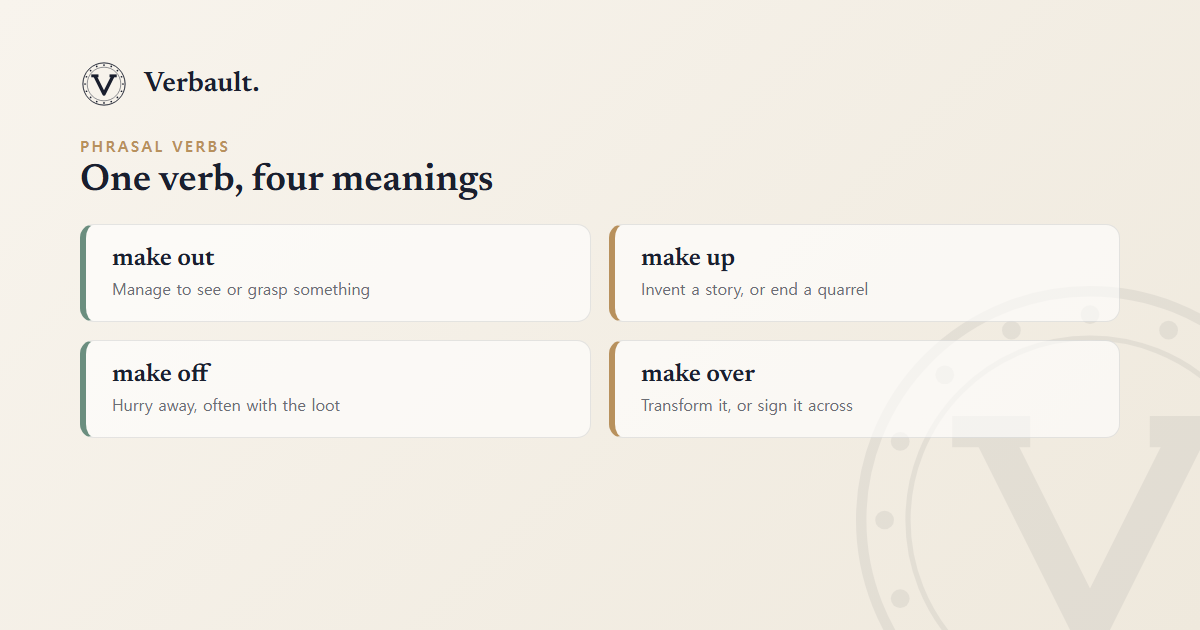
One verb, four particles, four unrelated meanings — and make is only one of dozens of verbs that behave this way. Multiply that across a whole novel and you can see how a reader who "knows all the words" still loses the thread.
How to read them: keep the phrase, not the word
The good news is that phrasal verbs are learned the way you learned most of your language: from context, by meeting them often enough that the meaning settles. You do not need a list of three hundred of them. You need to read, and to notice. Three habits do most of the work.
- Read the phrase, not the particle. When a sentence stops making sense, check whether the verb has a small word riding along behind it. If it does, treat the pair as a single word and ask what that means, not what out or off means on its own.
- Let the sentence teach you. "The carriage drew up at the gate" can only mean the carriage stopped, and the context settles it without a dictionary. Most phrasal verbs are like this: the surrounding sentence is a better teacher than any definition read cold.
- Keep the ones that block you. If a phrasal verb keeps tripping you up, save it. But save the whole sentence it came in, not the bare phrase, because a phrasal verb out of context is half a thought.
How Verbault helps you read them
Verbault is built around close reading of exactly these texts, and a few of its features make phrasal verbs easier to handle. Here is how to use them.
Tap the parts to be sure of them. In the Reader, open a classic such as the Sherlock Holmes stories and tap any word. Its meaning in this sentence, its reading level, and a button to hear it read aloud appear without taking you out of the page. One honest limit is worth stating plainly: Verbault defines single words, so tapping make in make out gives you make, not the pair. What it does give you is certainty about the parts, and a fast way to confirm you are not missing a plainer word.
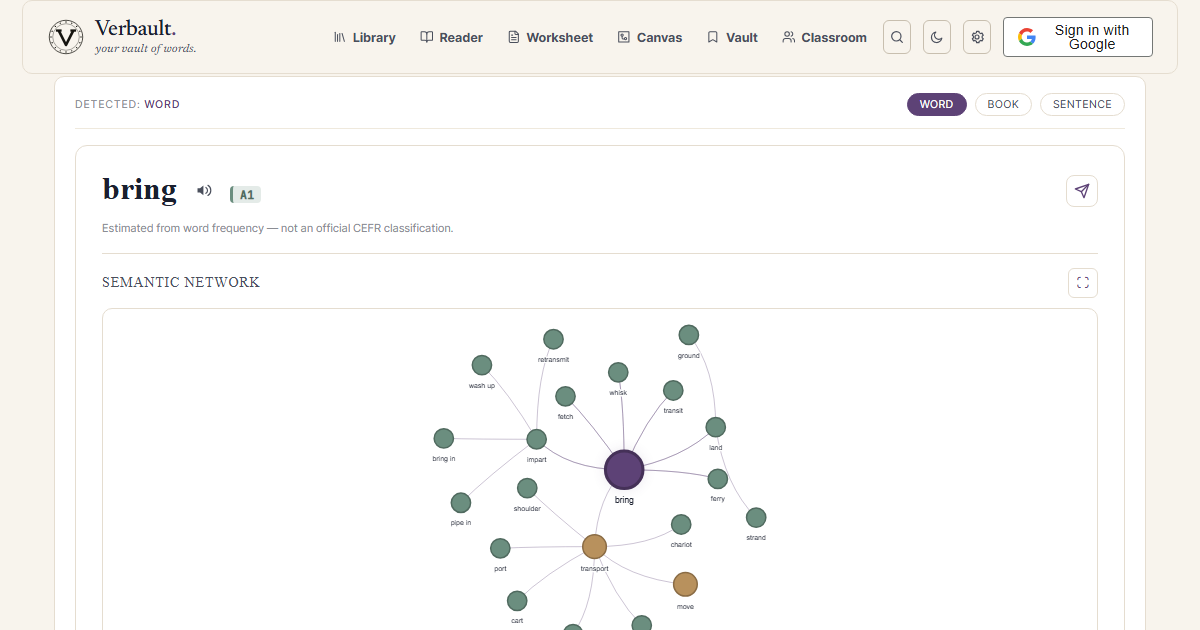
Tap a verb like bring and its own page opens, with the plain verb you already know, how common it is, and a web of related words. That page is the literal verb. Bring up, to raise a child or raise a subject, and bring round, to revive someone or win them over, are built on it but live in the sentence rather than on the single word's page — which is the whole point: the unit is larger than the word.
Hear it spoken. A phrasal verb read aloud as one unit is often easier to catch than the same phrase on the page, where the eye treats the two words separately. The play button on any passage in the Reader reads the sentence in a natural voice, and hearing the pair together helps it register as one thing.
Save the whole sentence, not the word. When a phrasal verb is worth keeping, bookmark the sentence it appears in. A bookmark stores the full sentence with its source, so the phrase stays attached to the context that explains it. Come round keeps the fainting witness beside it, and the meaning returns with the scene. Then meet it again a few days later, once it has gone slightly cold, which is when it actually sticks.
This is the same method that works for hard single words, covered here, with one adjustment: the thing you save and re-meet is the phrase in its sentence, because that is the smallest piece that still means anything.
In short
Phrasal verbs are not a special difficulty of old books. They are the ordinary machinery of English, and the classics simply use a great deal of it. Read the phrase rather than the particle, let the sentence carry the meaning, and when one is worth keeping, keep the whole sentence it lives in. Do that, and the small word pairs that once tripped you up become some of the easiest things in the book to read.
Comments (0)
Log in to comment.