How to Get Better at Reading English (Without Just Reading More)
The fog of half-known words
You passed the grammar. You know the common words. And a real English book can still feel like wading through water, not because the sentences are too complex but because of a steady drizzle of words you half-recognise. You know roughly what each one means, but not quite, and twenty of them a page add up to a fog.
The usual advice for this is some version of "read more." It is not wrong, but on its own it plateaus. You can read a great deal and still feel like you are guessing your way through. What actually moves you forward is reading in a way that teaches you while you do it, and that comes down to two habits plus a way to make both of them cheap.
Read at the edge of your level, not above it
The fastest way to stall is to pick something far too hard. If almost every sentence hides a word you do not know, you are not reading, you are decoding, and almost nothing sticks. Read something far too easy and you stay comfortable but never grow. The useful zone is in between: you follow the page without effort and meet a small handful of genuinely new words on it. Those few have room to stick.
The hard part is judging, before you commit a whole evening, whether a book sits in that zone for you. This is the first place Verbault earns its keep. Open any text in the Reader and every word is marked by how common it is — easy, medium, or hard — right there in the line you are reading. You can tell at a glance whether a page is mostly familiar with a few stretches, or a wall of hard words you will spend the night looking up. If it is a wall, choose something gentler and come back to the hard book later, once more of it has turned familiar. (For how large a vocabulary a full novel actually asks of you, see how many words it takes to read a novel.)
Make looking a word up cost one tap, not two minutes
Here is the dilemma every reader knows. Stop at each unfamiliar word with a dictionary and you learn the word, but the sentence falls apart in your hands and reading turns into homework. Push through and guess from context and you keep the flow, but most of those words wash straight back out. Neither is good, so most people just pick the one they dislike less.
The dilemma only exists because looking a word up is expensive. Make it cheap and it disappears. Open a book like Pride and Prejudice in the Reader, tap a word, and a small card shows three things: its level, its part of speech in this sentence, and the meaning that fits this context — not a list of every sense the word has ever carried. You can hear it read aloud, too. One glance and you are back in the sentence before you have lost the thread.
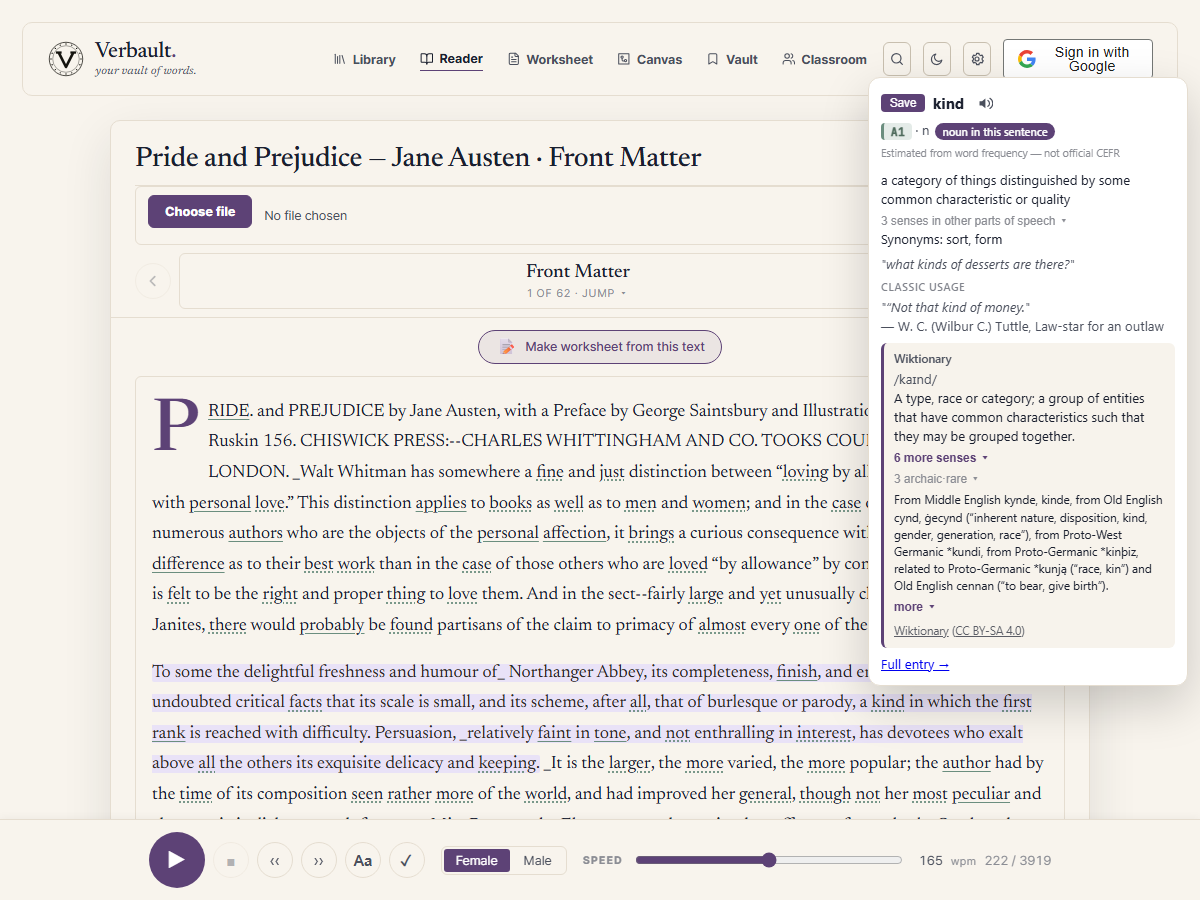
That "in this context" part matters more than it sounds. Many ordinary English words carry several unrelated meanings — a single word can mean half a dozen things — and quietly taking the wrong one breaks your grasp of the whole passage. Landing on the right sense in half a second is most of what keeps close reading from turning into a slog.
Turn the words you meet into words you keep
This is the habit most readers skip, and it is the one that compounds. You look a word up, understand it for that one sentence, and forget it by the next chapter, so the lookup taught you nothing lasting. Recognising a word when you see it is not the same as being able to reach for it yourself; the gap between passive and active vocabulary is exactly the gap a single lookup never closes. A word crosses from the first into the second only by being met again, on purpose, a few times.
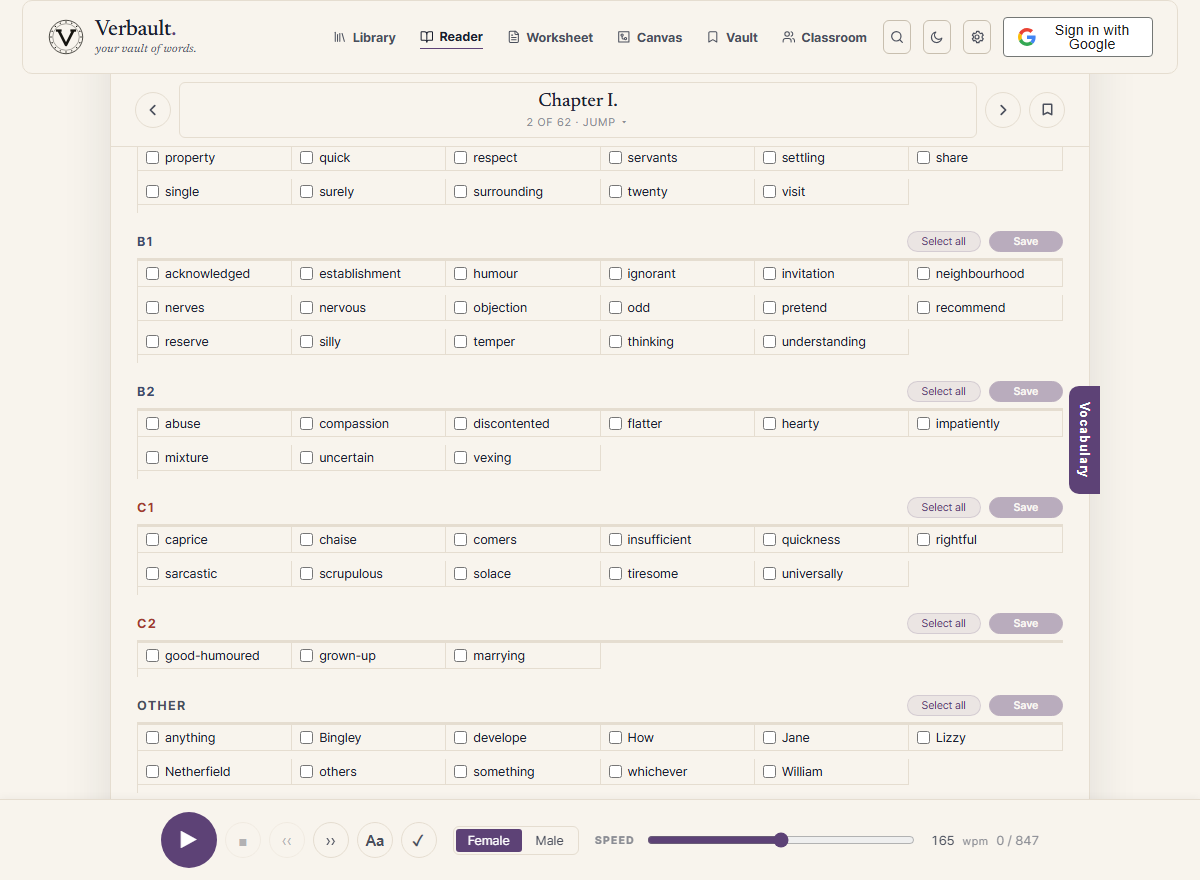
So keep the ones worth keeping. As you read, save a word to your vault in a single tap. The Reader's Vocabulary tab gathers the words from a passage and sorts them by level, so you can run your eye down the harder, less familiar ones and save the few that are genuinely useful to you, rather than every word you happened not to know.
Saving is only half of it. A few days later a short review session brings those words back, timed to arrive just before you would have forgotten them. That is the whole difference between a word you looked up once and a word you own: the second and third meetings happen by design instead of by luck.
Finish the book, then read another by the same hand
Graded exercises and short extracts have their place, but words truly settle when you read whole works. An author reuses their own vocabulary, so a word that stopped you in chapter two is ordinary furniture by chapter ten; you have met it six times without trying. That repetition is free, and you only collect it by staying with a long text to the end.
This is the quiet case for old books. The public domain is full of complete novels, free to read, written in rich but careful prose, which is exactly the varied, repeating vocabulary that makes classic books such good teachers. Pick one a little above comfortable and let the book itself do most of the work.
The short version
- Choose a text a little above comfortable, not far above it. The level marks in the Reader show you which is which before you start.
- Look words up the instant you need them, one tap each, and take the meaning that fits the sentence in front of you.
- Keep the few words worth keeping, and let a short review bring them back on a schedule.
- Finish the book, then start another by an author you liked.
None of this is about reading harder, or reading more for its own sake. It is about reading so that the reading pays you back — in words you still have next month, and in pages that come a little easier each chapter. If you are new here, the Reader guide walks through everything the Reader can do.
Comments (0)
Log in to comment.