One Text, Every Level: Teaching a Mixed-Ability Reading Class
A single English class rarely reads at one level. Open the register and you may have a student reading two years ahead of the syllabus beside one reading two years behind it, with a dozen more spread between. Choose one text for the room and you seem stuck: pitch it at the middle and you bore one end and lose the other. The usual escape — a harder book for the strong readers, an easier one for the strugglers — fixes the reading level and creates three new problems. The class no longer shares a text, so it can't share a discussion. You now prepare and juggle several readings where you had one. And the moment the "easy" group notices it has the easy book, the difficulty has become a label.
There is a better move, and it is older than any piece of software: keep the text, change the task.
Don't change the book — change the task
The idea behind differentiated instruction, the approach most closely associated with Carol Ann Tomlinson, is that a mixed class can read the same material when the support and the demand are tuned to the reader. One shared text holds the room together: everyone can join the same conversation about the same chapter, while the work each student does on it differs. You are not lowering the bar for some and raising it for others; you are giving each reader a task they can succeed at and still learn from.
This is a social matter as much as an academic one. Differentiation done clumsily — a visible "low" table, a worksheet stamped easy — can stigmatise the very students it means to help. A shared text is part of the remedy. When the whole class is on the same page, the differences in task are quieter, and far easier to rotate.
A passage has more than one level inside it
Here is the fact that makes all of this work: any real passage already holds words at every level of difficulty. A single paragraph of Shelley or Dickens carries a few rare words, a layer of mid-frequency ones, and a base that nearly everyone knows. (How those levels are reckoned — chiefly by how common a word is — is a story of its own; the reading-levels guide tells it.)
Take the paragraph in Frankenstein where the creature first stirs to life: "It was on a dreary night of November…" For a reader near the bottom of the class there is plenty to learn from its accessible words — collect, spark, instrument. For a reader near the top, the same lines offer convulsive, delineate, catastrophe, glimmer: words rare enough to be worth a stop. Same sentences, different harvest. The struggling reader isn't doing baby work and the strong reader isn't marking time. Each is mining the layer of the text that is live for them.
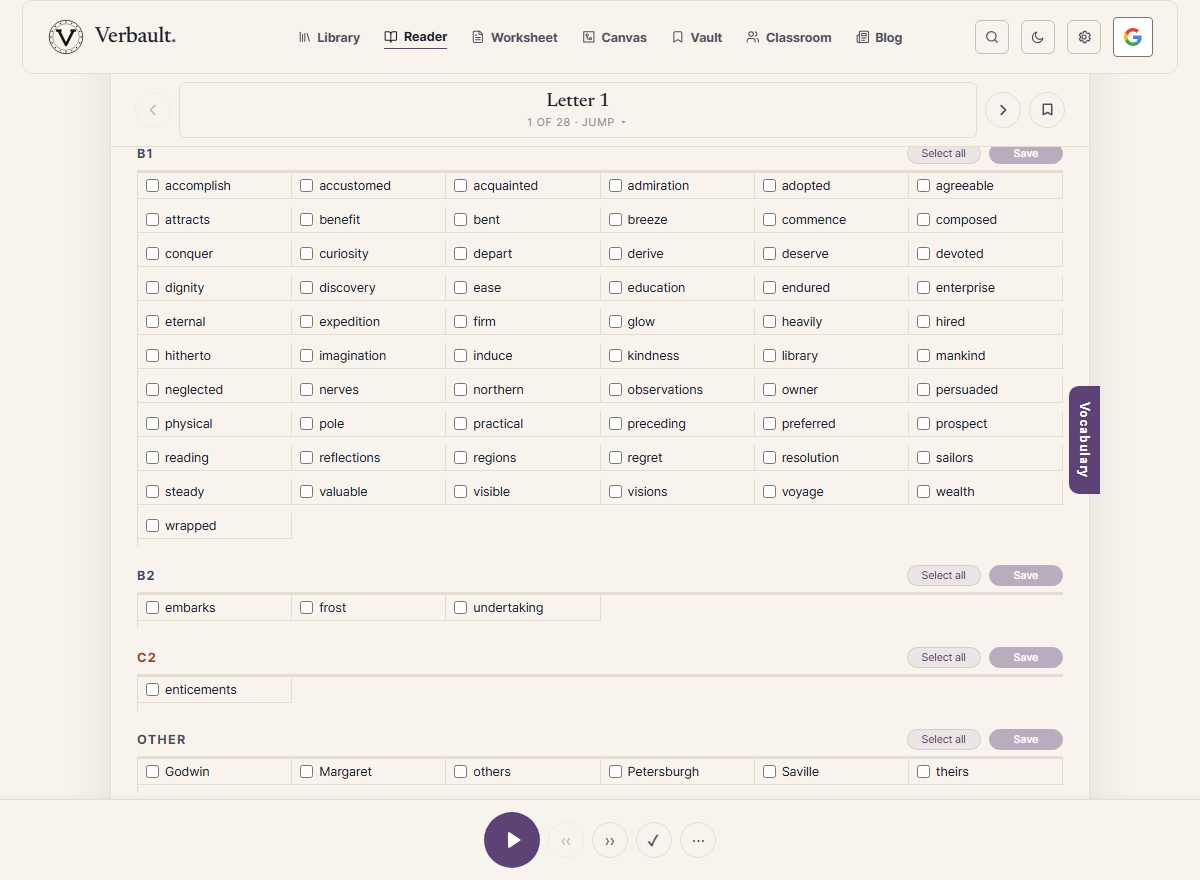
Verbault tags each word with its CEFR level, the A1 to C2 scale many teachers already use, and groups a passage's vocabulary band by band:
Tier the task, not the text
Once you see a passage as a stack of levels, the differentiation nearly designs itself. Give every student the same reading and three versions of the task built from it:
- Emerging readers work on recognition: match words to meanings, fill a gap from a word bank, pick the odd one out of a set. The load is lighter and success comes early, which is what keeps a struggling reader reading.
- Core readers take the mid-frequency words with a little production — write the meaning in their own words, find a synonym.
- Advanced readers go after the rare words and the harder moves: define without help, map a word to its relatives, use it in a sentence of their own.
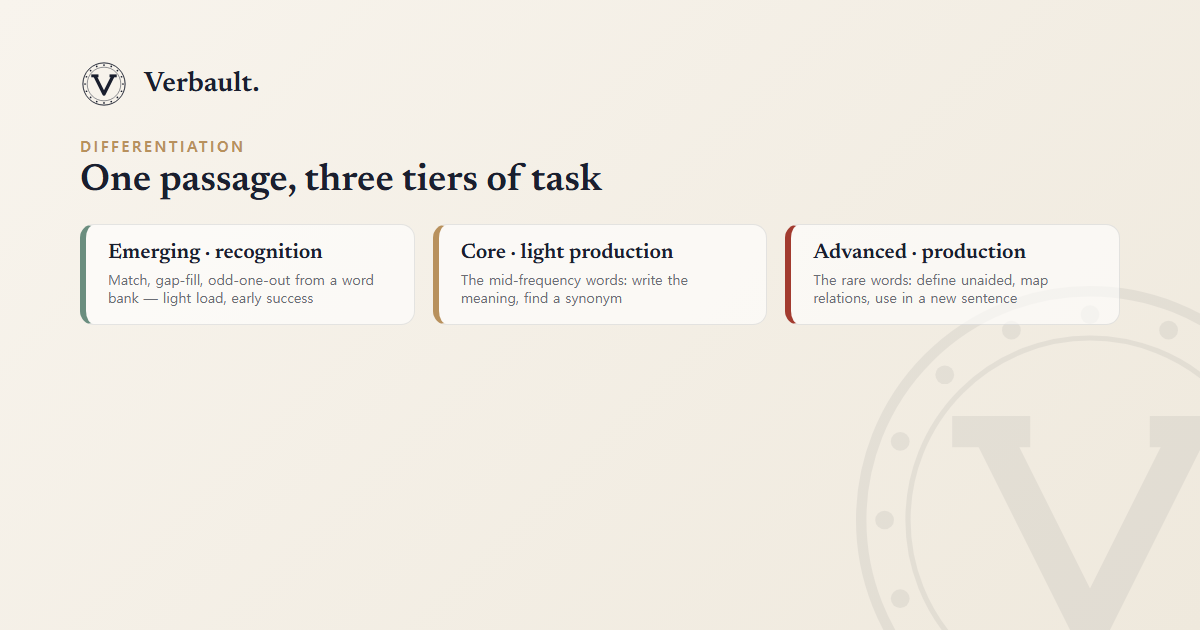
The three groups have done different work, at different depths, on the same paragraph — and they can all sit down to one discussion of what the paragraph means, which is the part worth sharing.
"Just hard enough," for each reader
Underneath this sits a tidy idea, usually credited to the linguist Stephen Krashen: we take in language best from material that is mostly understood, with a manageable edge of the unknown — familiar enough to follow, new enough to stretch. It is a principle rather than a formula; no one can dial it in to the word. But it explains why differentiation works. A text that is "just hard enough" for the middle of your class is too hard for one end and too easy for the other. Tiering the task is how you give the same text that just-hard-enough quality to readers who begin in different places. (For how much of a text a reader needs to know before it reads comfortably, see how many words it takes.)
Doing it with Verbault
The slow part of all this has always been the prep: finding the words at each level and building three tasks where you had time for one. That is the part worth handing to a tool.
- Open the passage in the Reader. Paste it in, or pick the book from the library. Every word is labelled by level, so the text's built-in tiers are visible at a glance.
- Read its vocabulary map. The Reader's Vocabulary tab sorts the passage's words by reading level, with a catch-all group for proper names and rare terms — your tier map, made for you. The vocabulary-collection guide covers that tab.
- Generate worksheets at more than one difficulty. From the same passage, the easy setting builds a sheet around its accessible words and the hard setting around its rare ones, each as a printable PDF with a matching answer key. The worksheet guide walks through the formats.
One caveat from practice: a short passage holds only so many rare words, so the hard sheet for a single paragraph can run thin. Give your advanced group a longer stretch — a whole scene rather than a paragraph — and the top tier has room to work.
What differentiation isn't
It is not infinite tracks. Two or three tiers is what a real teacher can sustain; past that you are running a theatre, not a classroom. It is not permanent, either: the labels are a starting guess. A word the system files as hard is not hard for the student who already owns it, so use the tiers to plan and then trust what you see on the page. And keep the tiers quiet — rotate them, don't announce them, and let the shared text and the shared discussion carry the class as one room. With the work tuned underneath, it can be.
Comments (0)
Log in to comment.