Why Is There a 'B' in Debt? The Story of Silent Letters
Here is a question with a surprisingly long answer: why is there a b in debt? Nobody pronounces it. No one ever has, in English. You could strike it out and lose nothing but the trouble of remembering it is there, and yet it has sat in the word for four hundred years, silent, doing no work anyone can name.
English is full of these: letters that are written but not said. They are the first thing that makes the spelling look like chaos — a k nailed to the front of knight, a gh buried in through, an s loitering in the middle of island. But most silent letters are not random at all. Each one is a small fossil, and once you can read the fossil, the word stops looking like a mistake and starts looking like a record of where it has been.
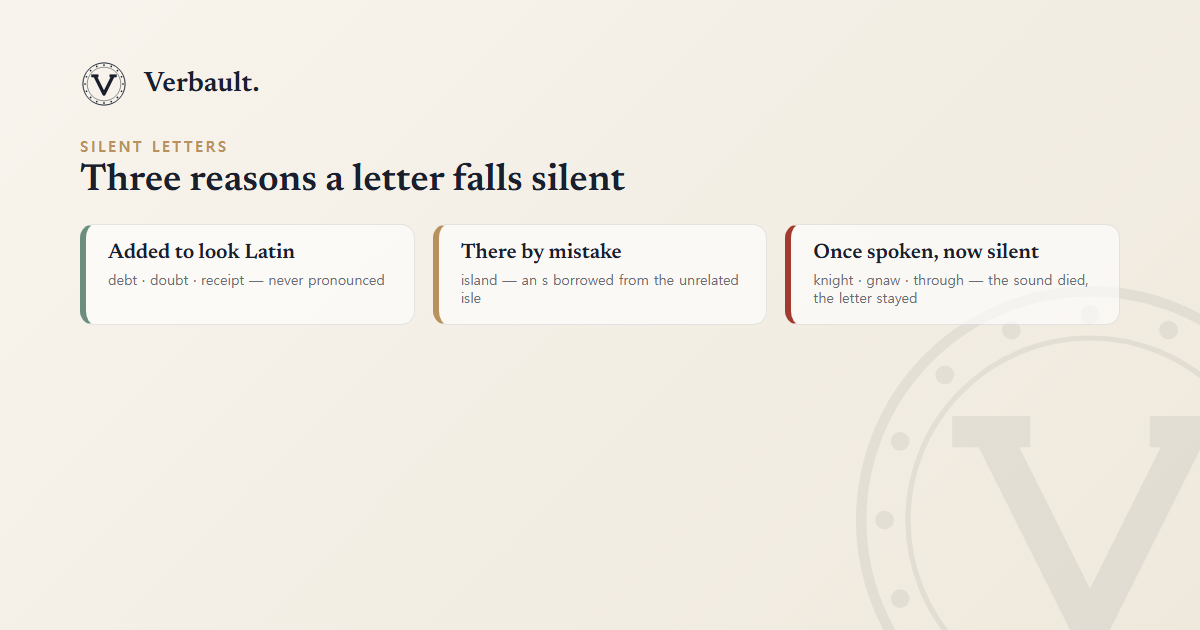
There are really three reasons a letter falls silent, and they are worth telling apart.
The letters that were never spoken
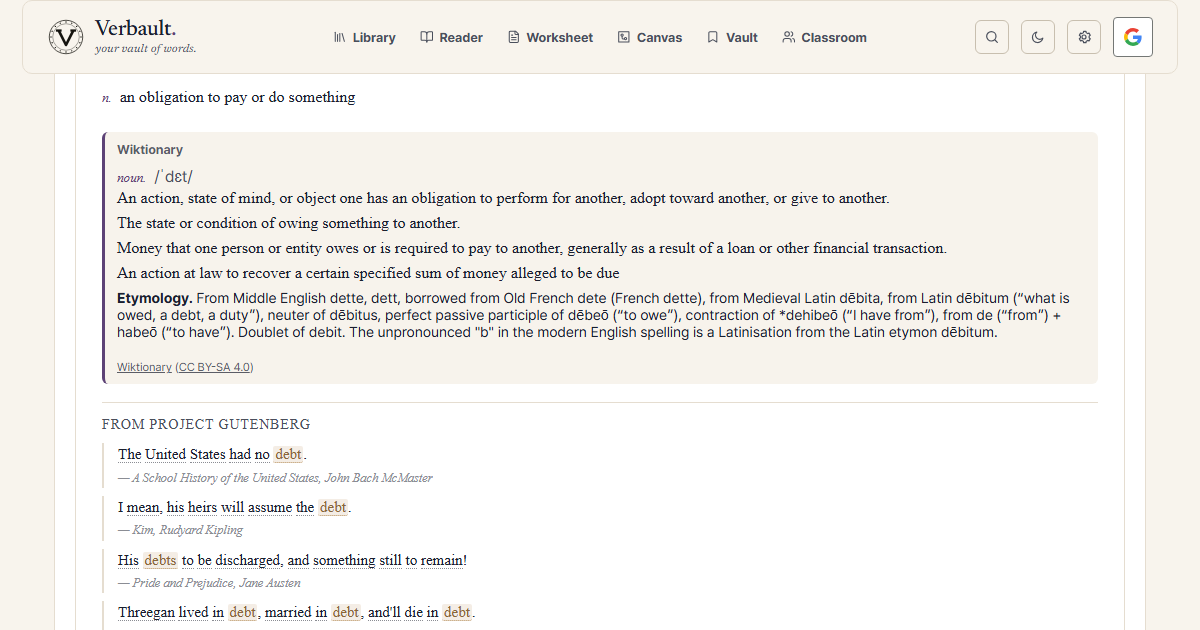
Start with debt, because it is the purest case. English borrowed the word from French, where it was spelled dette and said, sensibly, "det." For a while English spelled it that way too. Then, in the sixteenth century, scholars who admired Latin decided the word ought to show off its Latin ancestor, debitum ("something owed"), and quietly slipped a b into the spelling to match. The b was for the eye, not the ear. It changed how the word looked and nothing about how it sounded.
Verbault's word page for debt lays the whole chain out in its etymology, tracing the word back to the Latin debitum and noting that the silent b was a later addition the pronunciation never followed. The same impulse explains the b in doubt (after Latin dubitare) and the p in receipt (after receptus). None of those consonants was ever pronounced in English. They were inserted to make plain, French-borrowed words look like the Latin their writers wanted to honour.
There is a quiet irony in the reading levels here. Doubt is about as ordinary as English words come; Verbault marks it A1, the easiest band, a word every beginner meets in their first weeks. And it carries a Renaissance vanity letter that most native speakers have never once thought about. The fossil is hiding in plain sight.
The one that is simply a mistake
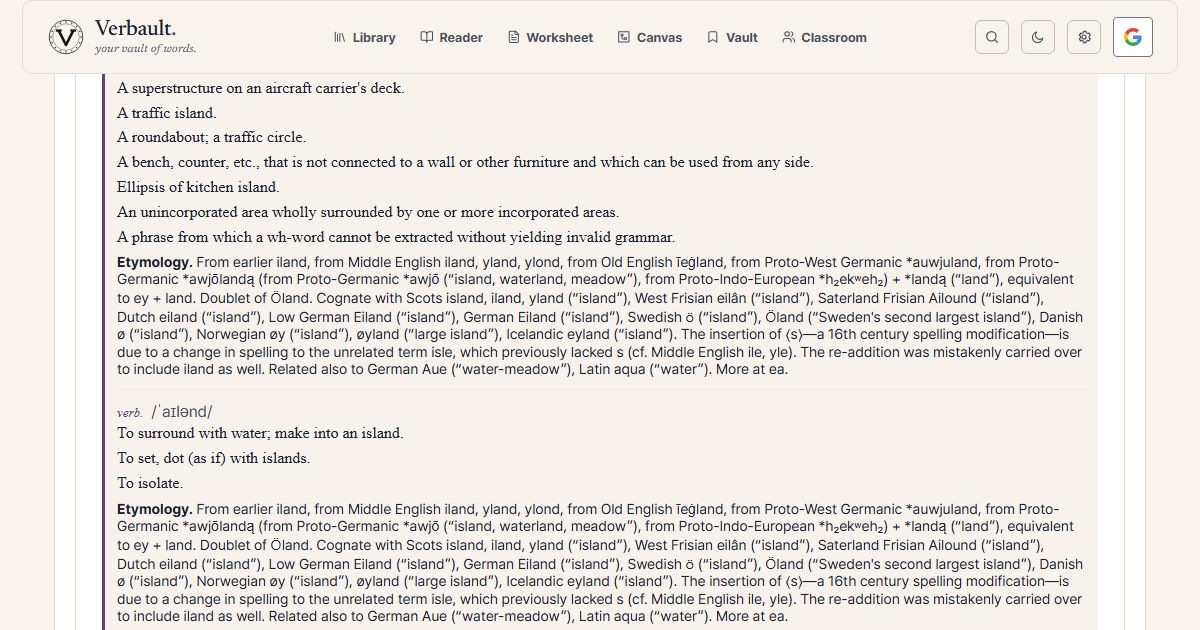
Island is stranger, because its s should not be there at all. The word is native English, not borrowed: it comes from Old English iegland, roughly "water-land," and went for centuries with no s anywhere in it, spelled iland and said "eye-land."
The s arrived by confusion. There was another, unrelated word, isle, which came from Latin insula by way of French and did have a legitimate s in its history. Sixteenth-century writers, reaching for the same etymological polish that gave debt its b, assumed iland must be related to isle and "corrected" it to island to match. It was not related. The s was, in the plainest sense, a blunder, and it has stuck for four hundred years anyway. The word page for island records exactly this: a spelling change borrowed from the unrelated isle and carried over by mistake.
The letters that used to be loud
The third kind is the opposite of the first. These letters are silent now, but they were once pronounced, every one of them, and the spelling simply outlived the sound.
Say knight the way a reader of Chaucer would have: "k-nicht," with the k sounded and the gh a rasp in the throat, like the ch in the Scottish loch. Nothing was wasted. Over the next few centuries English shed those sounds. The kn- at the start of knight, know, and knee lost its k; the gn- of gnaw and gnat lost its g; the wr- of write and wrong lost its w; and the throaty gh of night, light, and through faded to nothing, or hardened into an f (which is why enough rhymes with stuff). The sounds went. The letters stayed, frozen on the page like a photograph of a pronunciation no one uses any more.
You can see the age of these words on their pages too. Knight and know both trace back through Old English to a Germanic root, and in those older forms the awkward opening consonant was no awkwardness at all. It was simply how the word was said.
So why keep them?
It is fair to ask why English does not just tidy up. The honest answer is that history explains a silent letter without excusing it: the spelling is fixed by convention now, and knowing that the b in debt was added to flatter Latin will not earn you a mark on a spelling test. If you want the rules, you still have to learn the rules.
But the letters stop being noise. A silent letter you can read is a small piece of the word's biography: proof of a scholar showing off, or a centuries-old slip, or a sound the language used to make and quietly gave up. That is the same reason a word's origin is the easiest part of it to remember: a fact with a story attached gives you something to hold on to. Spelling that looks arbitrary is hard to keep; spelling that has a reason behind it tends to stay.
How to read a silent letter on Verbault
Every word on Verbault has its own page with an etymology, and that is where the story of a silent letter lives. To find one:
- Open the word's page. Go to a page like /word/debt or /word/island — every word in the dictionary has one — and find the Etymology section.
- Read for the tell. Words such as added, inserted, Latinisation, or silent mark a letter that was put there on purpose. A trail back to Old English usually means the opposite: a letter that was once spoken and later went quiet.
- Check the reading level. The badge near the top shows how common the word is. Plenty of silent-letter words are everyday ones — doubt and know are both marked A1 — which is part of the fun: the fossils are not all buried in rare vocabulary.
- Meet it in a real sentence. Open a book in the Reader, tap the word where it appears, and you get its meaning in that context alongside the same level badge. Save it if it is worth keeping.
For more on how each word page is put together, with WordNet, Wiktionary, and the reading levels side by side, see how the dictionary and reading levels work; the Reader guide covers everything the Reader itself can do.
The short version
- Many silent letters were added on purpose, to make an English word resemble its Latin ancestor — the b in debt and doubt, the p in receipt — and were never pronounced.
- A few are honest mistakes. The s in island wandered in from the unrelated isle and never left.
- Others were once spoken, and the sound died while the spelling lived on: the k in knight, the g in gnaw, the gh in night.
- On Verbault, the etymology on any word page tells you which — and turns a silent letter from a nuisance into a clue.
Pick a word that has always looked odd to you — debt, island, knight — and read its etymology. Then open Pride and Prejudice or Frankenstein in the Reader and notice how many of these quiet letters you start to catch once you know what they are. The piece on words that changed meaning in the classics follows the same habit: read closely, and the dictionary turns into a history book.
Comments (0)
Log in to comment.