Collocations: Why It's 'Make a Decision,' Not 'Do a Decision'
Ask an English speaker why it is make a decision and never do a decision, and you will usually get a shrug. Both verbs mean, roughly, "to bring about." Do would be perfectly logical. It simply is not what English says. The pairing is fixed by use, not by reason, and the speaker learned it the way everyone does — by meeting it again and again until the right word arrived on its own.
These habitual pairings have a name: collocations. They are why a sentence can be flawless in its grammar and still sound wrong to a native ear, and they are among the last things to settle when you learn a language. Here is what they are, why no rule can hand them to you, and why reading can.
Words that keep company
A collocation is a pair or cluster of words that go together so habitually that swapping in a synonym, even an exact one, sounds off. Tea is strong, not powerful; an engine is powerful, not strong. Rain falls heavily, not strongly; a smoker is heavy, not big. None of this follows from the dictionary. Strong and powerful are near-synonyms, yet each noun quietly insists on one and refuses the other. The meaning would survive the swap; the idiom would not.
That gap — grammatical, meaningful, and still wrong — is where collocations live. A learner who says do a decision has made no logical error. They have simply not yet heard make a decision often enough for it to feel inevitable.
Most collocations fall into a few recurring shapes. Once you can see the shapes, you start catching them everywhere.
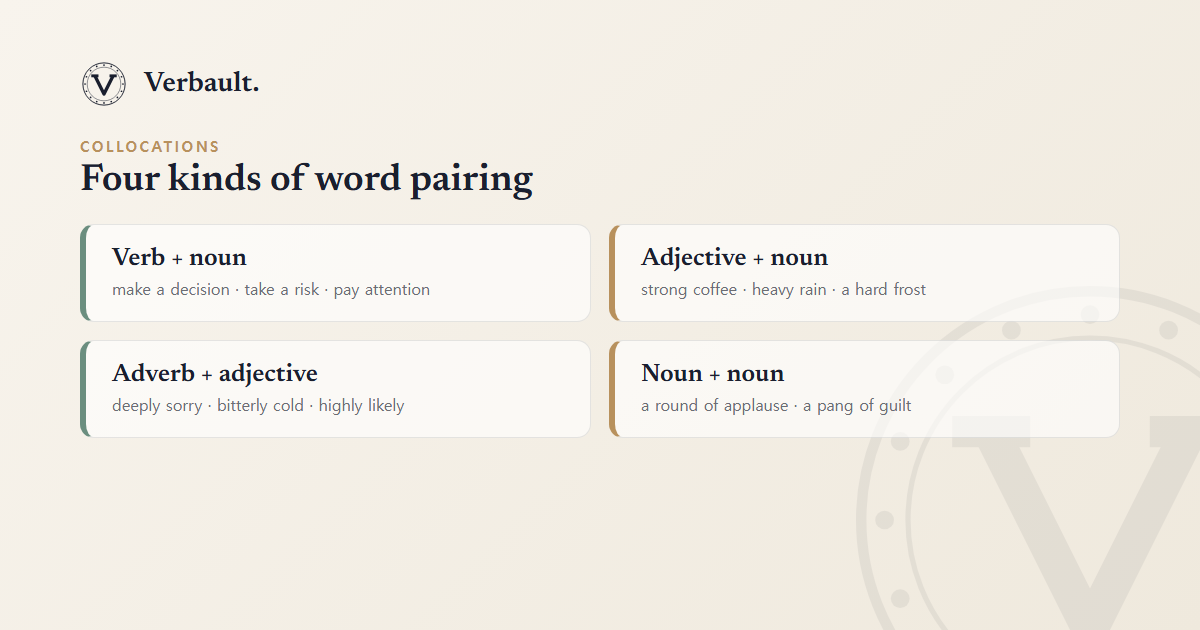
- Verb + noun — make a decision, take a risk, pay attention, do the dishes. The verb is half-emptied of its own meaning; it is there because the noun expects it.
- Adjective + noun — strong coffee, heavy rain, a hard frost, a warm welcome.
- Adverb + adjective — deeply sorry, bitterly cold, highly unlikely. (Very sorry exists, but in a flatter register.)
- Noun + noun — a round of applause, a pang of guilt, a flurry of activity.
There is a fifth kind worth flagging only to set it aside: the verb that fuses with a small word — make out, give up, come round — and changes meaning entirely. Those are phrasal verbs, a deep enough subject to have their own post.
Why the rules can't help, and reading can
You cannot reason your way to collocations. No rule predicts make a decision over do a decision; the pattern is too fine-grained and too pocked with exceptions for any rule to cover it. What a native speaker has instead is a kind of statistical memory: they have met make a decision thousands of times and do a decision never, and that lopsidedness is precisely what "sounds right" means. The instinct is just frequency, felt from the inside.
That tells you the only dependable way in. To grow the same instinct you need the same diet: a great deal of natural English, met in context, where the words arrive already paired. Reading is the densest source of it. A single novel hands you tens of thousands of collocations pre-assembled by a writer who had the instinct cold, and it does so without ever stopping to explain, which is exactly why it works. You absorb the pairing whole instead of memorising it as a fact.
Older books are especially good for this. A nineteenth-century novelist writes long, fully furnished sentences, and the formal register leans on collocations a textbook would never list: take one's leave, beg your pardon, a marked attention. Read enough of them and the pairings stop feeling foreign. They become the version that simply sounds right.
How Verbault helps you notice them
Reading does the teaching, but a few small tools make the pairings easier to catch and to keep. All of this lives in the Reader.
Read with the word still in view
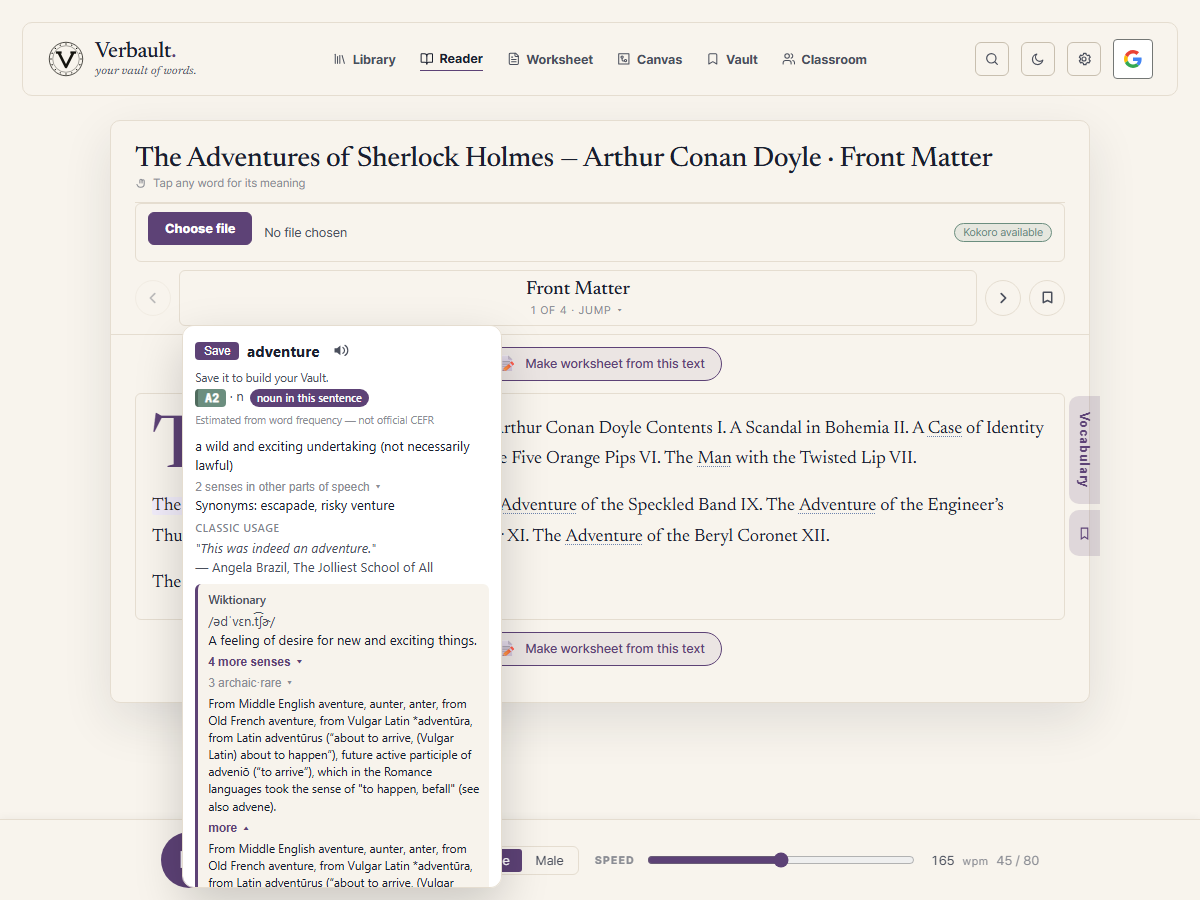
The trouble with looking a word up is that it pulls you out of the sentence, and the sentence is where the collocation lives. Verbault's Reader keeps both in view. Open a book, say The Adventures of Sherlock Holmes, and when a word stops you:
- Tap or click the word. A small panel opens beside it.
- Read its meaning, part of speech, and reading level in that panel — the sense that fits this sentence, not a list of every meaning the word has ever held.
- Glance back at the surrounding text, which is still right there behind the panel, so you see the company the word is keeping while you read what it means.
Tap anywhere else to close the panel and read on. Because it is a single tap each time, you can check a word without losing the thread — and noticing which words sit beside it is half of what builds the instinct.
See a word's usual partners on its own page
Every word also has its own page — for instance /word/strong or /word/decision. Alongside the definition, the page gathers example sentences pulled from real books and a map of related words. Skimming a few of those examples is a fast way to see which partners a word actually takes in the wild, rather than guessing from its meaning.
Study the cluster, not the bare word
The word-web worksheet takes a single word and lays out its synonyms and the words it tends to combine with, so a learner studies the whole cluster at once instead of an isolated entry. It is one of six printable worksheet types; the worksheet guide walks through all of them.
Keep the pairing, not just the word
When you save a word to your vault, Verbault stores the sentence you met it in, not only the word. So you revise make a decision, not a lonely make, and bitterly cold, not a stranded bitterly. The pairing travels with the word into your review, which is the only place it was ever going to stick.
A few to listen for
You do not need to memorise lists, but it helps to know where learners most often slip, so you can notice the right version when a book offers it:
- make vs do — make a decision, a mistake, a promise; do the dishes, your homework, business.
- strong vs powerful — strong coffee and a strong accent; a powerful engine and a powerful argument.
- fast vs quick — a fast car, but a quick word and a quick shower.
- heavy — heavy rain, heavy traffic, a heavy smoker, a heavy heart.
Meet these often enough in real sentences and the table dissolves. The pairing stops being a rule you recall and becomes the only thing that sounds right.
The short version
- Collocations are habitual word pairings — make a decision, strong tea — fixed by use, not by logic.
- No rule can teach them. The instinct is frequency, so you build it from exposure, not explanation.
- Reading is the densest exposure there is, and the classics, with their long, formal sentences, are especially rich in it.
- Read with the word in its sentence, and keep the pairing, not the bare word — that is what turns a noticed collocation into one you own.
Open a book and read a page with this in mind, watching for the places where the writer's word is not the only logical one, only the one English keeps. Pride and Prejudice and Frankenstein are both a tap away in the Reader. For more on how classic prose teaches vocabulary, see what makes classic books such good teachers; for how reading levels mark which words are worth slowing down for, see reading levels and the dictionary.
Comments (0)
Log in to comment.