How to Practise Reading Comprehension with the Classics
You can read every word and still miss the chapter
Here is an experience every serious reader knows. You work through a chapter of a real book, understanding each sentence as it passes, and you reach the last line with almost nothing in your hands. Ask what the chapter was about and you find you cannot quite say — not because the words defeated you, but because the meaning ran through your fingers while you were busy decoding it.
That gap is the subject of this post. Knowing the words is one skill. Comprehension — following who wants what, holding a long argument together, catching what a writer implies but never states — is a separate one. Vocabulary grows by meeting words; comprehension grows only by reading in a way that forces you to check that you understood, and then mending what you missed. Reading on its own, page after passive page, does not reliably train it. Deliberate reading does.
The classics are unusually good material for that deliberate practice, and the rest of this is how to use them for it.
Why the classics are the right material
A graded reader hands you a tidy paragraph and a question about it. A classic novel hands you four hundred pages over which a plot, a cast, and an argument all have to be held in your head at once. That is the harder and more useful exercise: comprehension at the scale of a whole book, not a single clean extract.
Classics also carry the layer that comprehension questions are really testing — meaning that is implied rather than stated. A nineteenth-century narrator says one thing and means its opposite; a character's politeness is the story's cruelty; what matters most is the thing left off the page. Reading between the lines is the part of comprehension no vocabulary list ever touches, and old books are full of it.
One condition makes all of this work: read at a level where the meaning is the effort, not the words. If every other word stops you, you are decoding rather than comprehending, and there is no attention left over to follow the sense. Pick a book whose words mostly come easily, so the challenge is what the sentences are doing. Where to start with the classics walks through choosing one, and the Reader marks every word by reading level so you can see at a glance whether a page sits in your range.
Four moves that turn reading into comprehension practice
Reading becomes practice the moment you stop and check yourself. These four moves do exactly that, and not one of them needs anything beyond the book and a little discipline.
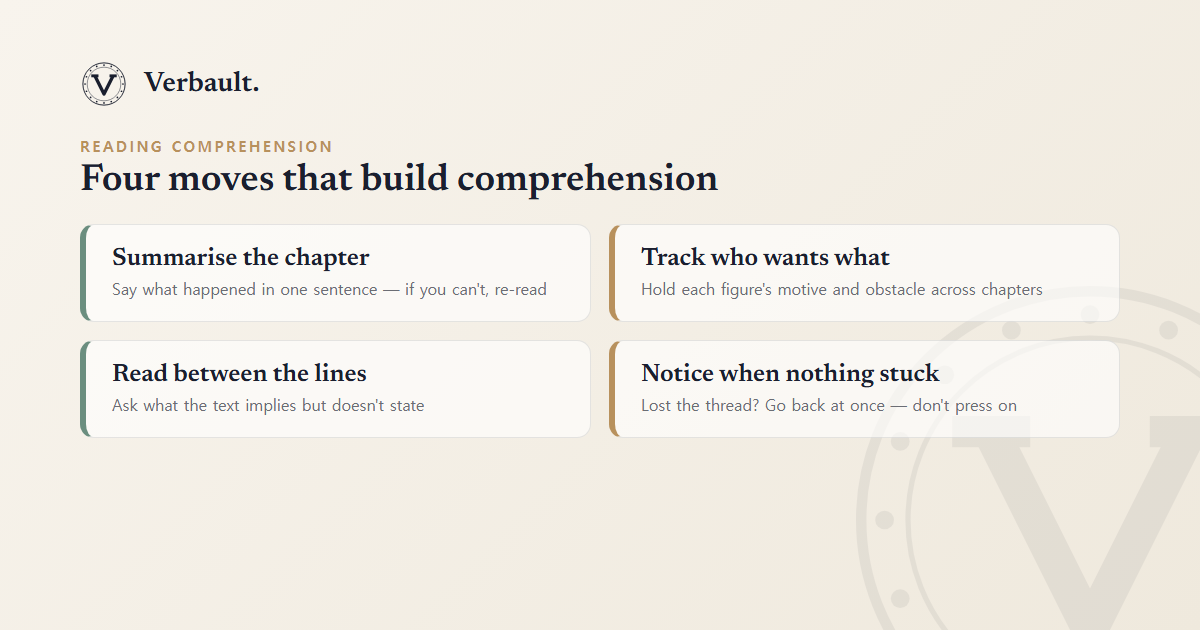
Summarise each chapter in a single sentence. When you finish a chapter, look away from the page and say what happened in one sentence, out loud or in writing. It is the fastest comprehension test there is. If the sentence comes easily, you followed the chapter. If you reach for it and find nothing, you read the words without building the meaning — and that is the signal to go back, not to press on.
Track who wants what. In a long book, most of comprehension is holding motives and relationships steady across chapters. For each main figure, keep a one-line answer to two questions: what do they want, and what stands in their way? Update it as the book turns. When a later chapter confuses you, the confusion is almost always a want or an obstacle you quietly lost track of three chapters back.
Read for what is implied, not only what is said. After a scene that seems to mean more than it states, stop and ask the question plainly: what is the text telling me here that it has not put into words, and why did the writer choose this detail in this order? This is slow at first and then becomes a reflex, and it is the single move that separates comprehension from following-along. The classics repay it more than any other reading, because they were built to be read this way.
Notice when comprehension drops, and re-read at once. The clearest sign of lost comprehension is reaching the foot of a page and realising nothing stuck. Do not turn it. Comprehension lost early in a passage compounds, because every sentence after it rests on a foundation you no longer have, so go back to the last point you were genuinely following and read forward from there. Re-reading a paragraph you fogged out on is not a failure. It is the practice.
Check yourself against more than your own summary
Your one-sentence summary is the best comprehension check you have, but it shares a blind spot with every self-check: you are the same mind that just read the chapter, so one you only half-followed can still feel like one you understood. A second check from outside your own head helps — as long as you are honest about what it tests.
Verbault's chapter quizzes are that outside check, and they work at the level of words. After a library chapter, a few four-choice questions ask you to put the right word back into a sentence you just read, so what they confirm is that you followed the chapter's sentences closely enough to know which word belongs. That is a floor, not a ceiling: passing does not prove you grasped the chapter's meaning, but failing proves you did not even hold its sentences, which is worth catching before you read on. Treat the quiz as the floor and your own summary as the real test of comprehension. How the quizzes work is covered in chapter quizzes and earned reading progress.
Tools for the sentences that fight you
Comprehension tends to break at two places: a word taken in the wrong sense, and a sentence too long to hold. The Reader has a tool for each.
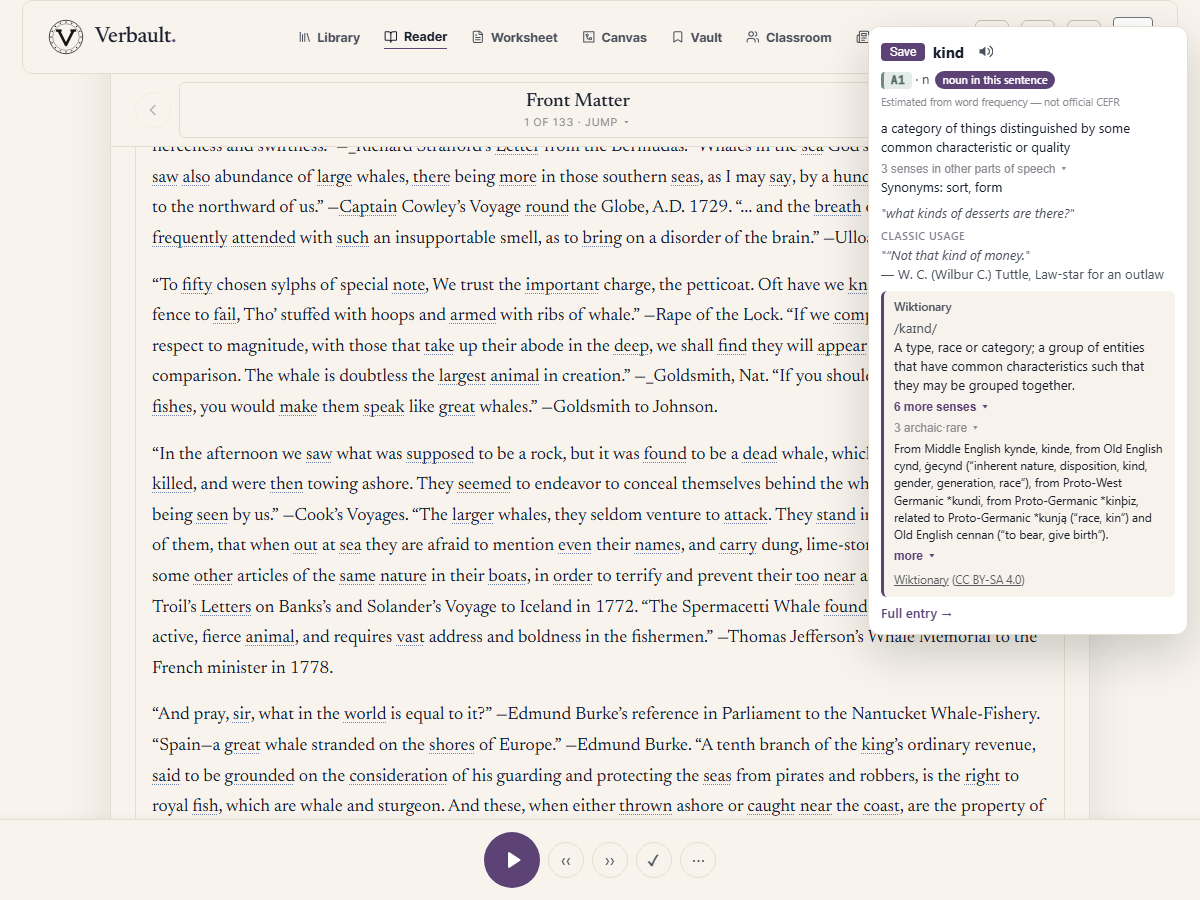
Tap for the meaning that fits the sentence. Many ordinary words carry several unrelated senses, and quietly taking the wrong one wrecks a passage without your noticing. Tap a word in the Reader and it leads with the sense that fits this sentence, rather than a list of every meaning the word has ever held, so you land on the right one in a second and keep the thread. Try it on a genuinely hard book like Moby-Dick, where a single misread word can lose you a paragraph.
Hear the long sentences. A classic sentence that runs half a page is often easier to parse by ear than by eye. Press the speaker control and the Reader reads it aloud while highlighting each word, which helps you hear where the main clause sits beneath all the subordinate ones. Pair it with the guide to reading a long sentence for the manual version of the same skill, and see text-to-speech for how the audio works.
Translate as a check, not a crutch. The Reader can translate a paragraph into your own language, but use it after you have formed your own understanding of a hard passage in English, then reveal the translation to confirm or correct it. Reach for it first and you have skipped the practice; reach for it last and it becomes a marking scheme.
Re-read, and finish the book
Comprehension compounds over length. An author reuses their own themes, their own cast, their own habits of sentence, so the effort you spend understanding chapter two is repaid with interest by chapter ten, once all of it has become familiar ground. That return only arrives if you stay with a book to the end, and it is the one thing extracts and graded exercises cannot give you. For why a famously hard novel is hard, and how to read through it, see why Moby-Dick is hard to read.
The short version
- Read at a level where the meaning is the work, not the words. The Reader's level marks show you which books those are.
- Summarise each chapter in one sentence. If you can't, re-read it.
- Track who wants what, and read for what the text implies but does not say.
- Notice when nothing stuck, and go back at once rather than press on.
- Back your summary with an outside check — the chapter quizzes catch the sentences you didn't even follow at the word level, beneath what your summary tests.
- Finish the book, and let the later chapters come easier than the first.
Comprehension is not a gift some readers have and others lack. It is a skill, and like any skill it grows from practice with a feedback loop: read, check, mend, repeat. The classics give you endless material to practise on, and the Reader gives you the checks. If you are new here, the Reader guide shows everything it can do, and how to get better at reading English is the companion piece on the vocabulary side of the same habit.
Comments (0)
Log in to comment.